The Lineage of Gandiva
Brihannala names five sets of weapons and the six who held the great bow
In short
At the shami tree outside Virata's city, Uttara asks whose weapons these are, and his charioteer answers him piece by piece. The greatest of the bows is Gandiva, worth a hundred thousand weapons, held in turn by Brahma, Prajapati, Shakra, Soma and Varuna before it came out of the water into Arjuna's hands. Bow by bow, quiver by quiver and sword by sword, the dancing master lays out the arms of the five sons of Pandu without once naming himself.
Told in the Virata ParvaSet in Virata and Khandava Forest12 min read
The Questions at the Burning Ground
Vaishampayana told this part slowly, because nothing in it moves.
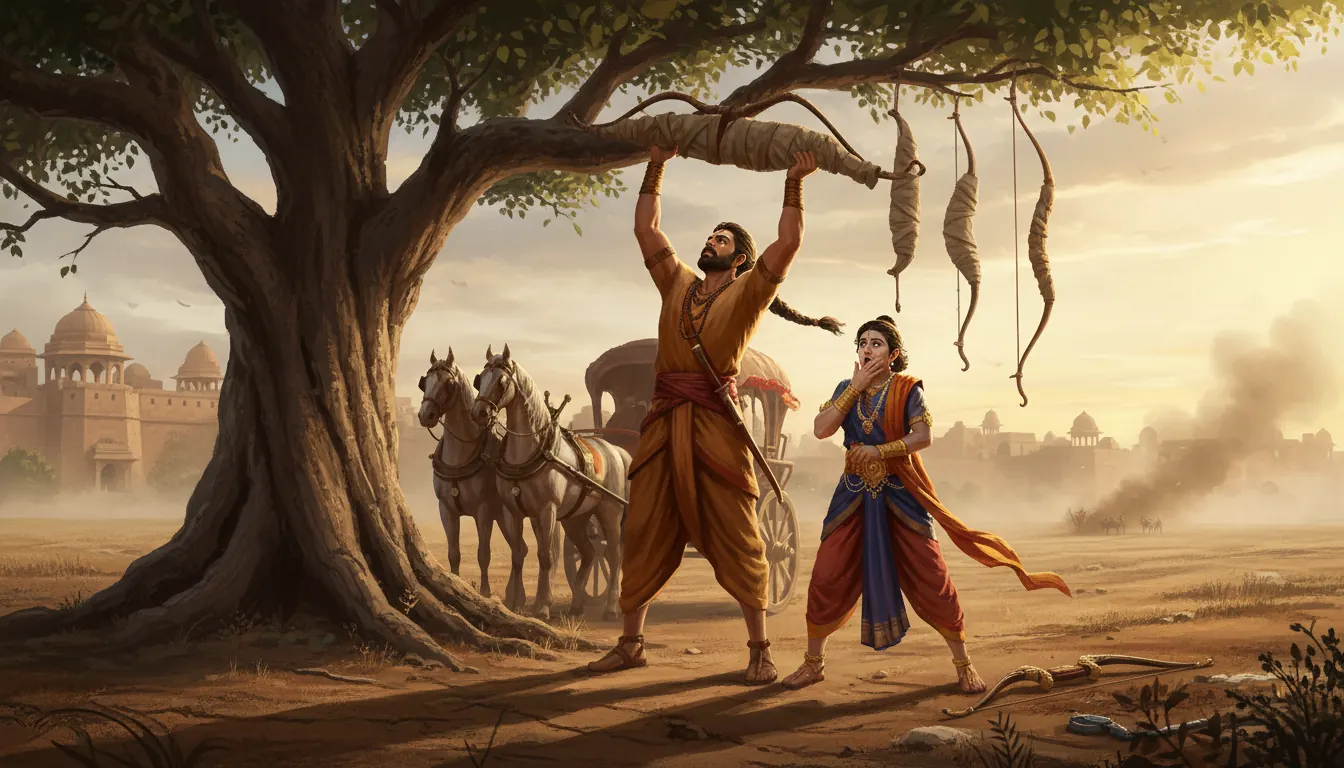
The Kuru host had driven off the cattle of Matsya, and the only man left in the city to answer them was Virata's son, and the only charioteer left for him was the dancing master out of the women's quarters, a person in braid and bangles who called himself Brihannala. The prince had seen the array, and the array had emptied him, and afterwards, when he had been brought back to the shami tree that stands beside the cemetery outside the city, he had climbed it at his driver's word and taken down the long bundle that had been sleeping in its branches for a year.
What came out of the wrapping stopped him. Not one weapon but five sets of them, bows and arrows and quivers and swords, and every piece of it made for a hand richer and heavier than any hand he knew.
So he began to ask, and he did not stop for a long time.
Whose was the excellent bow with a hundred golden bosses on it and ends that gave off light. Whose was the one with golden elephants shining on the staff. Whose was the one adorned with sixty golden Indragopakas, the small red insects of the rainy season, set at even intervals along the back. Whose was the bow with three brilliant golden suns on it. Whose were the thousand winged arrows with golden heads in their golden quivers, and the sable quiver with five images of tigers on it, and the seven hundred long shafts like crescent moons that were made to drink an enemy's blood. Whose was the sword with the mark of a toad on it. Whose was the scimitar from the country of the Nishadas. Whose was the blade just longer than the breadth of thirty fingers, polished smooth by constant clash with other men's weapons.
"I have asked you, Brihannala," the boy said at the end of it, "so answer me truly. I am filled with wonder at the sight of all these excellent things."
The dancer had waited a year to be asked that question. He began with the largest bow.
The Bow Without a Knot or Stain
"The one you asked about first," he said, "is Arjuna's bow, famous throughout the world, called Gandiva, which can lay waste whole enemy hosts."
He did not begin with the man. He began with the object, and he described it the way a herald describes a king.
This Gandiva, adorned with gold, is the highest and largest of all weapons. It alone is equal to a hundred thousand weapons. It can always push out the borders of kingdoms. With it Partha conquers both men and gods in battle.
Read that list again for what it claims. The first clause is about size and the second about worth, and the third is about what a bow does to a map, which is a thing a bow does only when the man holding it does not lose. And the fourth clause puts gods and men quietly on the same side of the account, as two kinds of opponent that this one weapon has already dealt with.
The gods, the Danavas and the Gandharvas have always worshipped it. It is patterned in excellent colours. This large and smooth bow has no knot or stain anywhere.
That last is the detail to hold, because it is the only one a person standing in a cemetery could check for himself. Any stave grown out of wood carries the memory of the tree in it somewhere, a knot where a branch went out, a darkening where the sap ran. Uttara was turning a length of the thing in his two hands in the light, and there was nothing on it. No flaw, no join, no mark of the making. It had not been cut from anything. It had been given.
"Full of great energy and of high heavenly origin," said Brihannala, "this is the best of all bows. Worshipped among gods and men, it has a handsome form."
Then he told him where it had been.
The history of Gandiva is short in the telling, because it is only a list of owners and the number of years each of them held it. It is not short in any other way.
The Six Who Held It
Brahma held it first, for a thousand years.
Afterwards Prajapati held it, the lord of creatures, and he held it for five hundred and three years. Then Shakra, which is another name for Indra, and Shakra held it for eighty-five years. Then Soma, who is the moon and also the drink of the sacrifice, and he held it for five hundred years. Then Varuna, lord of the waters and keeper of oaths, for a hundred years. And finally Partha, surnamed Swetavahana, which means he of the white horses, who has held it for sixty-five.
Set the numbers beside each other and the shape of the thing appears. Two thousand one hundred and eighty-eight years of divine ownership, handed down in a descending order, from Brahma to Prajapati to the king of the gods to the moon to the sea, and then out of the sea into the hands of a man. Every one of the five who held it before him had it for a longer term than Arjuna has had it so far, and Arjuna is not finished.
"Partha obtained this beautiful bow from Varuna," Brihannala said.
He did not give the boy the circumstances, and there is no need for more than a line of them here. Agni came to two young men on the bank of the Yamuna wanting to eat a forest, and could not eat it while Indra sent rain on it, and Varuna was asked for the arms that would let two men hold off the sky. The bow came out of the water that day, with two quivers that never empty and a chariot with an ape on its banner. The gods had been keeping it for somebody, in the way that things are kept, and the somebody turned out to be a young man.
Uttara stood in the burning ground with the smooth bow in his hands and no idea yet whose hands he was standing next to.
Brihannala went on to the second bow.
The Bows of the Other Four
"This other bow with handsome sides and a golden handle is Bhima's," he said, "with which that son of Pritha, that scourge of foes, conquered the whole of the eastern regions."
That is how the four remaining bows were named. Not by their beauty, though the beauty is given, but by the ground each of them has already taken. The boy had asked whose they were. What he got back was a map.
The bow of beautiful shape adorned with the images of Indragopakas, the one with the sixty golden insects along its back, belongs to king Yudhishthira. Brihannala said it exactly that way, king Yudhishthira, standing at the edge of a cemetery outside a city where a man of that name was at that hour riding with Virata against the Trigartas as his dice-playing courtier and being spoken to as a servant.
The bow with golden suns of blazing splendour shedding a dazzling light around it belongs to Nakula.
And the bow adorned with golden images of insects and set also with gems and stones belongs to that son of Madri who is called Sahadeva.
Madri was Pandu's second queen and the mother of the twins, and she went into the fire when her husband died, and her two boys were brought up by Pritha, the elder queen, whom the world calls Kunti. Brihannala named her without explaining her, the way a man names a woman his own household has always known, and if the prince noticed that, he did not say so.
Five bows had come down out of one tree in one wrapping, and here they were being dealt out to five brothers, and those five brothers were the most famous missing men alive. Any listener could have arrived at it. The sons of Pandu had gone into the forest thirteen years ago and for the past year had not been heard of at all, and their weapons were in a tree at the edge of Virata's burning ground, and a dance teacher in a woman's braid knew every piece by sight the way a farmer knows his own tools.
Uttara did not arrive at it. He asked about the arrows instead.
So Brihannala counted out the arrows.
The Arrows and the Quivers
"These winged arrows, a thousand of them, sharp as razors and deadly as the poison of snakes, belong to Arjuna."
Then the thing that is said of them and of nobody else's: when they are shot in battle against foes, these swift arrows blaze more brightly and become inexhaustible.
Not many. Not enough. Inexhaustible, and brighter the longer they are used, which is a promise about the man shooting as much as about the shafts.
The long thick ones shaped like the crescent moon, sharp-edged and able to thin the enemy's ranks, belong to Bhima. Seven hundred of them, as the prince had counted, every one shaped like a moon three days old and made to take a man apart sideways.
The quiver bearing five images of tigers, full of yellowish shafts whetted on stone and fitted with golden wings, belongs to Nakula. And here the geography came back into it, because Brihannala did not stop at the name. This is the quiver of the intelligent son of Madri, he said, with which he conquered in battle the whole of the western regions.
East to Bhima, west to Nakula. Quiver by quiver, the boy was being told that the quarters of the earth had already been walked over by the owners of the things he was holding.
The arrows all bright as the sun, painted all over in various colours and able to destroy enemies by thousands, are Sahadeva's.
And the short, well-tempered, thick shafts, with long feathers and golden heads and three knots each, belong to king Yudhishthira.
No boast is attached to that last set and no conquest is named for it. The eldest brother's arrows are the plainest things in the bundle, short and heavy and knotted three times over, and they are described the way a carpenter's rule is described. They came out of the tree with all the rest, and they had been waiting up there just as long.
Then the swords, which the prince had asked about first and was answered about last, because a sword is what a man reaches for when everything else in the bundle has failed him.
The Five Swords
"This sword, with its long blade carved with the image of a toad and its head shaped like a toad's mouth, strong and irresistible, belongs to Arjuna."
This long-bladed sword in its sheath of tiger-skin, handsome and irresistible and terrible to enemies, belongs to Bhimasena.
This handsome sword, with its excellent blade, its well-painted sheath and its golden hilt, belongs to the wise Kaurava, Yudhishthira the just.
He said Kaurava, and he was right to. The word means the line of Kuru, and the sons of Pandu belong to it exactly as much as the sons of Dhritarashtra do, and there was a time before the dice when nobody would have thought the word needed sorting out.
This strong-bladed sword in its sheath of goat-skin, irresistible and made for many excellent styles of fighting, belongs to Nakula.
And this huge scimitar, in a sheath of cow-skin, strong and irresistible, belongs to Sahadeva.
That was the end of the answer. Five bows, five sets of arrows, five swords, each one matched to a name, the whole inventory delivered in the flat voice of a man reading out a list of things he has owned all his life and has not been allowed to touch for a year.
He had not once said I. He had said Arjuna's bow, and Bhima's, and king Yudhishthira's, and the son of Madri's, and he had kept himself out of every sentence in it. Only the tenses gave him away. He described the working of Arjuna's arrows in battle in the present tense, as a thing that happens, not as a thing that used to happen to somebody who was dead.
And the prince was standing in a burning ground with the weapons of five dead men laid out around him, except that nothing in the bundle was rusted and nothing was rotted, and the wrapping had been dressed up as a corpse only to keep the curious off, and the man who had brought him here knew which sword was whose without looking twice.
Uttara looked up from the toad-marked blade and asked where those five men were now.
Dharma Lesson
A weapon in this epic is never only a weapon. It is a record of who has held it and what was done with it, and Gandiva carries more than two thousand years of that record before a man ever draws it. What Arjuna gives Uttara is not a boast but an inventory, spoken about himself in the third person, at the end of a year in which he was forbidden to touch any of it. What a man is does not rot while he is pretending to be something else. It lies wrapped in a tree, unrusted, waiting for the day the pretence ends.