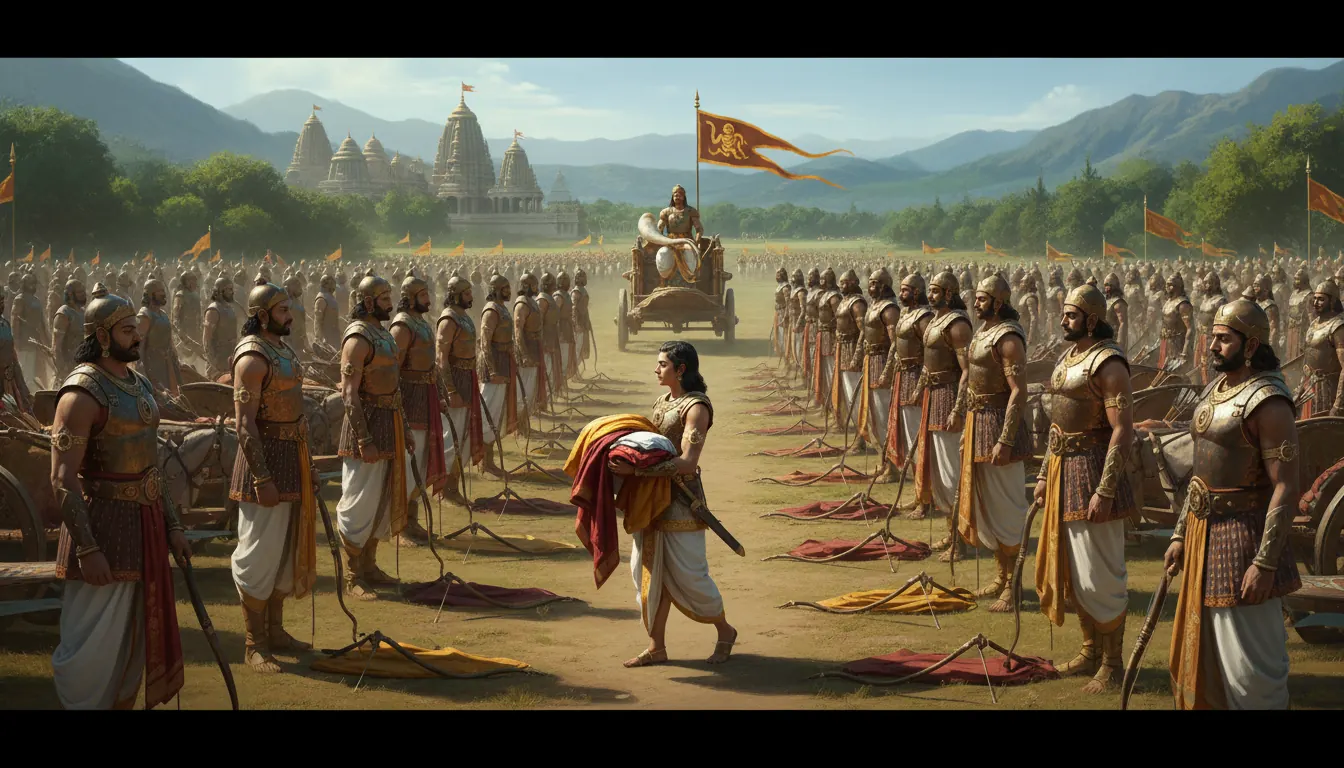
The Sleep Weapon and the Robes for the Dolls
Six great warriors disarmed, and a promise kept to some girls
In short
Duryodhana wounds Arjuna in the forehead and is shamed back into the fight, and the whole Kuru command closes on Arjuna at once. He answers with the Sammohana weapon and the blast of Devadatta, and every bow drops out of every hand. Then he sends Uttara down among the senseless warriors to strip their robes, because the palace girls asked for cloth for their dolls.
Told in the Virata ParvaSet in Virata16 min read
The Grandsire Leaves the Front
When the duel of celestial weapons was over, the two of them settled down to arrows.
Arjuna came in close and cut Bhishma's gold-decked bow with an arrow sharp as a razor, and in the blink of an eye Bhishma had taken up another, strung it, and was pouring a cloud of arrows down on him. They stood and shot at each other until no man on the field could tell one from the other. Both of them hid the ten directions. The Pandava covered Bhishma, and Bhishma covered the Pandava, and the warriors who guarded the grandsire's chariot fell one after another beside the wheels of the son of Kunti. The feathered arrows of Shvetavahana, shot from the Gandiva, fell in every direction as though he meant to slaughter the enemy wholesale, and as they streamed out of his chariot those blazing, golden-winged arrows looked like rows of swans crossing the sky.
High above, the Gandharva Chitrasena watched with the gods and could not keep quiet about it.
"Look at Partha's arrows flying through the sky in one unbroken line," he said to the lord of the gods. "You cannot see a gap between his taking up the arrows, setting them on the string and loosing them from the Gandiva. The soldiers cannot even look at him; he is like the midday sun blazing in the sky. Nor does anyone dare to look at Bhishma, the son of Ganga. Both are famous for their deeds, both are fierce in their prowess, both are equal in heroism, and both are hard to defeat."
And Indra, hearing that, honoured them both with a shower of celestial flowers.
Then Bhishma came at Arjuna's left side, just as the man who could draw with either hand was about to pierce him, and Bibhatsu laughed aloud and cut his bow again, and put ten arrows into his chest while the old man was fighting with all his strength. In great pain, Ganga's son stood a long time leaning on the pole of his chariot. And his driver, remembering the rule about protecting a warrior who has fainted, took him away from the front of the battle.
An Arrow in the Forehead
With Bhishma gone from the front, the son of Dhritarashtra raised his flag high and came at Arjuna himself, bow in hand, with a loud roar.
He drew a spear-headed arrow back to his ear and let it go, and it took Arjuna in the forehead.
Pierced by that keen, gold-tipped arrow, the hero of famous deeds looked splendid, king, like a beautiful hill with a single peak. The warm blood poured from the wound and ran down over his body, and the blood on him shone like a wreath of golden flowers.
Arjuna did not put a hand to it. He swelled with rage and answered, taking up arrows as deadly as poisonous snakes, and he pierced the king in return. And Duryodhana, a man of formidable energy, attacked Partha, and Partha attacked Duryodhana, and those two great men, both born in the line of Ajamida, struck each other blow for blow, and for a little while there was nothing else on that part of the field.
It was late in a very long afternoon. Arjuna had already cut Bhishma's standard off clean at the roots, and when Dushasana and Vikarna and Dussaha and Vivingsati surrounded him for it he had broken Dushasana's gold-plaited bow and put five arrows in his chest and sent him out of the fight; he had struck Vikarna in the forehead and knocked him off his chariot; he had killed the horses of the other two and left them to be carried off by the men behind. Behind Duryodhana the whole Kuru command had been standing since morning, six great chariot warriors who had spent an hour of it quarrelling in public about a dice game, and every one of them now had to decide what to do about a wound on a forehead.
Eight Hundred Paces
Vikarna came next, seated on a maddened elephant as huge as a mountain, with four chariots in support.
Arjuna saw the beast charging and drew a heavy iron arrow back to his ear and struck it on the head, between the temples. Like the thunderbolt hurled by Indra splitting a mountain, that vulture-feathered arrow went in up to the feathers, into the body of an elephant as big as a hill.
The great elephant began to tremble. Then, its strength gone, it crashed to the ground in terrible agony, like a mountain peak split by thunder.
Vikarna jumped clear as it fell, terrified, and ran back a full eight hundred paces on his own feet before he found a chariot he could climb onto, which was Vivingsati's.
And having killed with a single thunderous arrow an elephant huge as a hill and dark as a mass of clouds, the son of Pritha put another arrow of the same kind into Duryodhana's chest.
The elephant was down and the king was wounded and Vikarna had broken and gone, taking with him the men who guarded the king's chariot. The other warriors, struck by arrows from the Gandiva, fled from the field in panic.
Where Is Your Persistence in Battle
Duryodhana turned his chariot hastily and fled in the direction where Partha was not.
He was vomiting blood as he went. Arjuna, still eager for battle and able to stand up to any enemy, did not pursue him. He raised his voice instead, and he was heard by both armies.
"Why are you running away, turning your back and throwing away your great fame and glory? Why are those trumpets silent now, that sounded when you set out from your kingdom?
"Look, I am Yudhishthira's obedient servant, the third son of Pritha, and I stand here ready for battle. Turn back. Show me your face, son of Dhritarashtra, and remember how kings behave.
"The name Duryodhana they gave you has lost its meaning now. When you run away from the battle, where is your persistence in battle? I see no bodyguards in front of you or behind you. Run, then, best of men, and save that life of yours which is so dear to you."
It was not said to make him fight. It was said in the hearing of the men who had ridden out of Hastinapura behind those trumpets, and it was designed to leave the king only one door open, and the king went through it.
Pricked By a Hook
Called back to battle like that, Dhritarashtra's son turned round, stung by those taunts like a maddened elephant pricked by a hook. He was a brave and very swift chariot warrior, and he could not bear what had been said of him, so he brought his chariot round like a snake that has been trodden on.
Karna, that hero among men with his golden necklace, saw the king coming back with his wounds, stopped him on the way and calmed him, and then went on himself, passing along the north side of Duryodhana's chariot, to meet Partha in battle.
And mighty-armed Bhishma, the son of Shantanu, turned back his own horses, huge tawny horses decked with gold, and rushed forward bow in hand to protect Duryodhana from Partha. Drona came, and Kripa, and Vivingsati, and Dushasana, and the others, turning quickly with their bows drawn and their arrows already on the strings, all of them to protect the king.
Arjuna saw those divisions advancing on him like the swelling waves of the ocean, and he rushed at them the way a crane rushes at a descending cloud.
They surrounded him completely, celestial weapons in their hands, and rained arrows on him from every side, as clouds pour a heavy downpour on a mountainside. He turned aside, weapon by weapon, every weapon of those bulls among the Kurus. And then, hemmed in by the six of them and by the whole army behind them, the wielder of the Gandiva reached for something his father had given him in heaven.
Sammohana
The weapon was called Sammohana, the stupefier, and he had received it from Indra, and there was no answer to it.
He brought it out there in the middle of the ring around him. He covered all the directions, the main ones and those between, with sharp, keen-edged, beautifully feathered arrows, and with the twang of the Gandiva running under them he stunned the senses of every man in front of him.
Then he took up his great loud-blaring conch in both hands and blew it with force, and filled every direction, the whole earth and the sky, with that one noise.
And those great Kuru heroes were all knocked senseless by it.
They sank down senseless where they were in their chariots, and their bows, from which not one of them had ever been separated, dropped out of their hands and lay in the dust beside the wheels.
Drona lay there in his white robes with nothing in his hands. Kripa lay beside him. Karna lay with his golden necklace on and his face turned toward a man he had promised that morning to grind like an elephant tormented with burning brands. Duryodhana lay in blue with the blood drying on his chest. Ashwatthama, who had refused an hour ago to lift a bow against Arjuna at all, lay disarmed like everybody else.
The army behind them stood as well, rank upon rank of it, sixty thousand cattle lowing somewhere beyond in the dust, and nothing moving on that whole field except one chariot and two men in it.
Every one of the six had spoken that morning. Karna had promised to hold this man as a bank holds the sea. Kripa had counted out, item by item, the things he had done alone, and had concluded that six of them together would be needed. Ashwatthama had said that he would not fight Dhananjaya at all and that the Gandiva does not throw Krita or Dvapara. Bhishma had told them that the worst calamity that can befall an army is disunion among its leaders. Not one of those speeches was worth anything now. The weapon had not asked which of them believed in the cause.
The Cloth for the Dolls
Then Partha remembered a promise, and it was not one he had made to a king.
When the chariot had gone out of the city that morning, the girls of the inner apartments had come around it, and Uttaraa and her maidens had called up to the dancing master who was holding the reins, "Brihannala, when you have beaten the Kurus, with Bhishma and Drona at their head, bring back all kinds of fine, lovely cloth for our dolls." And he had answered them, smiling, in a voice deep as the roar of the clouds, that if Uttara could defeat those mighty warriors in battle he would certainly bring back fine and beautiful cloth.
Now he turned to the son of Matsya.
"Best of men, go among the Kurus while they lie senseless, and bring away the white garments of Drona and Kripa, Karna's handsome yellow ones, and the blue ones of the king and of Drona's son."
Uttara looked at the standing army.
"One thing," said Arjuna. "I do not think Bhishma is stunned, because he knows how to counter this weapon of mine. So go past him with his horses on your left. That is how anyone still conscious should be avoided."
The famous son of Matsya handed over the reins, got down from the chariot and walked in among the greatest archers alive, none of whom moved, and took the garments off them one by one, keeping well clear of the old man with the tawny horses. Then he came back to his place with an armful of cloth for the dolls of the palace girls, picked up the reins again, and urged on the four handsome horses, their flanks covered in golden armour. And those white horses carried Arjuna out of the middle of that battlefield and beyond the ranks of infantry standing there with their standards in their hands.
The One Who Was Not Asleep
Bhishma was not asleep, and he watched them go, and he shot.
Arjuna answered by killing his horses, putting ten arrows into him and killing his charioteer, and left him standing there on the field, and came out of that crowd of chariots like the sun coming out from behind clouds.
Then Dhritarashtra's son came to his senses, looked around at his own disarmed army, and saw the son of Pritha standing out on the open ground alone, like the lord of the gods.
"How did this man get away from you?" he said hurriedly to Bhishma. "Strike him down so that he cannot escape."
And Shantanu's son smiled at him.
"Where was this good sense of yours, and where was your prowess too, when you were lying there unconscious, with your arrows and your handsome bow dropped from your hands?
"Bibhatsu is not given to cruel deeds, and his heart does not lean towards sin. He would not give up his principles even for the three worlds. That is the only reason all of us have not been killed in this battle.
"Greatest of the Kuru heroes, go back to the city of the Kurus, and let Partha go too, now that he has won back the cows. Do not throw away your own good out of folly. A man should do what leads to his welfare."
The king listened to the grandsire's words, which were for his own good, sighed deeply and fell silent, and lost his appetite for battle. And the other warriors, thinking the advice sound, and seeing that the Pandavas were growing stronger, decided to go back, to protect Duryodhana.
They had come to take cattle. Most of them went home without their robes.
Salutes, and a Crown Broken
As the great Kuru heroes left for their city, Dhananjaya followed them for a while with a glad heart, because he wanted to speak to them and pay them honour.
He honoured the aged grandsire, the son of Shantanu. He honoured the teacher Drona. He saluted Drona's son, and Kripa, and the other revered elders among the Kurus, with beautiful arrows sent past them in the proper way. Then, with one more arrow, he smashed Duryodhana's jewelled crown to pieces.
Having saluted all those revered and brave warriors in that way, he filled the three worlds with the twang of the Gandiva, and suddenly blew his conch Devadatta, and the hearts of all his enemies were pierced by the sound.
"Turn the horses round," he said to Matsya's son. "Your cows have been won back. The enemy is leaving. Go back to your city with a glad heart."
And the gods, having watched that battle, were delighted, and went away to their own homes, thinking over Partha's feats.
Then out of the deep forest came a large number of Kuru soldiers who had been cut off in the rout, walking slowly, their hair loose, worn out with hunger and thirst, in a foreign land, numb with terror and confused in mind. They stood before him with joined palms.
"We are your slaves," they said.
"Welcome, and blessings on you," said Arjuna. "Go your way. You have nothing to fear. I will not take the lives of those in distress. I give you my word that you are safe."
And they blessed him, praising his fame and wishing him long life, and went away after their army.
On the road back, Arjuna gave the prince his instructions.
"You alone know, child, that the sons of Pritha are living with your father. Do not praise them when you enter the city, or the king of the Matsyas may hide himself in fear. When you enter the city, declare before your father that the deed is your own. Say: I defeated the army of the Kurus, and I won back the cows from the enemy."
"What you have done is beyond my power," said Uttara. "I could never have done it. But I will not tell my father who you are, Savyasachin, until you tell me to."
"Then look ahead," said Arjuna. "The cowherds are driving the cows in front of us. We will enter the capital in the afternoon, when the horses have been watered and bathed. Let the cowherds go ahead quickly to the city at your order with the good news, and proclaim your victory."
And Uttara gave the messengers their orders, and they went. "Go and proclaim the king's victory. The enemy has been routed, and the cows have been won back."
So they came back to the cemetery and to the same shami tree, and Arjuna stood under it with his body torn by the enemy's arrows. And that terrible monkey, blazing like fire, rose off the flagstaff into the sky with the other creatures that had sat there, and the illusion made by Vishvakarma melted away, and Uttara's own banner with its lion device was set up on the chariot again. The arrows and quivers of the sons of Pandu were put back into the tree, and the Gandiva with them.
Then Partha bound his hair in a braid, as it had been before, took the reins out of Uttara's hands, and drove into the city of Virata as Brihannala, the prince's charioteer, with the robes of five great warriors folded on the floor of the chariot for some girls' dolls.
Dharma Lesson
Power is measured by what it declines to do once nothing can stop it. Arjuna has five of the greatest archers alive lying helpless in front of him and takes nothing from them but cloth for a child's toys. Bhishma names the reason plainly: they are all alive only because Bibhatsu does not do atrocious things, and will not abandon his principles even for the sake of the three worlds.