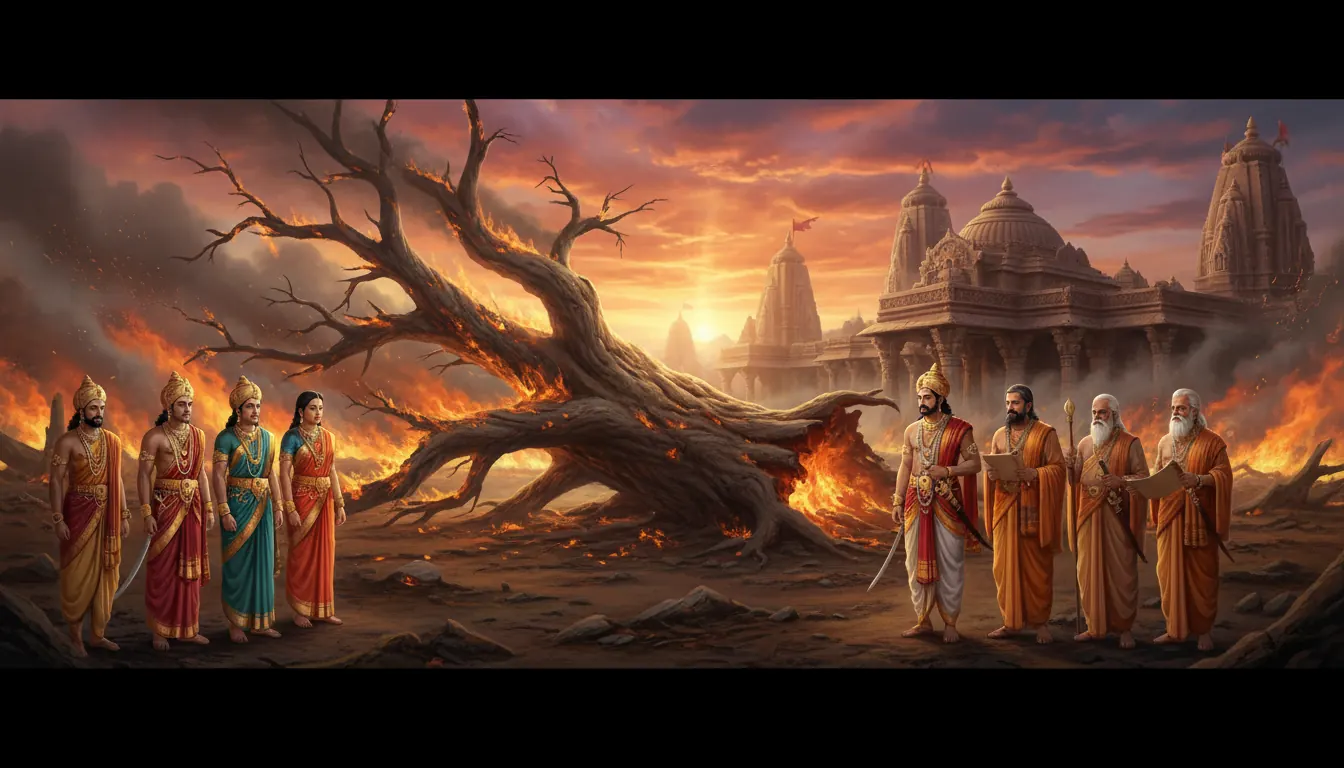
In short
Kichaka's kinsmen find him crushed in the dance hall, blame the sairindhri, and obtain Virata's permission to burn her alive on his bier. Bound and carried to the cemetery, Draupadi cries out the five secret names her husbands took on the road. Bhima goes over the palace wall, uproots a tree ten vyamas tall, and kills a hundred and five Sutas with it.
Told in the Virata ParvaSet in Virata16 min read
What the Torches Found
They came into the dance hall with torches, by thousands, because the woman had gone to the doorkeepers herself and told them to come and look at what her Gandharva husbands had done.
What lay on the floor of that hall had been the commander of the armies of Matsya. It did not look like a man. It lay drenched in blood with every limb mangled, like a tortoise dragged out of the water onto dry ground, and the guards who bent over it with their torches could not at first work out what they were looking at.
"Where is his neck?" one of them said. "Where are his legs?"
The arms had been driven into the trunk. The head had been pushed down into the shoulders. Bhima had crushed the whole of him into a ball of flesh and then stood on him, and there was nothing on that body that a weapon had touched, which is why every man in the room came to the same conclusion at the same moment, and it was the conclusion the Pandavas had needed them to come to. No human being had done this.
Then the kinsmen of Kichaka arrived.
They were Sutas of his own clan, a hundred and five of them, and they had ruled Virata's court from behind his general's shoulder for years. They came in and stood around the thing on the floor and wailed aloud, and the hair on their bodies stood on end, for they saw him crushed all over as a Danava is crushed by Indra, and they had never in their lives imagined that Kichaka could be reduced to anything at all.
So they lifted him to carry him out for his funeral rites. And as they lifted him, one of them saw the woman.
She had not run. She was standing at the edge of the hall with her back against a pillar, watching them take him up, and she had faultless limbs and she was not weeping.
Let Her Burn With Him
"Kill this unchaste woman," the Sutas said, all together, "for it was for her that Kichaka lost his life."
And then one of them thought of something better.
"Or rather, instead of killing her here, let us burn her with the man who lusted after her. It is right for us to do everything that would please the dead son of the Suta."
They liked it. It gave him in death the one thing he had failed to take in life, and it gave it to him with rites and with a priest and with the permission of the crown.
So they went to the king. They carried the body of his commander into his presence and set it down where he could see it, and said: "It was for her sake that Kichaka lost his life. So let him be burned together with her. Grant us this permission."
Virata knew what the Kichakas were. He knew their prowess and he knew how much of his kingdom's strength sat in that clan, and he had just been shown, on his own floor, what happened to the strongest of them. He was a king who had taken a strange woman into his house and given her to his wife to keep. He had a duty to her that was older than any claim these men could make, and he had a hundred and five armed Sutas standing in his hall, and their general dead between them.
He gave his assent.
That is the whole of it, and the Vaishampayana who told this to Janamejaya did not soften it: the king of the Matsyas, being afraid, gave permission for a woman living under his protection to be burnt alive on another man's bier.
Bound to the Bier
They came for her where she stood. She was frightened and stupefied, and she did not fight them, and there were a hundred of them.
They seized her with violence. They bound that damsel of the slender waist, wrists and ankles, and they lifted her and laid her on the bier itself, on the same boards as the crushed thing that had been Kichaka, and tied her there so that she could not roll off, and hoisted the whole burden onto their shoulders and set out with great energy for the cemetery.
The city came out to watch it go. This was the sairindhri, the hairdresser and unguent-maker whom queen Sudeshna had kept for a year, the one so beautiful that the queen had been afraid to keep her, and here she went up the road on her back with a corpse beside her and a hundred and five men carrying her to the burning ground.
No one stopped it. There was no one in Matsya who could have stopped it.
She was the daughter of Drupada, the sister of Dhrishtadyumna, the wife of five men who between them could have emptied that road in the time it takes to say so, and every one of those five was somewhere within the walls behind her, cooking, or grooming horses, or counting cattle, or teaching the king's daughters to dance, or sitting at a gaming board with a king; and every one of them had sworn to stay exactly where he was for one more year, and the year was not finished.
So, being carried alive to her own pyre, she used the only weapon her husbands had left her, which was five words.
Jaya, Jayanta, Vijaya, Jayatsena, Jayadvala
She wailed aloud from the bier, and what she cried was not the name of any husband.
"Oh, let Jaya, and Jayanta, and Vijaya, and Jayatsena, and Jayadvala hear me. The Sutas are taking me away."
They were names nobody in Matsya had ever heard. On the road into this kingdom, before they came down out of the woods and put on their disguises, the five brothers had agreed among themselves on five names of victory that they would use for one another and for no one else, so that if any of them had to call to another in a crowded place he could do it without saying Bhima, or Arjuna, or Yudhishthira aloud. For a year those names had not been used once.
"Let those illustrious Gandharvas hear me, so swift of hand, whose chariots clatter loud, whose bowstrings twang like the roar of thunder in the thick of the great battle. The Sutas are taking me away!"
And in the kitchen of the palace of Virata, a big man lying on his bed heard a woman shouting five words in the street.
Bhima did not stop to think for a moment. He did not weigh the year, or the vow, or the twelve years in the forest that had been paid for in advance, or what his eldest brother would have told him to do. He came up off that bed already answering her.
"I have heard what you said, sairindhri," he said. "So, timid lady, you have nothing more to fear from the Sutas."
Out by the Wrong Door
Then the mighty-armed son of the Wind began to swell his body, and the man who had been Vallava the cook for a year went out of that palace like something let off a chain.
He was careful even so. He changed his clothes, because the cook's clothes were known and a cook running through the city at night would be remembered afterwards, and he did not leave by the kitchen door that everybody used. He went out by a wrong exit, at the back, where nobody was posted. He found a tree growing against the palace wall, climbed it, went over the wall, dropped on the far side, and was outside the excellent city of the Matsyas in the dark with no one having seen his face.
Then he ran for the cemetery.
He did not run to where the road was. He ran at the burning ground straight across whatever lay between, and near the funeral pyre he saw the thing he wanted: a large tree, tall as a palmyra palm, with gigantic shoulders and a withered top.
He put his arms around it and pulled it out of the ground the way an elephant pulls one, roots and earth and all, and got it up onto his shoulders. It measured ten vyamas, trunk and branches together, and he did not shorten it or strip it. He carried it as it was.
And he came on at the Sutas at a run, with that tree on his shoulder, like Yama himself with the mace in his hand, and by the sheer force of his rush the banians and the peepals and the kinsuka trees that stood in his path came down and lay in clusters on the earth behind him.
A Hundred and Five
The Sutas had the bier on their shoulders and the woman tied to it, and they looked up and saw a Gandharva coming at them out of the dark like a lion in fury with a tree in his hands.
They were the best fighting clan in Matsya. Every one of them was armed. They trembled, and were greatly distressed, and became panic-struck, and they said to each other exactly what men say at such a moment.
"Look, the mighty Gandharva is coming this way in a rage, with an uprooted tree in his hand. The sairindhri is the cause of this danger to us, so let her go."
They put the bier down. They cut her loose, or loosed her enough, and let her go, and turned, and ran breathlessly for the city.
Bhima killed a hundred and five of them with the tree.
He went through them the way the wielder of the thunderbolt goes through Danavas, and when he was finished the corpses lay scattered over the burning ground so that the place looked like a great forest covered with uprooted trees after a hurricane. With Virata's general, slain in the dance hall the night before, the slaughtered Sutas of that clan numbered one hundred and six. Kichaka's house was finished in a single day and a night, root and branch, and there was no one left of it to make a claim on anybody.
Men and women had come out of the city to watch the burning, and they had watched this instead. They stood on the edge of the cemetery and looked at it, and the power of speech was suspended in every one of them.
Go Back by the Road, I Will Go by Another
He came back through his own work to the bier and set her free from her bonds, and then that irrepressible Vrikodara had to do the harder thing, which was to comfort her, and he was never good at it.
Her face was bathed in tears. He stood in front of her covered in what he had just done.
"This is how those who wrong you without cause are slain, timid one," he said. "Go back to the city, Krishna. You have nothing more to fear. I will go to Virata's kitchen by another way."
That was the whole of it, and it was the necessary part. Two people could not walk back through that gate together. He would go around, over the wall, in by the wrong door, and be lying on his bed in the kitchen when the news arrived, and she would walk in at the front of the city with her hands empty, alone, and let the whole of Matsya look at her.
So she washed her limbs and her clothes in water, because she had been lying against a corpse and there was blood on her, and she went up the road into the city like a doe that has been frightened by a tiger.
And the citizens, seeing her come, ran away in all directions. Some of them shut their eyes as she passed, so as not to be caught looking at the woman whose Gandharvas killed a hundred and five men in the time it takes to walk to the burning ground.
At the door of the kitchen she found him standing, huge as an infuriated elephant, exactly where a cook should be. She looked at him with her eyes wide, and said, in words that were plain to the two of them and meant nothing to anybody else: "I bow to that prince of the Gandharvas who has rescued me."
"Those at whose command the men of this city have lived until now," Bhima answered her in the same way, "will go about the city from now on, regarding themselves as freed from the debt."
The Dancing Master Asks a Question
Then she went on into the palace, and at the dancing hall the king's daughters came pouring out around her, and Brihannala came out behind them.
"By good luck, sairindhri, you have been saved from your dangers," the girls said, all at once. "By good luck you have come back safe. And by good luck those Sutas who wronged you, innocent as you are, have been slain."
"How were you saved, sairindhri?" said Brihannala, in the light voice she used with the girls. "And how were those sinful wretches slain? I want to hear all of it from you, exactly as it happened."
Something in Draupadi broke at that.
"Blessed Brihannala, you pass your days happily in the girls' apartments, so what concern is the sairindhri's fate to you, that you should ask? You have no grief to bear like the grief the sairindhri bears. That is why you ask me like this, in mockery, when I am in such distress."
The dancing master stood among the king's daughters with bangles on her arms and did not answer at once.
"Blessed one," Arjuna said, "Brihannala too has sorrows beyond compare. She has sunk as low as a beast. You do not understand this, girl. I have lived with you, and you have lived with us. So when you are in misery, who would not feel it? But no one can fully read another's heart. That is why, gentle one, you do not know mine."
And the girls, hearing none of it, took her hands and led her away to the queen.
A Woman Cannot Offend
Meanwhile the citizens had gone to the king.
"King, those mighty sons of the Sutas have all been slain by the Gandharvas. They lie scattered on the ground like huge mountain peaks split by thunder. And the sairindhri has been set free and is coming back to your palace in the city. Alas, king, if the sairindhri comes, your whole kingdom will be in danger. The sairindhri is very beautiful, the Gandharvas are very powerful, and men, beyond doubt, are by nature driven by desire. So find a way at once, king, to keep your kingdom from being destroyed because of wrongs done to the sairindhri."
They had watched her tied to a bier that morning and said nothing at all. They said a great deal now.
"Perform the last rites for the Sutas," Virata told them. "Let all the Kichakas be burnt on one blazing pyre, with gems and fragrant unguents in plenty."
Then, filled with fear, the king of the Matsyas went and found his queen.
"When the sairindhri comes back, give her this message from me," he said to Sudeshna. "'Blessings on you, fair-faced sairindhri. Go wherever you like. The king has been alarmed by the defeat already suffered at the hands of the Gandharvas.' With the Gandharvas protecting her, I dare not say this to her myself. But a woman cannot give offence, and that is why I send this to her through a woman."
He had let them bind her because he was afraid of the Kichakas. He put her out of his house because he was afraid of her husbands. In between he did not once ask her anything.
Thirteen Days More
So when Draupadi came before the queen, Sudeshna said her husband's words for him.
"Sairindhri, go quickly wherever you like. The king, may good come to you, has been filled with fear by this defeat at the hands of the Gandharvas. You of the graceful eyebrows, you are young and without equal on earth in beauty. Men desire you, besides. And the Gandharvas are quick to anger."
Draupadi had been bound, carried, cut loose and washed since sunrise, and she did not argue and she did not beg. She counted.
"Beautiful lady," she said, "let the king allow me to stay here just thirteen days more. The Gandharvas will surely be greatly obliged by this. Then they will take me away from here and do what will please Virata. By doing this the king and his friends will surely reap a great benefit."
Thirteen days was the exact remainder of the thirteenth year. She asked for the term of her husbands' vow, to the day, and she asked for it from a frightened queen as a favour, and she got it.
And in the city and in the provinces men spoke of nothing else, from province to province: that for bravery the king's Vallava and Kichaka had both been mighty warriors, and that the wicked Kichaka, an oppressor of men and a dishonourer of other people's wives, had been slain by Gandharvas in the hours of darkness.
Which is how the news travelled. In Hastinapura the spies came back to Duryodhana, seated in his court with Drona and Karna and Kripa and the high-souled Bhishma, and reported that they had searched the wildernesses and the mountain tops and the cities and had found no trace at all of the sons of Pandu; and then, to please him, they added one piece of pleasant news from the west. Matsya's commander Kichaka, who had beaten the Trigartas so often, lay dead with all his brothers, killed in one night by invisible Gandharvas.
Duryodhana thought about that for a long time.
Dharma Lesson
A crime avenged is not finished until the avenger is willing to answer for it a second time. Bhima killed Kichaka in secret and let the city believe a Gandharva had done it, and the price of that secrecy came due within hours when a hundred and five of Kichaka's kinsmen tied Draupadi to the same bier. Protection is not a single act but a standing obligation, and the one who takes it up must be ready to be called back to it at the worst possible hour.