Where a Good King Must Be Living
The Kuru court tries to find five men by their weather
In short
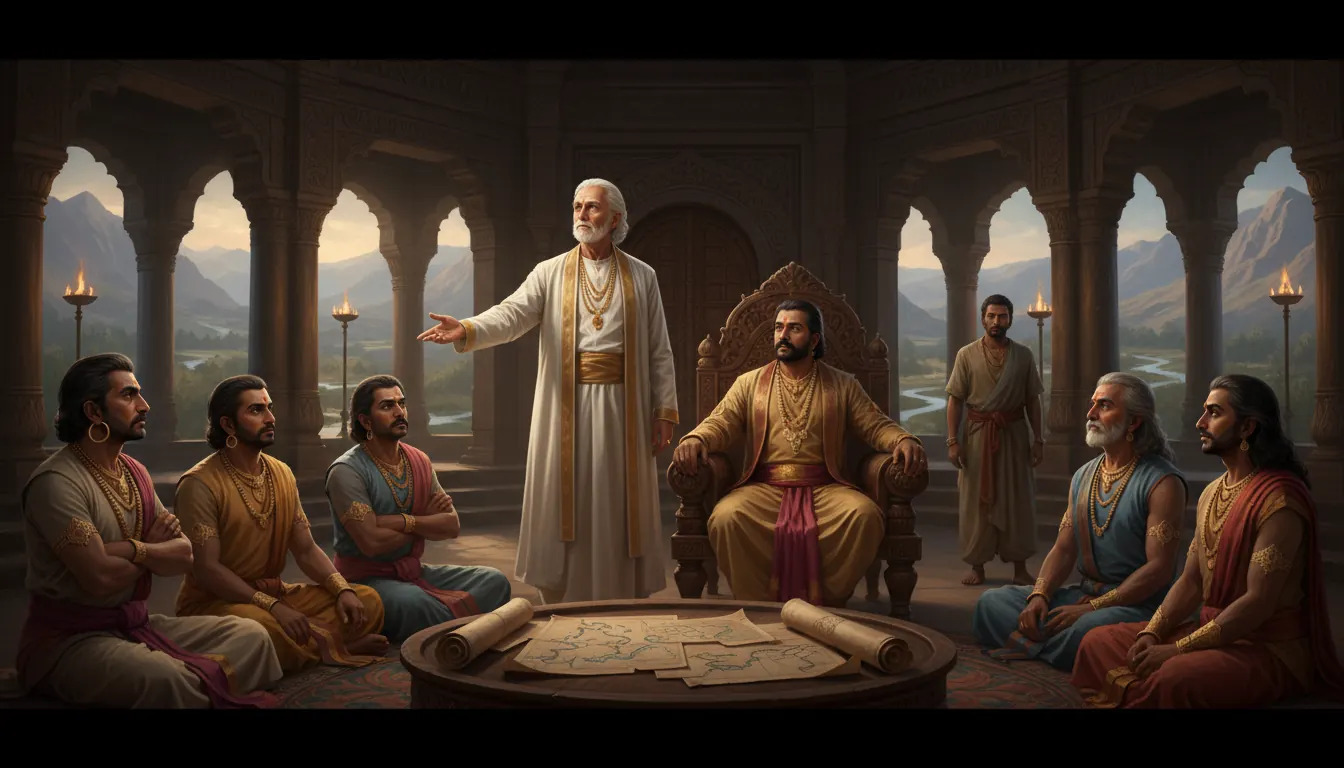
With most of the thirteenth year gone and his spies empty-handed, Duryodhana convenes his court. Karna wants abler spies in every shrine and mine and river bank; Dushasana suggests the Pandavas are simply dead. Drona says such men do not perish. Then Bhishma refuses the whole method and describes instead the country Yudhishthira must be living in.
Told in the Virata ParvaSet in Hastinapura and Virata17 min read
The Spies Come Back Empty
Vaishampayana said: The spies came into the hall at Hastinapura together, Janamejaya, and they came together because not one of them wished to say it alone.
Duryodhana was seated in his court with Drona on one hand and Karna on the other, and Kripa beside them, and Bhishma the son of Shantanu above them all; his own brothers filled the benches, and along the wall stood the Trigarta lords, who had come to complain of Matsya and had not yet been given an answer. Into that assembly the searchers made their report.
"We have always taken great care in searching for the sons of Pandu," they said. "We have searched the lonely wilderness full of deer, overgrown with trees and every kind of creeper. We have searched the thickets of tangled woods. We have searched mountain tops and strongholds no one can climb, crowded kingdoms and provinces, camps and cities. We looked for their footprints there and in other places. No trace of the sons of Pandu has been found."
"You followed the charioteers," said Duryodhana.
"For a while we followed their charioteers, king, and we made our inquiries properly, and we found out for certain what we wanted to know. The charioteers reached Dwaraka without the sons of Pritha among them. Neither the sons of Pandu nor the princess of Panchala are in that city of the Yadavas. We have not been able to find either their trail or where they are now living. With respect, king: they are gone for good."
The hall took that in. It was not the answer any man in it had wanted, and yet there was a sound in the benches that was almost relief.
"But hear this happy news of ours too," the chief of them went on, "which promises you great good. King Matsya's commander, wicked Kichaka, who defeated the Trigartas again and again and slaughtered them with his mighty army, now lies dead on the ground with all his brothers, killed by invisible Gandharvas in the night. We are delighted to have heard this happy news of our enemies' downfall. Now tell us what should be done next."
Along the wall, the Trigarta lords looked at one another. Nobody in that hall yet understood what the death of Kichaka meant, or where the Gandharvas had come from.
What Remains Is by Far the Smaller Part
Duryodhana did not answer at once. He sat and thought for some time, and the court waited on his silence, and when he did speak it was not to the spies but to the whole assembly.
"It is hard to be sure how things will turn out," he said. "So all of you, work out where the sons of Pandu have gone. Of this thirteenth year, which they must pass without any of us finding them, the greater part has already gone. What remains is by far the smaller part."
He let that sit in the hall a moment, because every man there could do the sum.
"If the sons of Pandu, devoted as they are to their vow of truth, can get through the rest of this year undiscovered, they will have kept their pledge. Then they will come back like mighty elephants in rut, or like snakes of deadly poison. Filled with anger, they will surely inflict a terrible punishment on the Kurus."
"Then find them," said someone from the benches.
"That is what I am saying. So you must lose no time in making every effort to force the sons of Pandu, who know the right moment for everything and are now living in painful disguise, to go back to the woods with their rage held in." He said the last words slowly, because that was the whole design: not to kill them, but to catch them one day short, so that the twelve years would begin again from the beginning and the thing would never have to be settled at all. "Find a way to remove every cause of quarrel and anxiety from the kingdom, so that it is peaceful and free of enemies, and can never lose an inch of its territory."
So the question was put to the court, and the court answered it in the order in which men rose.
Karna Wants Better Spies
Karna rose first, as he generally did.
"Let other spies, cleverer and more cunning, men able to accomplish their task, set out quickly, Bharata," he said. "These men searched forests. Forests are where a hunted man is looked for, and the sons of Pandu know that as well as we do. Let the next ones be well disguised, and let them roam through thriving kingdoms and crowded provinces, prying into gatherings of the learned and into the pleasant retreats of the provinces."
He began to count the places off, and the list was not the list of a man who had ever been hunted himself but of one who had thought carefully about where he would go.
"In the inner rooms of palaces. In shrines and holy places. In mines. In all kinds of other places of that sort, the sons of Pandu should be searched for with keen and careful effort. Let those living in disguise be hunted by skilled spies in large numbers, devoted to their work, well disguised themselves, and all well informed about the men they are looking for. Let the search be made on the banks of rivers, in holy places, in villages and towns, in hermitages, in pleasant mountains and in mountain caves."
It was a good plan. It assumed that five men in hiding would go where hiding was easy, and it left out entirely the possibility that they had gone where hiding was hardest, into the middle of a king's household, in front of everybody, every day.
Dushasana Prefers Them Dead
When Karna had finished, Duryodhana's second brother rose, and Dushasana was always at his most cheerful when he had a comfortable thing to say.
"King, lord of men," he said, "let only spies we trust go out on the search again, and let them be paid in advance. This, and everything else Karna has said, has our full approval. Let all the spies set about the search as already directed, province by province, by the approved rules."
Then he came to what he actually thought.
"But I believe that the trail the Pandavas took, or where they now live, or what they are doing, will never be discovered. Perhaps they are deep in hiding. Perhaps they have gone across the ocean. Or perhaps, proud as they are of their strength and courage, they have been eaten by wild beasts. Or perhaps some unusual danger overtook them and they have perished for ever."
He turned to his brother with the ease of a man handing over a gift.
"So, prince of the Kuru race, put all anxiety out of your heart. Do whatever you want, always acting with all your energy."
It was the most agreeable speech made in that hall all day, and it was the only one that asked nothing of anybody. Duryodhana did not look comforted by it.
Drona Says They Do Not Perish
Then Drona spoke, and the assembly quieted, because the teacher did not often trouble to contradict the king's brother.
"Men like the sons of Pandu never perish," he said, "and they are never defeated. They are brave and skilled in every science, intelligent, masters of their senses, virtuous and grateful and obedient to the virtuous Yudhishthira. They always follow their eldest brother, who understands policy, virtue and profit, who loves them like a father, and who holds fast to virtue and is firm in truth. Men so devoted to their royal brother, and a brother of great intelligence who never harms anyone and who in turn listens to his younger brothers, do not perish like that."
He let his eyes go along the benches.
"Why then should the son of Pritha, who knows policy, not be able to restore the fortunes of brothers so obedient, so devoted and so great-souled? That is why they are carefully waiting for their chance to come. Men such as these never perish. That is what my reason tells me."
"Then what is to be done, teacher?" said Duryodhana.
"Do quickly, without losing time, what needs to be done now, after proper thought. And let us now settle where the sons of Pandu are to live. They are heroic and sinless and rich in ascetic merit, and while their time of hiding lasts they will be hard to find. Devoted to truth and versed in the principles of policy, pure and holy, the son of Pritha is the embodiment of boundless energy and can burn up his foes with a single glance." He paused. "Knowing all this, do what is right. Let us search for them once more, but let us send brahmanas and Charanas, ascetics who have attained perfection, and others of that kind who may know those heroes."
Karna's face did not change, but every man in the hall understood what had just been said about his spies.
The Grandsire Declines the Method
Then the grandsire of the Bharatas rose, Bhishma the son of Shantanu, learned in the Vedas, aware of what was proper to every time and place, and knowing every duty of morality. First he praised the teacher.
"What twice-born Drona has said, knowing as he does the truth of every matter, I approve. I have no hesitation in saying so. Those heroes bear every auspicious mark, keep virtuous vows, know the Vedas, follow the advice of the old, hold to their vow of truth, know what is proper to each time, keep the pledge they have given, are pure in conduct, always hold to the duties of the kshatriya order, always obey Keshava, are great-souled and very strong, and they can never wither under misfortune. Sustained by their own energy, the sons of Pandu, who are now living in hiding out of obedience to virtue, will surely never perish. That is what my mind tells me."
Then he set the whole day's business aside.
"So, Bharata, I am in favour of using honest counsel in our dealings with the sons of Pandu. No wise man would make it his policy to have them discovered now by spies."
Duryodhana said nothing. Bhishma went on, and now he was speaking only to him.
"I will tell you, after thinking it through, what we should do about the sons of Pandu. Understand that nothing I say comes from ill will towards you. Men like me should never give such counsel to the dishonest, for counsel like mine should be offered only to the honest; and evil counsel should never be offered at all. Child, a man who is devoted to truth and listens to his elders, a man who is truly wise, should always speak the truth when he speaks in an assembly, if winning virtue matters to him."
"Say it, then," said Duryodhana.
"I will say that I think differently from everyone else here about where Yudhishthira the just is living in this thirteenth year of his exile."
The Country a Just Man Makes
"Child, the ruler of the city or the province where King Yudhishthira lives cannot suffer any misfortune," said Bhishma. "Do not send men out to find him. Send them out to find the place I am about to describe, and when they have found it, they will have found him."
And the old man described a country, and it took him some time, and nobody interrupted him.
"The people of the country where King Yudhishthira lives must be charitable and generous and humble and modest. The people of the country where King Yudhishthira lives must be pleasant in speech, masters of their passions, truthful, cheerful, healthy, pure in conduct and skilful in their work. The people of that place cannot be envious, or spiteful, or vain, or proud, but must all keep to their own duties. Where Yudhishthira is, Vedic hymns will be chanted all around, sacrifices will be performed, the final full offerings will always be poured, and gifts to brahmanas will always be plentiful."
"There the clouds will surely pour abundant rain, and with good harvests the country will always be free from fear. There the paddy will not be without grain. The fruit will not lack juice. The flower garlands will not lack fragrance, and men's talk will always be full of pleasant words. There the breezes will be delicious, the meetings of men will always be friendly, and there will be nothing to fear."
"There the cows will be plentiful, none of them lean or weak, and the milk and the curds and the butter will all be tasty and nourishing. There every kind of grain will be nourishing and every food full of flavour. There everything the senses meet, taste and touch and smell and hearing, will be of the finest quality. There the sights will be gladdening, and the twice-born of that place will be virtuous and steady in keeping their duties."
"In the country where the sons of Pandu may have made their home in this thirteenth year, the people will be content and cheerful, pure in conduct and free from misery of any kind. Devoted with their whole souls to the gods and to guests and to honouring them, they will love giving, and, full of great energy, they will all keep the eternal virtue. There the people will shun all that is evil and want only to do what is good. The people of the place where King Yudhishthira lives will always keep their sacrifices and their pure vows and hate a lie; they will always want what is good, auspicious and beneficial, and their hearts will always lean towards virtue."
He had been asked for a hiding place and he had given them the weather, the harvest, the cattle, the manners of strangers in a street. It was the strangest report ever delivered in that court, and it was also the only accurate one.
I Dare Not Say Anything More
"Child," Bhishma said, and his voice had gone quieter, "that son of Pritha, in whom there is intelligence and charity, the highest tranquillity and unfailing forgiveness, modesty and prosperity, fame and great energy and a love for all creatures, cannot be found out now that he has hidden himself, not even by brahmanas, let alone by ordinary people."
He looked at Duryodhana steadily.
"The wise Yudhishthira is living deep in disguise in lands like the ones I have described. About his excellent way of life, I dare not say anything more."
The hall was very still. There were men on those benches who had heard a description that afternoon and had begun, quietly, to think of a particular country lying to the south and west, where the rains had been generous and the herds were famous and where the king's own general had just died in the night. Bhishma had not named it. He had come as close to naming it as a man may come and still keep both his honesty and his side.
"Think all this over carefully," he finished, "and lose no time in doing whatever you think best, prince of the Kuru race, if you have any faith in me at all."
Duryodhana said nothing at all. It was not the silence of a man who had been convinced. It was the silence of a man who had been told something true by someone he could not dismiss and did not intend to obey.
Kripa Tells Him to Count
Then Sharadvan's son, Kripa, spoke, and he began by agreeing.
"What old Bhishma has said about the Pandavas is reasonable, suited to the moment, in keeping with virtue and profit, pleasing to the ear, full of sound reason, and worthy of him. Listen also to what I have to say on this subject."
And then he turned the whole council through a quarter turn, from the question of where the Pandavas were to the question of what would happen when they stopped being anywhere in particular.
"Child, a man who cares for his own welfare should not disregard even an ordinary foe. What then can I say of the Pandavas, who are complete masters of every weapon in battle? When the time comes for those great-souled men, who are now living in deep disguise, to show themselves again, you should already have measured your strength, both in your own kingdom and in the kingdoms of other kings. There is no doubt the Pandavas' return is near. When their promised term of exile is over, the illustrious and mighty sons of Pritha, of boundless prowess, will come here bursting with energy."
"Then what would you have me do?" said Duryodhana.
"Set yourself to building up your forces and filling your treasury, and use sound policy to make a treaty with them on good terms. Count up your own strength among all your allies, weak and strong. Find out how effective your forces are, where they are weak and where they are indifferent, who among them is loyal and who is not. Then we should either fight the enemy or make a treaty with him. Using the arts of conciliation, division, punishment, bribery, gifts and fair dealing, attack your foes, crush the weak by force, and win over your allies and your troops with soft words. When you have strengthened your army and filled your treasury, complete success will be yours. When you have done all this, you will be able to fight any powerful enemies who come against you, let alone the sons of Pandu, short as they are of troops and animals of their own. If you use all these means as the customs of your order require, best of men, you will win lasting happiness in due time."
So the council ended. Not one measure had been agreed on, and two of the three elders had said in plain words that the search was over and the war was coming.
And it was into that silence, Janamejaya, that Susharma the king of the Trigartas stepped forward from the wall, looking sideways at Karna as he came, and said that the mighty Kichaka was dead, and that Virata, stripped of his pride and his refuge gone, would have lost all courage, and that the Matsya country was rich in grain and in fine cattle of every breed, and that what had happened, he thought, was a stroke of luck for them all.
Dharma Lesson
A just man cannot be hidden for long, because the place he lives in begins to look like him. Righteousness is not a private condition; it shows up in the rainfall, the fatness of the cattle and the manners of strangers in the street. Bhishma could describe Yudhishthira's hiding place without ever having seen it, because virtue leaves the same signature everywhere it settles.