The Ten Names of Arjuna
A frightened prince demands proof at the burning ground
In short
Uttara throws down his bow and runs from the Kuru array, and his charioteer catches him by the hair within a hundred steps. Brought back to the shami tree by the cemetery, the prince refuses to touch what he thinks is a corpse, then takes down five bows and asks whose each one is. When the driver says he is Arjuna, Uttara demands the ten names as proof.
Told in the Virata ParvaSet in Virata19 min read
The Prince Gets Down From the Chariot
The boy had been magnificent about it in the palace. He had said, in front of the women, that if he only had a charioteer worth the name he would go out and take the cattle back from Bhishma and Drona and Karna himself, and the women had told him he was splendid, and the sairindhri had said that the queen's dancing master could drive.
Now he was standing on the floor of his own chariot with the Kuru array in front of him, and he had stopped talking.
"My hair is standing on end and I am fainting with fear at the mere sight of these fighters," he said. "My father has gone out to meet the Trigartas and taken his whole army with him, and left me in an empty city. There are no troops to help me. I am alone, and only a boy who has not had much training in arms, and I cannot face these countless warriors, all skilled in weapons. So stop, Brihannala. Go no further."
"Why do you look so pale with fear, and add to your enemies' joy?" said the person holding his reins. "You have done nothing on the battlefield yet. It was you who ordered me to take you towards the Kauravas. So I will take you there, where all those flags are. When we set out, you boasted so much of your manliness before men and women alike. Why would you give up the fight now? If you go home without winning back the cows, brave men, and even women, will laugh at you when they get together."
"Let the Kurus rob the Matsyas of all their wealth," Uttara said. "Let men and women laugh at me. Let my cows perish. Let the city become a desert. Let me stand disgraced before my father. Still there is no need to fight."
And with that the terrified prince, the earrings still in his ears, jumped down from the chariot, threw away his bow and his arrows, and ran.
Within a Hundred Steps
"This is not how the brave behave, a kshatriya running from the battlefield," the charioteer called after him. "Even death in battle is better than running away in fear."
Then Dhananjaya stepped down from that fine chariot and went after him, and what the two armies saw was a dancing master in pure red garments running across the open ground with a long braid flying out behind, chasing a prince. Soldiers who did not know what they were looking at burst out laughing.
The Kurus did not laugh. They stood in their ranks and argued about it.
"Who is this, hidden like fire in ashes? He is partly a man and partly a woman. Though he has the form of a eunuch, he looks like Arjuna. His head and neck are the same, his arms are the same, like a pair of maces, and this one walks like him too. He can be no one but Dhananjaya. Who else in this world but Dhananjaya would come alone against us? Virata left a single son in the empty city. It must be Uttara who has come out, and he has surely made Arjuna his charioteer. He is running away in panic at the sight of our army, and Dhananjaya is running after him to bring him back."
He caught him by the hair within a hundred steps.
And the son of Virata, held by the hair in the middle of the plain, began to bargain like a merchant.
"Listen, good Brihannala of the slender waist. Turn the chariot round, quickly. Whoever stays alive can still prosper. I will give you a hundred coins of pure gold, and eight bright lapis lazuli set in gold, and a chariot with a golden flagstaff drawn by fine horses, and ten elephants mad with strength besides. Brihannala, let me go."
The tiger among men laughed at him, and dragged him back to the chariot by the hair, and set him on his feet against the wheel.
"If you dare not fight the enemy, come and hold the reins while I fight. Protected by the might of my arms, drive into that formidable array of chariots. Do not be afraid. You are a kshatriya and the foremost of royal princes. I will fight the Kurus and win back the cows."
What Drona Read in the Sky
While the prince was being lifted, fainting and reluctant, back onto his own chariot, it turned towards a shami tree that stood near the burning ground, and on the other side of the field the greatest teacher of arms alive was watching it turn.
"The winds are blowing hot and violent, showering gravel everywhere," Drona said. "The sky is covered in an ashen gloom. The clouds are a strange sight, dry and without water. Our weapons of every kind are slipping out of their cases. The jackals are howling hideously. The horses are shedding tears, and our banners are trembling though no one moves them. With such bad omens, a great danger is close. Stay alert. Protect yourselves and draw up the troops. Be ready for a terrible slaughter, and guard the cows well."
Then he said the thing plainly, to Bhishma, in front of them all.
"Son of Ganga, this one dressed as a woman is Kiritin, named after a tree, who carries on his banner the sign of the one who laid waste the gardens of Lanka's lord. This scourge of his foes is the valiant son of Pritha, called Savyasachin. He does not give up a fight even against the gods and the demons together. He has suffered great hardship in the forest, and he comes in anger. Taught by Indra himself, he is like Indra in battle. So, Kauravas, I see no hero who can stand against him."
"You are forever belittling us by praising Falguna's virtues," said Karna. "But Arjuna is not equal to even a sixteenth part of me or of Duryodhana."
"If this is Partha, son of Radha," said Duryodhana, and he was pleased about it, "then I have already got what I wanted. For if he has been found out, the Pandavas will have to wander for twelve years again. Or, if this is someone else in a eunuch's dress, I will soon lay him on the ground with keen-edged arrows."
Bhishma and Drona and Kripa and Drona's son all applauded his manliness. Not one of them corrected the arithmetic, which was wrong, and which Bhishma at least knew to be wrong.
Climb the Tree
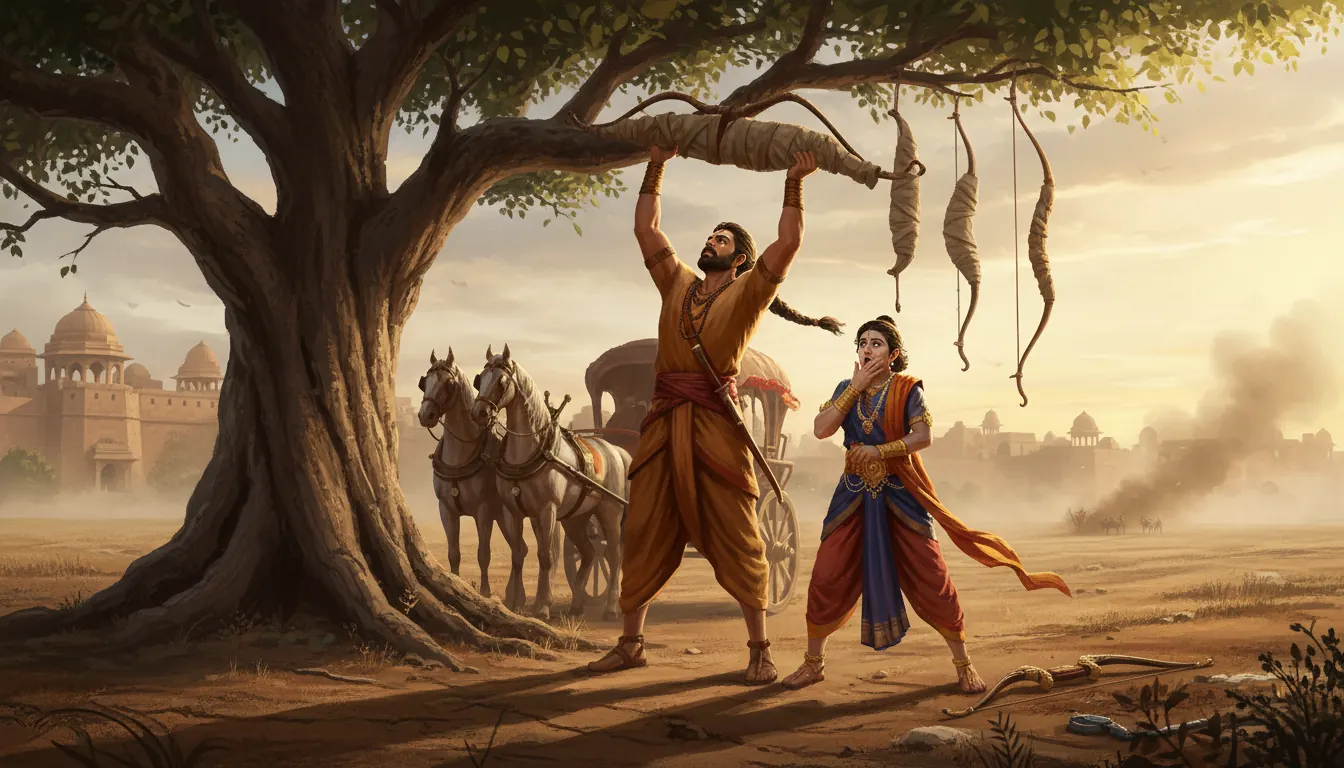
They reached the shami. It was an old tree with thick foliage, standing where such trees stand, at the edge of a cemetery where nobody goes without a reason, and there was a long bundle wrapped and lashed high in its branches.
Arjuna looked at the delicate, inexperienced boy beside him and gave him something to do.
"Do as I tell you, Uttara, and quickly bring down some bows that are up there. These bows of yours cannot bear my strength, or my heavy weight when I crush horses and elephants, or the stretch of my arms when I set out to defeat the foe. So, Bhuminjaya, climb this leafy tree. For in this tree are tied the bows and the arrows and the banners and the fine coats of mail of the heroic sons of Pandu: of Yudhishthira, and Bhima, and Bibhatsu, and the twins.
"Arjuna's bow is there too, the Gandiva, a bow of great power, which alone is equal to many thousands of other bows and can push out the borders of a kingdom. It is as big as a palmyra tree and can bear the greatest strain. It is the largest of all weapons, able to hold back any foe, handsome and smooth and broad, without a knot, adorned with gold, stiff and beautifully made, and it can bear the heaviest weight. And the other bows there, of Yudhishthira and Bhima and Bibhatsu and the twins, are just as mighty and tough."
He said it all in the light, high voice he had been using for a year, sitting in the driver's place in a woman's red garments with his braid over his shoulder, and the prince heard the names of the five vanished brothers of Kuru come out of that mouth and did not think about it at all, because he had noticed something else about the tree.
There Are Only Bows in This Tree
"We have heard that there is a corpse tied in this tree," Uttara said. "So how can I, a prince by birth, touch it with my hands? I was born a kshatriya, the son of a great king, and I always keep my mantras and vows, so it is not fitting for me to touch it. Why should you, Brihannala, make me unclean and polluted, a carrier of corpses, by forcing me to touch a dead body?"
It was not superstition, and it was not a mistake. It was the exact rumour the Pandavas had planted a year ago, when they came down out of the woods and had to hide five arsenals in a country where a man carrying Gandiva would be known within the hour. Nakula had gone up this tree and lashed the bows and the swords and the quivers to the parts of it that would not break and where the rain would not reach. Then they had hung a corpse up beside them, so that anyone who caught the stench would say, here surely is a dead body, and keep well away; and when the shepherds and the cowherds asked about it, they answered that it was their mother, aged one hundred and eighty years, hung up in a tree according to the custom observed by their forefathers. The story had held for twelve months. It was holding now, against the man who had invented it.
"King of kings, you will stay clean and unpolluted," said Brihannala. "Do not be afraid. There are only bows in this tree, not corpses. You are heir to the king of the Matsyas and born of a noble family. Why would I make you do something so shameful, prince?"
So the son of Virata, with his earrings on, got down from the chariot and climbed the tree, reluctantly, and the charioteer stayed where he was and called up to him to be quick about it.
The boy cut the wrappings first, and then the ropes with which the weapons were tied, and the bundle came open in the branches.
Five bows came into the light together. They began to blaze, radiant as the sun, like the planets shining at their rising, and their shapes were like sighing snakes, and Uttara sat in the fork of that tree with his hands on them and the hair on his body stood on end.
Whose Is This Bow?
He brought them down and laid them out, and then he could not stop asking.
"Which famous warrior owns this splendid bow, with a hundred golden bosses and such shining ends? Whose is this handsome bow, with smooth sides and an easy grip, on whose staff golden elephants shine so brightly? Whose is this bow, adorned with sixty Indragopakas of pure gold, set at proper intervals along the back of the staff? Whose is this bow with three blazing golden suns on it, flashing so brilliantly? Whose is this beautiful bow, bright with gold and gems, with golden insects set with beautiful stones?
"Whose are these arrows, feathered all round, a thousand of them, with golden heads, in golden quivers? Who owns these great arrows, so thick, with vulture feathers, whetted on stone, yellowish, sharp-pointed, well-tempered and made entirely of iron? Whose is this black quiver with five tigers on it, holding arrows mixed with boar-eared ones, ten in all? Whose are these seven hundred arrows, long and thick, made to drink the enemy's blood, shaped like the crescent moon?
"Whose is this excellent sword, irresistible and terrible to enemies, marked with a toad and with its point shaped like a toad's head? Whose is this great sword with its fine blade in a bright sheath of tiger-skin, chased with gold and hung with tinkling bells? Whose is this handsome scimitar with a polished blade and a golden hilt? Whose is this sword of polished blade in a cow-skin scabbard, made in the country of the Nishadas, irresistible and unbreakable? Whose is this beautiful long sword, dark as the sky, mounted with gold, well-tempered, in a sheath of goat-skin?
"I am asking you, Brihannala: tell me the truth. I am filled with wonder at the sight of all these splendid things."
Brahma Held It First for a Thousand Years
"The first one you asked about is Arjuna's bow, known throughout the world, called Gandiva, which can lay waste enemy hosts. It alone is equal to a hundred thousand weapons, and it can always push out the borders of kingdoms, and with it Partha defeats men and gods alike in battle. Always worshipped by the gods, the Danavas and the Gandharvas, this large, smooth bow has no knot or flaw anywhere.
"Brahma held it first for a thousand years. After him Prajapati held it for five hundred and three years. Then Shakra, for eighty-five years. And then Soma held it for five hundred years. And after that Varuna held it for a hundred years. And finally Partha, called Swetavahana, has held it for sixty-five years. Partha got this beautiful bow from Varuna."
The prince was counting on his fingers, and the sums were not the sums of any man's life.
"This other bow with handsome sides and a golden handle is Bhima's, with which that son of Pritha conquered all the eastern lands. This other excellent, beautifully shaped bow, adorned with Indragopakas, belongs, son of Virata, to King Yudhishthira. This other weapon, with its blazing golden suns throwing a dazzling light around, belongs to Nakula. And this bow, adorned with golden insects and set with gems and stones, belongs to the son of Madri called Sahadeva."
Five bows on the grass under a shami tree, and a name attached to every one of them, and every name a man who had disappeared from the world thirteen years ago, and the person reciting them did it the way a housekeeper recites the contents of a store-room.
The Arrows and the Swords
"These feathered arrows, a thousand of them, sharp as razors and deadly as snake poison, belong to Arjuna. When he shoots them at his foes in battle, these swift arrows blaze more brightly, and never run out.
"And these long, thick arrows, shaped like the crescent moon, keen-edged and able to thin the enemy's ranks, belong to Bhima. And this quiver with five tigers on it, full of yellowish arrows whetted on stone and fitted with golden feathers, belongs to Nakula. This is the quiver of the wise son of Madri, with which he conquered all the western lands in battle. And these arrows, all shining like the sun, painted all over in many colours, able to destroy enemies by thousands, are Sahadeva's. And these short, thick, well-tempered arrows with long feathers and golden heads, each with three knots, belong to King Yudhishthira.
"And this sword, with its long blade engraved with a toad and its head shaped like a toad's mouth, strong and irresistible, belongs to Arjuna. This sword in a tiger-skin sheath, long-bladed, handsome, irresistible and terrible to enemies, belongs to Bhimasena. This handsome sword with an excellent blade, in a well-painted sheath, with a golden hilt, belongs to the wise Kaurava, Yudhishthira the just. And this sword with a strong blade, irresistible and made for many fine styles of fighting, in a goat-skin sheath, belongs to Nakula. And this huge scimitar in a cow-skin sheath, strong and irresistible, belongs to Sahadeva."
The prince listened to a dancing master go through a dead family's armoury item by item, in order of seniority, without once hesitating over which brother owned which knife.
I Would Believe It If
"These gold-adorned weapons of quick-handed, great-souled Partha are very beautiful indeed," Uttara said slowly. "But where are Arjuna, the son of Pritha, and Yudhishthira of the Kuru race, and Nakula, and Sahadeva, and Bhimasena, the sons of Pandu? The great-souled Pandavas, who could destroy any foe, lost their kingdom at dice and have not been heard of since. And where is Draupadi, the princess of Panchala, famed as the jewel among women, who followed the sons of Pandu to the forest after they lost at dice?"
"I am Arjuna, also called Partha," said the charioteer. "Your father's courtier is Yudhishthira. Your father's cook Vallava is Bhimasena. The groom of the horses is Nakula, and Sahadeva is in the cow-pen. And know that the sairindhri is Draupadi, for whose sake the Kichakas were slain."
The boy stood among the bows with the Kuru army half a day's arrow-flight behind him and did not fall at anyone's feet.
He had been raised on those five names. Everybody had. The whole world had been telling the story of the sons of Pandu for thirteen years, and half of the world was quite sure they were dead, and here in a cemetery a person in a woman's clothing had just claimed all five of them and a princess of Panchala as well. The prince did what a kshatriya should do with a claim, which is ask it for its proof.
"I would believe all this," Uttara said, "if you can tell me the ten names of Partha that I have heard before."
Every Name a Deed
"Son of Virata, I will tell you my ten names. Listen, and compare them with what you have heard before. They are Arjuna, Falguna, Jishnu, Kiritin, Swetavahana, Bibhatsu, Vijaya, Krishna, Savyasachin and Dhananjaya."
"Tell me truly why you are called Vijaya, and why Swetavahana. Why are you named Krishna, and why Arjuna, and Falguna, and Jishnu, and Kiritin, and Bibhatsu, and why are you Dhananjaya and Savyasachin? I have heard before how that hero came by each of his names, and I can trust your words if you can tell me all about them."
So he told him, and every name turned out to be a piece of a life.
"They called me Dhananjaya because I lived surrounded by wealth, after conquering every country and carrying off its treasures. They called me Vijaya because when I go out to fight invincible kings, I never come back from the field without defeating them. I am called Swetavahana because when I fight the enemy, white horses in golden armour are always yoked to my chariot. They call me Falguna because I was born on the slopes of the Himavat on a day when the constellation Uttara Falguna was rising. I am named Kiritin for a diadem, bright as the sun, that Indra placed on my head long ago when I fought the powerful Danavas. I am known as Bibhatsu among gods and men because I have never done a hateful deed on the battlefield. And since both my hands can draw the Gandiva, I am known as Savyasachin. They call me Arjuna because my complexion is very rare within the four boundaries of the earth, and because my acts are always spotless. Among humans and gods I am known by the name of Jishnu, because I am unapproachable and cannot be kept down, a tamer of enemies, and the son of the slayer of Paka. And Krishna, my tenth name, was given to me by my father out of love for his dark-skinned boy of great purity."
The prince came nearer, and saluted him.
"My name is Bhuminjaya, and I am also called Uttara. By good luck, Partha, I see you. Welcome, Dhananjaya. Red-eyed one, whose mighty arms are each like an elephant's trunk, please forgive what I said to you in ignorance. Since the feats you have done before have been so wonderful and so hard, my fears are gone, and the love I feel for you is great."
Then he took up the reins himself, and asked the only question that was left.
"Hero, mount this great chariot with me as your driver: which division of the enemy army would you break into? Command me, and I will drive you there."
Dharma Lesson
A name earned is a record of deeds, and a man who can account for all of his is telling the truth about himself. Uttara does not accept the claim because it is impressive; he asks for the ten names and then for the reason behind every one, and only when each is answered does he salute. Proof of identity in this world is not a face or a weapon but a life that can be recited from end to end without a gap.