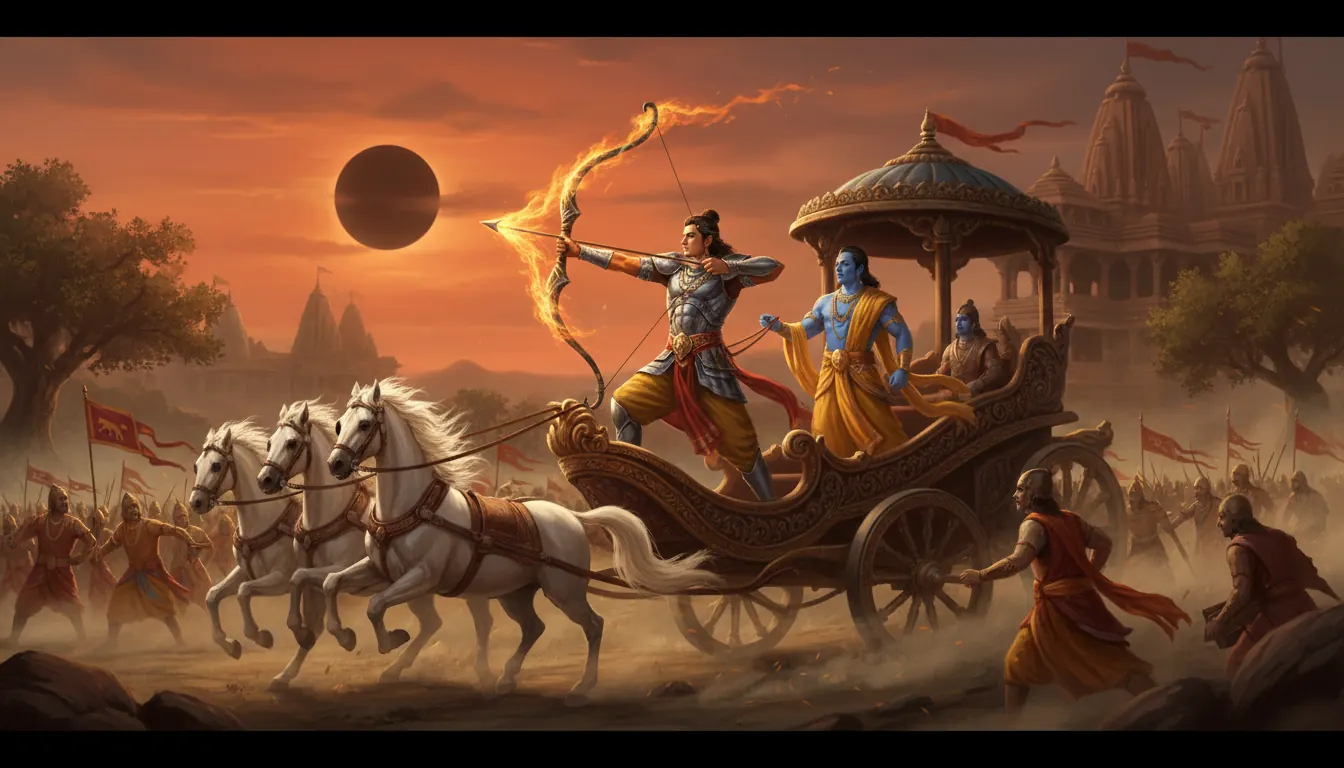
The Field Krishna Showed Him
Arjuna is driven at a walk over the ground he has won, and Yudhishthira answers with a hymn
In short
With Jayadratha dead and the sun already down, Krishna embraces Arjuna in the front of the battle and then drives him slowly across the wreckage of the day, naming the ornaments, the weapons, the elephants and the kings that lie on it, and reminding him twice whose shafts did it. Then he blows Panchajanya and carries the news to Yudhishthira. The king comes down from his chariot in tears, embraces the two Krishnas, and answers with a hymn that climbs from his own small victory back to the dark water before the world began. Bhima and Satyaki come in last, cut to pieces, and are told at last what their crossing was worth.
Told in the Drona ParvaSet in Kurukshetra21 min read
The Question About Bhima
Dhritarashtra had heard how the ruler of the Sindhus was killed. What he wanted now was the part of the afternoon he had not been told.
"While the battle stood like that," he said, "between those heroes of theirs and mine, what did Bhima do? Tell me everything, Sanjaya."
Sanjaya said: "Once Bhimasena had lost his chariot, the hero, stung by Karna's taunts and filled with rage, went to Phalguna."
It was still the fourteenth day, and the light was going. Bhima had no chariot under him. He had beaten Karna off the field more than once that afternoon and had been beaten in his turn, and at the end of it Karna had stood over him with the horn of his bow and made a speech about eunuchs and gluttons in front of two armies. Wounds close. That did not.
So he came to his brother and asked for the only remedy there was.
"Right in front of you, Dhananjaya, Karna has called me again and again: eunuch, fool, glutton, unskilled in weapons, do not fight, child, unable to bear the burden of battle. Whoever says that to me will be slain by me. Karna has said those words to me, Bharata. Mighty-armed one, you know the vow I made together with you. Remember the words I spoke then. Best of men, son of Kunti, act so that my vow, and your own vow too, may not be made false. Do whatever will make my vow come true."
Arjuna had killed Jayadratha inside the hour. He had a bow in his hand and a god driving his horses and the sun almost down, and his brother was asking him for something that could not be given with a weapon, only with a witness.
He turned the chariot and went to find Karna.
Said Aloud, Where the Troops Could Hear
He did not shoot. He got near enough to be heard, and spoke.
"Karna, you fight falsely. Son of a suta, you sing your own praises. You with your wicked mind, listen to what I tell you. Heroes meet one of two things in battle, victory or defeat. Both are uncertain, son of Radha. It is no different when Indra himself goes into battle."
Then he reminded the man of the hour he had just lived through. Satyaki, the grandson of Shini, had smashed Karna's chariot to pieces earlier that same evening and had let him walk away from the wreck.
"When Yuyudhana took your chariot from you, you lost control of your senses and were almost at the point of death. But that hero remembered that I had vowed to kill you, and he let you go without taking your life. It is true you managed to take Bhimasena's chariot from him. But your abuse of that hero, son of Radha, was sinful. Men who are truly righteous and brave never boast once they have beaten a foe, and never speak ill of anyone. Your understanding, though, is small. That is why, son of a suta, you make speeches like these.
"In full view of all the troops, of Keshava and of me, Bhimasena left you without a chariot in battle many times. Yet that son of Pandu never said a single harsh word to you."
That was the whole of what Bhima had wanted, and it was said where the armies could hear it. Arjuna did not stop there.
"Because you have spoken so many harsh words to Vrikodara, and because you and others killed the son of Subhadra when I was not there to see, today you will reap the fruit of those offences. It was for your own destruction, you wicked creature, that you cut Abhimanyu's bow that day. I will kill Vrishasena in battle before your very eyes. I say this truly, with my hand on my weapon."
Vrishasena was Karna's son. A father who had helped kill another man's son had just been told the day and the manner.
A huge, deafening uproar went up from the chariot-warriors of both armies. And at that frightful time, with confusion everywhere, the thousand-rayed sun dimmed his rays and went down behind the western hill.
By Good Luck, Jishnu
Krishna halted the chariot at the front of the battle, in front of everybody, and put his arms around Arjuna.
"By good luck, Jishnu, your great vow has been fulfilled. By good luck, Vriddhakshatra has been slain along with his son."
Vriddhakshatra was Jayadratha's father, the old king of the Sindhus, who had once laid a curse on whoever should make his son's head fall to the ground. Arjuna had shot the severed head through the air into the old man's lap where he sat at his evening prayers, and when Vriddhakshatra rose and it rolled off his knees, the curse took the man who had made it. Two Sindhu kings in one motion, and Krishna counted them both in a single breath.
"The commander of the gods himself, Bharata, would lose his senses in battle facing the army of Dhritarashtra's sons. I have no doubt of that. Apart from you, best of men, I cannot imagine anyone in the three worlds who could fight this host. Many royal warriors of great prowess, your equals or your betters, have joined together at Duryodhana's command. Yet even in their armour they could not stand against you once they met your anger in battle. Your energy and might are equal to Rudra's or the Destroyer's. No one else could show the prowess in battle that you, scorcher of foes, showed today, alone and without support."
Then he said the thing that told Arjuna the war was not over.
"I will praise you like this again once wicked Karna has been slain along with his followers. I will glorify you like this when that enemy of yours has been defeated and slain."
Arjuna gave the praise straight back.
"By your grace, Madhava, I have fulfilled this vow that even the gods would have found hard to keep. It is no wonder at all that those who have you, Keshava, for their lord should win. By your grace, Yudhishthira will win the whole earth. All this is due to your power, you of the Vrishni race. This victory is yours, lord. Our prosperity is your care, and we are your servants, slayer of Madhu."
Krishna smiled softly and did not argue with him, and took up the reins, and urged the horses slowly on.
The Slow Drive
He did not take him back to the camp. He drove him over the ground.
The horses went at a walk, because there was no other pace possible on that surface, and because Krishna wanted him to see it. Arjuna had spent the whole day inside a wall of dust with a bow in his hands, shooting into whatever came, breaking three armies open to get at one man before the sun went down. He had not once looked at what was behind him.
"Many heroic kings who wanted victory in battle or fame across the world," Krishna said, "are lying on the earth, struck by your arrows."
That is how the description begins, and the last three words of it are the ones that matter. Not lying on the earth. Struck by your arrows.
"Their weapons and ornaments lie scattered, and their horses, chariots and elephants are mangled and broken. Their coats of mail are pierced or split open, and they have come to the greatest grief. Some of them are still alive, and some are dead. But the dead still seem alive, because of the splendour that is on them."
That is the first strange thing about the field at dusk. The dead did not look dead. They were kings, and they had come out that morning dressed as kings, and the ornaments were still burning in the last of the light on men who had stopped breathing an hour before. A man riding past could not tell, without getting down, which of the shining figures on the ground still had somebody inside it.
"Look at the earth, covered with their gold-winged arrows, with their many other weapons of attack and defence, and with their lifeless animals."
The horses walked. Krishna held the reins loose and went on naming what they were passing, and he named it the way a man reads out the contents of a treasury, item by item, because that is what it had been at sunrise.
The Inventory of the Ground
"The earth is glittering with coats of mail and necklaces of gems, with heads still wearing earrings and headgear and diadems, with flower garlands and jewels from crowns, with Kanthasutras and Angadas, collars of gold, and every other kind of beautiful ornament."
Kanthasutras are the strings worn at the throat. Angadas are the ornaments clasped on the upper arm. They were still on the arms.
"It is strewn with Anuskaras and quivers, with standards and banners, with Upaskaras and Adhishthanas, with chariot poles and chariot crests, with broken wheels and beautiful Akshas in heaps, with yokes and horse trappings, with belts, bows and arrows. There are elephant housings, spiked maces and iron hooks, darts and short arrows, spears and pikes, Kundas and clubs, Sataghnis and Bhushandis, scimitars and axes, short heavy clubs and mallets, maces and Kunapas, and whips trimmed with gold, bull of the Bharatas. There are the bells and the many other ornaments of mighty elephants, flower garlands and every kind of decoration, and costly robes, all loosened from the bodies of men and animals. Covered like this, the earth shines brilliantly, like the autumn sky with its planets and stars."
That is the whole list, and in the telling the whole list runs on in a single breath, and it ends in the sky.
It is worth noticing the order of it. Krishna began with the ornaments men wear on their bodies and moved outward through the parts of chariots, the axles and yokes and crests and the beautiful Akshas, and then through every kind of weapon the age possessed, the Sataghni that is said to kill a hundred, the Bhushandi, the iron hook used on elephants, and then the bells that hang on an elephant's flanks, and then the garlands, and then the clothes, which had come off the bodies of men and animals both. Everything that had been fastened to something living that morning was loose on the ground by dark.
And the ground, so covered, was beautiful. He said so. Like the autumn sky when the rains have washed it and every planet and every star is out at once.
Arjuna was being asked to look at the most beautiful thing he had ever made.
Clasping the Earth Like a Dear Wife
"The lords of the earth, slain for the sake of the earth, are sleeping on the earth, holding the earth in their arms like a dear wife."
They had come for land. They had it.
"These elephants, like Airavata himself and huge as mountains, are pouring streams of blood from the wounds the weapons made, like mountains pouring streams of liquid chalk through their caves and cracks. Look, hero, at those huge creatures wounded by arrows, lying on the ground in convulsions. Look too, Partha, at those chariots without riders or drivers, which once looked like celestial vehicles or the misty shapes of the evening sky, now lying with their standards, banners and yokes cut to pieces. And foot-soldiers, hero, armed with bows and shields, slain in hundreds and thousands, are lying on the ground bathed in blood, holding the earth with every limb, their hair smeared with dust."
Then, in the middle of it, the two words that turn the whole speech.
"Look, mighty-armed one, at those warriors whose bodies your weapons have mangled."
Your weapons. He had said it at the opening and he said it again here, in case the beauty of the thing had begun to do its work.
"Look at the earth strewn with yak-tails and fans, umbrellas and standards, horses and chariots and elephants, blankets and reins and beautiful robes and costly Varuthas, so that it looks as if it were spread with embroidered tapestry. Many warriors who fell from the backs of well-equipped elephants, together with the beasts they rode, look like lions fallen from mountain summits that thunder has struck down.
"Look, best of men: the face of the earth is frightful to see, covered with heaps of slain elephants and horses and chariot-warriors, a mire of blood, fat and rotting flesh, where dogs and wolves and Pishachas and every kind of night-wanderer are bounding about in joy."
The jackals had not waited for the war to end. They were out among the ornaments already, and they were the only creatures on that field who were happy.
"This mighty, fame-winning feat on the battlefield could be done only by you, mighty one, or by Indra, the chief of the gods, who slays the Daityas and Danavas in great battles."
Then Krishna took up Panchajanya and blew it over the field he had just finished describing, and the delighted soldiers of the Pandava army blew their conches in answer, and the horses were turned toward the place where the king was.
The King Came Down From His Chariot
Yudhishthira, whom men called Ajatashatru because no living creature had ever been able to call itself his enemy, had spent that day at the head of a broken line, listening to rumours. Twice the shouting had made him think Arjuna was dead. He had sent Satyaki after him and then Bhima after Satyaki, and had been left standing in front of Drona with none of his best men beside him.
Now the chariot with the ape on the banner came in out of the dark, and Krishna got down and paid his respects to him first, with a glad heart.
"By good luck, king of kings, your fortunes are rising. Best of men, your foe has been slain. By good luck, your younger brother has fulfilled his vow."
The king came down off his own chariot. He was crying and did not trouble to hide it. He embraced the two Krishnas, dark Vasudeva and his friend who was called Krishna as well for the colour of him, and he wiped his bright lotus-like face and found his voice.
"Mighty chariot-warriors, by good luck I see you both, with your task done. By good luck, that sinful wretch, the ruler of the Sindhus, has been slain. Krishnas, by good luck you have done what has filled me with great happiness. By good luck, our foes have been plunged into an ocean of grief."
Four times in four sentences: by good luck. It is the phrase a man uses when he has spent all day sitting with the other possibility.
Then, still holding the two of them, he stopped speaking to his brother altogether and began to speak only to Krishna, and what came out was not thanks. It was a hymn.
"You are the sovereign lord of all the worlds, slayer of Madhu. In the three worlds, nothing is out of reach for those who have you as their teacher. By your grace, Govinda, we will conquer our foes, as Indra conquered the Danavas long ago."
Nobody had asked him for this. He was standing on a battlefield in the dark with the smell of it around him and his brother alive in front of him, and he went on for as long as it took.
What Yudhishthira Sang
"Whether it is the conquest of the world or the conquest of the three worlds, everything is certain, you of the Vrishni race, for those with whom you are pleased. They can have no sin, and they cannot be defeated in battle, giver of honours."
He began with his own case, and then went outward, and the further out he went the older his examples became.
"It is by your grace, Hrishikesha, that Shakra became chief of the gods and won the sovereignty of the three worlds on the battlefield. It is by your grace that the gods won immortality and enjoy the eternal regions. Shakra killed thousands of Daityas with a prowess that came from your grace, and so won lordship over the gods."
Shakra is Indra, the god of victory in battle. Yudhishthira was pointing out that the greatest warrior of the three worlds had also owed his day to somebody else.
"By your grace, Hrishikesha, the whole universe, moving and unmoving, keeps to its appointed course and is busy with prayers and homa. In the beginning this universe was wrapped in darkness, one vast expanse of water. By your grace, mighty-armed one, best of men, the universe became manifest."
He had gone back past Indra now, past the gods altogether, to the dark water before there was anything at all.
"You are the creator of all the worlds, you are the Supreme Soul, and you are unchanging. Those who see you, Hrishikesha, are never bewildered. You are the Supreme God, the God of gods, and you are Eternal. Those who take refuge in you are never bewildered. Without beginning and without death, you are Divine and unchanging. Those who are devoted to you always come through every difficulty. You are Supreme, the Ancient One, the Highest of the high. You are sung in the four Vedas. The four Vedas sing of you.
"You are the lord of winged creatures and the lord of all human beings. You are the Supreme Lord of everything. I bow to you, best of beings. Prosperity to you, Madhava. Large-eyed one, Universal Soul, you are the origin of all things."
And having climbed to the origin of all things, he came down in one step to the only thing he had been thinking about since morning.
"And whoever is Dhananjaya's friend, or works for Dhananjaya's good, reaches you, Dhananjaya's teacher, and finds happiness."
The whole hymn had been about his brother coming back.
It Was Your Wrath That Did It
When he had finished, the two of them answered him together, and they turned his argument round and handed it back to him.
"The sinful king Jayadratha has been burned up by the fire of your wrath."
Not by Gandiva. By the anger of a man who had not been within a mile of the killing.
"Mighty one, the army of Dhritarashtra's sons is vast and swollen with pride, and yet, Bharata, it is being struck down and wiped out. Slayer of foes, it is because of your wrath that the Kauravas are being destroyed. Wicked Suyodhana has angered you, who can kill with your eyes alone, and with his friends and kinsmen he will have to lay down his life in battle."
Then they named the proof, and the proof was lying four days behind them at the edge of the field, where it had fallen on the tenth evening.
"Struck down before this by your anger, and by the gods themselves, the invincible Bhishma, grandsire of the Kurus, now lies on a bed of arrows. Slayer of foes, those who have you for their enemy cannot win in battle, and death is waiting for them. Kingdom, life, loved ones, children and every kind of joy will soon be lost to the man you are angry with, scorcher of foes. I count the Kauravas as lost, with their sons and kinsmen, now that you, who keep the duties of a king, are angry with them."
This is a strange thing to say to Yudhishthira, and they said it deliberately. He was the one who had not wanted the war. He had asked for five villages. Of every man on that field he was the least likely to be described as a fire, and here were the two greatest bowmen in the world telling him that all of the last fourteen days had been his doing, because he was the king, and because a king who has been wronged and does not forgive is a slower and more complete weapon than any archer.
He had just spent a hymn insisting that nothing was his.
They spent their answer insisting that all of it was.
Neither side of that exchange was flattery. It is simply how those three men understood the war.
The Two Who Came Back Out of the Sea
Then two more men came in out of the dark, and both of them were cut to pieces.
Bhima and Satyaki had been sent across the whole Kaurava army that afternoon, one after the other, to reach Arjuna, and had been fighting ever since without knowing whether he lived. They saluted their senior, and then those two mighty bowmen sat down on the ground, torn by arrows, and the Panchalas gathered round them.
Yudhishthira looked at the pair of them in the dirt with their hands joined, and he found the same phrase again.
"By good luck I see you both, heroes, come out alive from that sea of enemy troops, the sea in which Drona played the invincible alligator and the son of Hridika the fierce shark."
Kritavarma, the son of Hridika, was the Vrishni who had taken Duryodhana's side while his own kinsman Satyaki fought for the Pandavas, and it was he who had held the mouth of that formation against both of them in turn. The king went through the whole crossing as though he had watched every yard of it.
"By good luck, you two have defeated all the kings of the earth. By good luck, Drona has been defeated in battle, and that mighty chariot-warrior, the son of Hridika, too. By good luck, Karna has been defeated with barbed arrows. By good luck, you both forced Shalya to turn away from the field, bulls among men. By good luck, I see you come back safe and sound, finest of chariot-warriors, so skilled in battle.
"By good luck I see you again, heroes, who crossed that sea of troops because I commanded it, who went into battle out of your wish to honour me."
That is the sentence that cost him something. He had sent them, over the objection of the man he gave the order to, and had spent every hour since not knowing what it had bought.
"You are heroes who delight in battle. You are as dear to me as life. By good luck, I see you both."
With that, the son of Pandu embraced both Yuyudhana and Vrikodara, those tigers among men, and shed tears of joy.
Then the whole Pandava host grew cheerful and filled with joy. And all of them once more set their hearts on battle.
It was full night by then. The fourteenth day had ended long ago by the sun, and nobody on either side had left the field.
Dharma Lesson
Krishna does not hide the field from Arjuna and he does not apologise for it. He drives him across it at a walk, names every ornament and every broken thing on it, calls the whole ruin as beautiful as the autumn sky, and twice in the middle of that beauty says that these are men his listener's own shafts brought down. A victory a man cannot bear to look at afterwards was not worth the winning, and a man who refuses to look at his is not yet done with it. Yudhishthira's hymn is the other half of the same lesson: having got everything he wanted that day, he stood in the dark and gave the credit away, and the two who had done the killing turned round and gave it straight back to him.