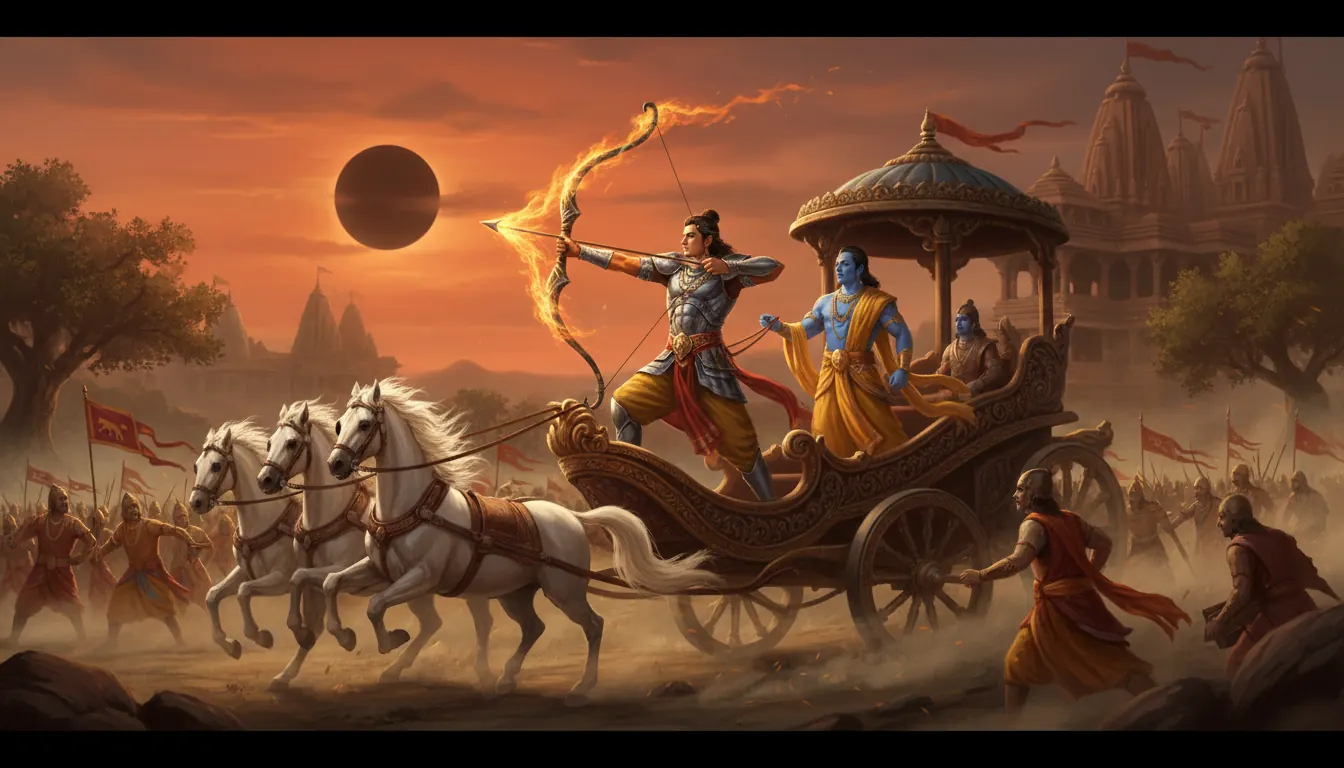
Bhima's Harvest on the Fourteenth Evening
Drona takes the head of the king of Sivi, and Bhima kills with his fists, his palm and a caught dart until the kings call him Rudra
In short
On the night that would not end after Jayadratha's death, Drona grinds through the Kaikeyas and the sons of Dhrishtadyumna and cuts off the head of King Sivi with its headgear still on. Bhima answers by leaping onto enemy chariots and killing the son of the king of the Kalingas with his fists, Dhruva with one blow and Jayarata with a slap of his palm in Karna's sight, and when Karna hurls a gold-decked dart at him he catches it in his hand and throws it back. He stamps the chariot of Durmada and Dushkarna into the ground, crushes them, and kills Karna's brother Vrikaratha, Satachandra and five brothers of Shakuni, while Yudhishthira empties the field of the allied tribes and answers Drona weapon for weapon down to the Brahma weapon itself.
Told in the Drona ParvaSet in Kurukshetra, Kalinga and Sivi (Usinara)17 min read
The Question He Kept Asking
Dhritarashtra had been asking the same thing all evening in different words, and Sanjaya kept answering it.
"When the invincible Drona, of boundless energy, unable to bear the killing of Jayadratha, plunged in anger into the midst of the Srinjayas," the old king said, "what did all of you think? Who followed that boon-giving hero, that greatest of the twice-born? Who stood behind him while he fought? Who fought in front of him while he was slaughtering? I think all the Pandavas, stricken by the arrows of Bharadwaja's son, were like thin cattle trembling under a wintry sky."
Then the question underneath the others, the one he came back to. "You say that my troops were killed, or huddled together, or defeated, and that my chariot warriors lost their chariots. You say the Pandavas were in good heart and full of hope, and that mine were gloomy and heartless and panic-stricken. How, Sanjaya, could you tell the Kurus from the Parthas who never retreated, on that night?"
It was a fair question, because there was no light to mark anything by. The fourteenth day had not stopped at sunset. Jayadratha was dead and Bhurishravas was dead and the sun had gone down on both of them, and neither army had left the field. The world was enveloped in darkness and nothing could be noticed. Jackals yelled with blazing mouths. Owls perched on the Kaurava standards and hooted from them. Friends could not be distinguished from foes, and every man out there was possessed with a kind of madness.
What light there was came off the men themselves. Golden coats of mail, angadas, ear-rings, the bright ornaments of the warriors, so that the Bharata host at dead of night looked like the firmament bespangled with stars, and swords and maces and axes as they fell looked like dazzling flashes of fire.
"In the course of that fierce night battle," Sanjaya said, "the Pandavas and the Somakas all rushed at Drona."
That is where the answer begins, and it does not begin well for the Pandavas.
The Head with the Head-Gear On
Drona was in the middle of them by then, and what he was doing was not a duel. It was grinding.
With his swift arrows he sent all the Kaikeyas into the world of spirits, and after them the sons of Dhrishtadyumna, boys of the Panchala house who had come at him because their father was somewhere ahead in the dark doing the same thing. Every mighty chariot warrior who advanced straight at Drona, every one of those lords of the earth, was sent on to the land of the dead. On that night alone, Sanjaya said, Drona's arrows pierced elephants by the thousand and chariots by the ten thousand, and foot soldiers and horses beyond counting.
Into that came the king of Sivi.
Sivi is a small hill kingdom of the northwest whose kings had a long name for generosity and a longer one for keeping their word, and its ruler had brought his men to Yudhishthira and had not so far been asked to do anything remarkable. He saw the teacher working through the Pandava line like a fire in dry grass, and he was filled with rage, and he went at him.
Drona pierced him with ten arrows made entirely of iron. Sivi pierced Drona in return with thirty, fletched with the feathers of the Kanka bird, and then, smiling all the while, he did the one thing that stops a great archer for a moment: with a broad-headed arrow he knocked the driver off the front of Drona's chariot.
For that moment the teacher had no one holding his reins.
He did not seem to need anyone. He killed Sivi's horses. He killed Sivi's driver. Then he cut Sivi's head from his body with the headgear still on it, the whole ornament of a king's rank going down into the churned ground with the man inside it.
Duryodhana, watching, quickly sent Drona a driver for his chariot. The reins were taken up by the new man, and Drona rushed once more against his foes, and the Pandava line in front of him went on coming apart.
The Son of the King of the Kalingas
Elsewhere on that field there was a young man looking for Bhima, and he had a reason.
Twelve days earlier, on the second day of the war, Bhima had gone into the Kalinga division alone and torn it open, and among the men he had killed there was the ruler of the Kalingas himself, a king of the eastern seaboard whose troops fought in a mass and did not scatter. The son of that king had spent the days since with that fact. Now, supported by the Kalinga troops, filled with rage at the slaughter of his father, he came at Bhimasena in the dark.
He shot well. He pierced Bhima with five arrows and then, correcting, with seven. He put three into Vishoka, who drove Bhima's chariot and who had been driving it since the war began, and one into the standard over Bhima's head.
Vrikodara did not answer with arrows.
He was filled with rage, and what he did was to leap from his own chariot onto his enemy's, across the space between two moving chariots in a night battle, and take that angry hero of the Kalingas with his fists alone. He had no weapon in his hands at all. When it was finished, the bones of that prince, slain in battle by the mighty son of Pandu with only his fists, fell down upon the earth separated from one another, and there was nothing on the floor of the chariot that could be lifted and carried home.
Karna saw it. So did the dead prince's brother, and neither of them could brook it. All of them began to strike Bhimasena with keen shafts resembling snakes of virulent poison, and Bhima was standing on a stranger's chariot in the middle of the Kaurava army with the arrows coming in from three sides.
He did not go back to his own chariot. He went forward, to the next one.
Two Chariots, and the Slap in Karna's Sight
The next chariot belonged to Dhruva, who had been striking him without pause through the whole of it.
Bhima left the dead Kalinga prince's chariot, crossed to Dhruva's, and crushed him with one blow of his fist. Struck like that by the mighty son of Pandu, Dhruva fell, and that was the whole of it.
When he had killed him, Bhimasena of great strength went on to Jayarata's chariot, and began to roar again and again like a lion.
That roar was a habit of his and it had a use. In a battle where friends could not be told from foes by sight, the voice carried, and men on both sides knew whose it was. Earlier that same day he had roared across the field so that Yudhishthira would know Arjuna was alive. On that chariot Bhima gave it again and again while he worked.
He dragged Jayarata to him with his left arm, still roaring, and he killed that warrior with a slap of his open palm in the very sight of Karna.
Karna had been shooting at him the whole time and had not stopped him, and now he was watching a man of his own side being killed by a hand, a few yards away, on a chariot that a moment ago had been full of the living. So Karna took up a dart decked with gold and hurled it at the son of Pandu.
It came out of the dark, from the man who was counted the greatest chariot warrior on earth, at a Bhima who had no bow in his hands and no chariot under him.
The Pandava, smiling the while, put out his hand and caught it.
The Dart He Threw Back
There is no comment in Sanjaya's account on how he did it. The dart was in the air and then it was in Bhima's fist, and the invincible Vrikodara, standing on the wreck of another man's chariot, turned and hurled that very dart back at Karna.
It went straight, and it would have arrived.
Shakuni saved him. The son of Subala, off to the side with his Gandhara horse, fixed a shaft that had drunk oil and cut the dart in two as it coursed towards Karna, and the pieces went down into the mud among the feet of the horses. That was the whole of Shakuni's part in this passage and it was the important one. Karna would live to the seventeenth day because a dice-player had a fast hand.
After these mighty feats in battle, Bhima, of wonderful prowess, came back at last to his own chariot, where Vishoka was still holding the reins with three arrows in him, and rushed against the Kaurava troops.
And while Bhima was advancing like this, slaughtering like the Destroyer himself in his rage, the sons of Dhritarashtra tried to hold that mighty-armed hero back. They knew what he had sworn about them. Every one of them who came out to meet him that night came knowing it, and Sanjaya, who had to describe them to their father afterwards, never once suggests that they hung back.
Those mighty chariot warriors covered him with a dense shower of arrows.
Bhima, smiling all the while, sent Durmada's driver and horses to the realm of Yama with his arrows, and left the prince standing in a chariot that could not move.
The Chariot He Put into the Ground
Durmada quickly climbed into the chariot of his brother Dushkarna.
Then those two scourges of their enemies, riding in the same chariot, both rushed at Bhima in the front rank of battle, like the Regent of the waters and Surya rushing together at Taraka, the greatest of the Daityas. They pierced him with arrows from the one chariot, two princes of the Kuru house on one floor, doing it properly, in front of the whole army.
They had an audience. Karna was there. So was Ashwatthama, and Duryodhana, and Kripa, and Somadatta, and Bahlika. Six of the greatest names on that side of the war were within sight of the thing that happened next, and none of them ever explained it.
The son of Pandu, that scourge of his enemies, with one stamp of his foot made the chariot of the heroic Durmada and Dushkarna sink into the earth.
The wheels went down and the floor went down and the two brothers were standing in the ground up to the axles with the horses screaming in the traces. Filled with rage, Bhima struck those mighty and brave sons of Dhritarashtra with his fists, and crushed them, and roared aloud.
Then cries of Oh and Alas arose among the troops.
And the kings, seeing Bhima, said to one another: "That is Rudra who is fighting in Bhima's form among the Dhartarashtras."
Saying those words they fled away, deprived of their senses, urging the animals they rode to their greatest speed, and Sanjaya adds the detail that tells you what kind of flight it was: no two of them could be seen running together. Each man went off alone into the dark in whatever direction he was facing.
When the carnage on that part of the field had spent itself, Vrikodara, with eyes beautiful as the full-blown lotus, was applauded by many bulls among kings, and he drove across to Yudhishthira and paid his regards to his brother.
The twins felt great joy. So did Drupada and Virata and the Kaikeyas, and Yudhishthira himself. All of them paid homage to Vrikodara, Sanjaya said, just as the gods did to Mahadeva after Andhaka had been slain.
Then the sons of Dhritarashtra, full of rage, with the teacher and a great number of chariots and elephants, surrounded Bhima on all sides, eager to fight, and it started again.
The Head That Went with the Mace
What came between was not Bhima's. It belonged to Ashwatthama, who spent the middle of that night alone against Ghatotkacha and a full akshauhini of rakshasas and burned them, and who at the end of it put a shaft through the chest of Bhima's son and left him to be carried off the field in somebody else's chariot. Drupada's sons died there, and the ten sons of Kuntibhoja, and Yudhishthira's chariot force turned away from the fight.
Seeing all that, Yudhishthira and Bhimasena and Dhrishtadyumna and Yuyudhana joined together and set their hearts firmly on battle.
Somadatta was waiting for Satyaki with an oath sworn on his dead son, and Bhima went in on Satyaki's side. He pierced the old Kuru hero with ten shafts; Somadatta answered him with a hundred. Then, fighting for Satyaki's sake, Bhimasena hurled at Somadatta's head a new and hard and terrible parigha, an iron-bound club made for breaking men, and Satyaki at the same instant shot at his chest a shaft equipped with goodly wings and resembling fire itself in splendour. The club and the arrow fell on that body together, and the old man went down.
His father came for them. Bahlika, son of Pratipa, the eldest man of the Kuru house still standing on a chariot, rushed at Satyaki scattering showers of arrows like a cloud in season, and Bhima put nine arrows into him to turn him. Bahlika, in a great fury, hurled a dart at Bhima's chest like Purandara hurling the thunderbolt, and Bhima was struck by it and trembled and fainted on the floor of his own chariot.
He recovered his senses. Then he took up a mace and threw it, and that mace snatched away the head of Bahlika, who fell down lifeless on the earth like a tree struck down by lightning.
Ten of Dhritarashtra's sons could not bear the slaughter of that bull among men. Nagadatta and Dridharatha and Viravahu and Ayobhuja and Dridha and Suhasta and Viragas and Pramatha and Ugrayayin came at Bhima together, each of them, Sanjaya says, equal to Rama the son of Dasaratha in prowess.
Bhima took up a number of arrows, each able to bear a great strain, aimed at one prince after another, and struck every one of them in a vital spot. They fell from their chariots, drained of energy and life, like tall trees broken off mountain cliffs by a tempest.
Karna's Brother, and the Five from Gandhara
He did not stop to be admired for it. With the ten princes still falling he turned and shrouded the favourite son of Karna with showers of arrows, and out of that shower came a man defending his nephew.
Vrikaratha was Karna's brother. Radha's sons were charioteers' sons, brought to this war by the one of them who had been made a king. Vrikaratha pierced Bhima with many arrows. The mighty Pandava, Sanjaya says without any elaboration at all, soon disposed of him effectually, and Karna, somewhere in the dark, had one brother fewer and no way to reach the place where it happened.
Then Bhima went into Shakuni's people.
He killed seven chariot warriors among the men of the king's brother-in-law, and then he came to Satachandra, who was the best of them, and did not shoot him. He pressed Satachandra down into the earth, the way he had pressed the chariot of Durmada and Dushkarna down into it, and left him there.
Five of Shakuni's brothers could not bear the killing of that mighty chariot warrior. They were Gavaksha and Sarabha and Bibhu and Subhaga and Bhanudatta, five great bowmen of the Gandhara house, and they rushed together at Bhimasena and attacked him with their sharp arrows like torrents of rain striking a mountain.
Bhima slew those five kings with five shafts.
Sanjaya gives it in that many words, one shaft for each brother, and then reports what it did to the men watching: seeing those heroes slain, many great kings began to waver. It was the second time that night that Bhima alone had made a line of kings think about their horses.
The King Who Emptied the Field
And then Yudhishthira, who had been holding the centre all night, was filled with wrath, and began to destroy the Kaurava ranks in the very sight of the Pot-born and of Dhritarashtra's sons.
The eldest brother is remembered as the man the others keep out of danger. What Sanjaya describes is a king going through allied nations one after another. With his arrows Yudhishthira sent to the realm of Yama the Ambashthas, the Malavas, the brave Trigartas, the Sivis. Cutting down the Abhishahas, the Surasenas, the Bahlikas and the Vasatis, he made the earth muddy with flesh and blood. In an instant he sent the Yaudheyas, the Malavas and great numbers of the Madrakas to Yama's realm. A loud uproar rose around his chariot, and in it could be heard, "Kill! Seize! Capture! Pierce! Cut to pieces!"
Duryodhana urged Drona at him, and Drona came.
He shrouded Yudhishthira with showers of shafts, and then, filled with great wrath, struck at him with the Vayavya, the weapon of the wind. The son of Pandu baffled that celestial weapon with a Vayavya of his own. Drona sped at him the Varuna and the Yamya, the Agneya, the Tvashtra and the Savitra, and the mighty-armed Pandava, conversant with morality, fearlessly baffled all of them, hurled or in the course of being hurled.
Then the Pot-born, striving to accomplish his vow and desirous of his king's good, invoked the Aindra and the Prajapatya. Yudhishthira invoked the Mahendra weapon and put them out. And Drona, seeing every weapon baffled, called up the Brahma weapon itself.
Enveloped as we then were by a thick gloom, Sanjaya said, we could not observe what passed. All creatures were filled with great fright. Seeing the Brahma weapon raised, Kunti's son checked it with a Brahma weapon of his own.
Then all the foremost warriors on both sides applauded those two bulls among men, the teacher and the pupil he had sworn to take alive, standing in the dark with the last weapons in the world put away between them.
Drona abandoned him and turned, with eyes red as copper, on the division of Drupada, and consumed it with the Vayavya until the Panchalas fled in the sight of Bhimasena and of Partha. The two brothers checked that flight, Bibhatsu attacking on the right and Vrikodara on the left, and the Kaikeyas and Srinjayas and Panchalas came after them with the Matsyas and the Satvatas.
And the Bharata host, slaughtered by the diadem-decked Arjuna and overcome now with sleep as much as with darkness, began to break. Drona tried to rally them. Duryodhana tried. The combatants, Sanjaya said, were incapable of being checked in their flight.
Dharma Lesson
Every feat in this stretch of the night is done with something other than a weapon: fists, an open palm, a stamped foot, a dart caught out of the air and sent back. That is the point the frightened kings make when they call Bhima Rudra and scatter without waiting for one another. A man who does not need his bow cannot be disarmed, and an enemy who has nothing left to take away from you is the most dangerous kind. The other half of the night says something quieter. Yudhishthira, the brother everyone protects, empties a stretch of the field of four nations and then stands alone against his teacher through the Varuna, the Agneya, the Aindra and the Brahma weapon and gives up nothing, and the armies applaud them both. Strength that has been kept in reserve is not the same as strength that is absent.