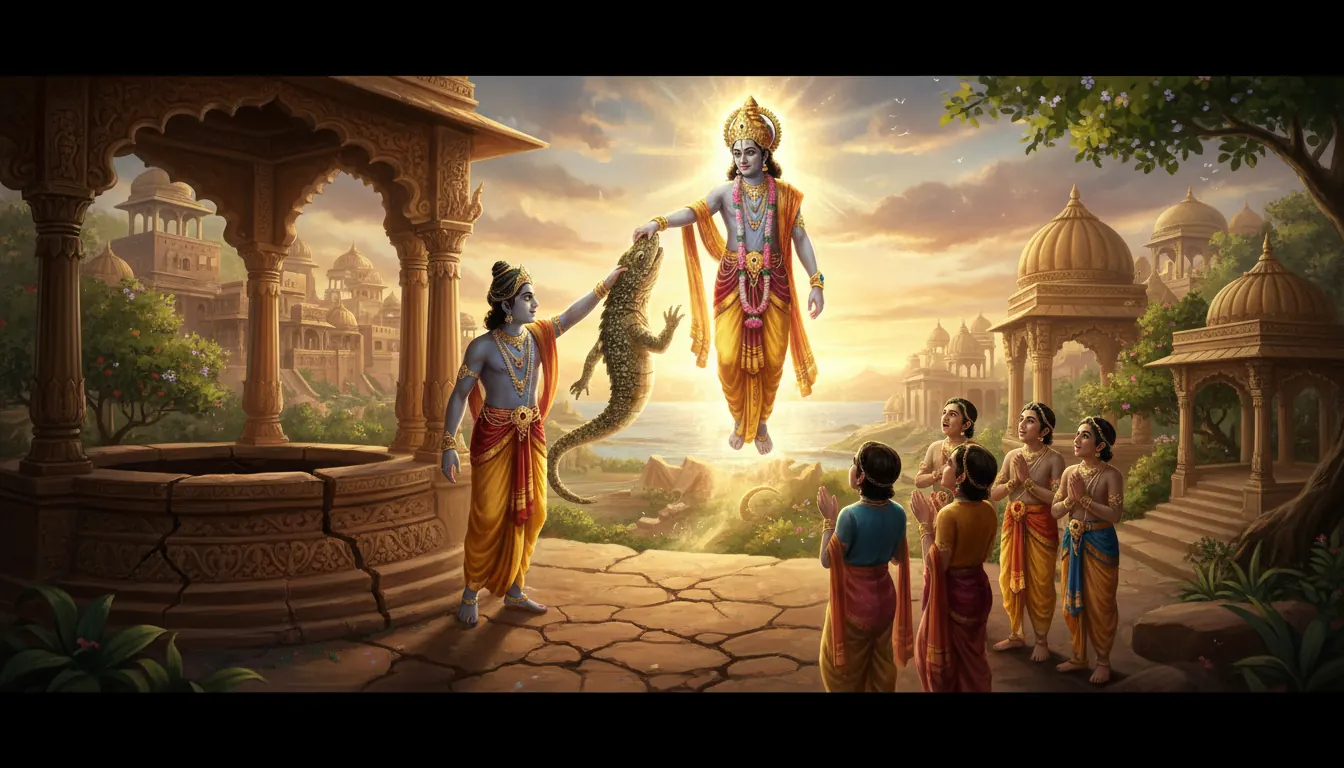
The Jackal and the Ape
Two friends meet again in a burning ground and account for their bodies
In short
Yudhishthira asks Bhishma what becomes of a man who promises a gift to a brahmana and never makes it. Bhishma answers that such a man's whole life of libations, gifts and penances is made fruitless, and cites the old conversation between a jackal and an ape who had been intimate friends while they were men. Each asks the other what he did to deserve the body he is wearing, and the two answers turn out to be the same offence from opposite ends.
Told in the Anushasana ParvaSet in Kurukshetra14 min read
The Gift That Was Only Promised
By this point in the Anushasana Parva the questions had narrowed to a very fine point. Bhishma lay on the bed of arrows on the field at Kurukshetra, waiting for the sun to turn north, and Yudhishthira came to him every day with the king's own difficulties. They had been through the merit of gifts at length: what should be given, and to whom, and at what hour, and what each gift is worth to the man who makes it. On this morning the king turned the whole subject over and asked about its shadow side.
"Glorious grandsire," Yudhishthira said, "what becomes of men who promise gifts to brahmanas and then, out of a clouded intellect, never give them? You are the first of all the righteous: tell me what duty requires here. What end awaits those wicked wretches who promise to give and do not give?"
Notice the phrase he chose for the offence. Clouded intellect. He was not asking about a man who refuses, or a miser who never opens his mouth in the first place. He was asking about the ordinary case, the one everybody has been on one side of or the other: a man says he will give, and means it while he is saying it, and then the day passes and the month passes and the thing is not given, and nobody ever raises the matter again.
It is a small sin, if it is a sin at all. There is no theft in it and no violence and no lie told outright. Yudhishthira wanted to know what it costs.
Bhishma told him, and the answer was not small.
Fruitless in Every Direction
"The man who promises and does not give," Bhishma said, "be it little or much, has the shame of seeing every one of his hopes come to nothing, like a eunuch's hope of children."
Be it little or much. The size of the promise is struck out of the reckoning at once. A man who has promised a herd and given nothing stands exactly where a man stands who promised a measure of grain and gave nothing, because what is being weighed is not the property but the word.
Then the grandsire set out the extent of the damage, and it is worth following clause by clause, because he does not stop where a listener expects him to stop.
"Whatever good such a man does between the day of his birth and the day of his death, Bharata, whatever libations he pours on the sacrificial fire, whatever gifts he gives, chief of Bharata's line, and whatever penances he performs, all of it bears no fruit."
Every item in that list is a thing a man does correctly. The libations are poured on the right fire at the right hour. The gifts, the ones he did make, went to the right hands. The penances were real, and cost him what penances cost. And the whole account is emptied out by the one gift that was spoken of and never handed over. Not reduced. Not deferred. Made fruitless, the way a field that is sown and tended and watered can still yield nothing at all.
Bhishma was careful to say that this was not his private severity. "Those who know the scriptures declare this to be their view, chief of the Bharatas, and they reach it with well-ordered understanding."
And because the men who settled that verdict were not in the business of leaving a man without a road back, they also fixed the price of the road. Those who know the scriptures hold that such a man can be cleansed by giving away a thousand horses with dark ears.
A thousand horses, of one particular marking, to wipe out one gift that was promised and withheld. That is the exchange rate. Then Bhishma said that there was an old story on this subject, a conversation between a jackal and an ape.
Two Friends, Afterwards
While both were human beings, scorcher of foes, they were intimate friends.
That is the first thing said about them, and it is said before anything else is said, so that everything which follows will be read against it. They were not two strangers who happened to meet. They were two men who had known each other in the way that men know each other over a long life, who had eaten in each other's houses and been trusted with each other's business, and whatever each of them did wrong, he did while the other was alive and near him and probably knew nothing about it.
Then they died, as friends do, and the friendship did not end so much as change its footing entirely.
After death one of them became a jackal and the other an ape.
Bhishma does not say how long afterwards this was, or in what country, and the story does not require it. What it requires is the place. One of them was in a crematorium, which is to say the burning ground at the edge of the settled land, where the fires are lit and let go out and the ash is left where it falls, and where the animals that live on what men leave behind come in at dusk and are not driven off because nobody wants to walk there.
That is where the jackal was, and he was eating. The text names the meal without softening it. He was eating an animal carcase, putrid, in the middle of the burning ground, and that was not a misfortune of one evening but his ordinary fare and his ordinary table.
The ape came upon him there.
And here the story does the thing that makes it a story and not a warning. The ape recognised him. He remembered his own former birth as a human being, and he remembered his friend's, and he stood at the edge of the ash looking at an animal with its mouth in a carcase and knew perfectly well who it was.
What Sin Did You Do
The ape spoke first, and he did not soften it either.
"What terrible sin did you commit in your last birth," he said, "that in this one you have to feed in a burning ground on such loathsome fare as the rotting carcase of an animal?"
It is a hard sentence to say to a friend. But consider the position the ape was speaking from. He had the whole of the previous life in his head, the two of them as men, and he could not find in it anything that would account for what he was looking at. Men who end in the burning ground eating carrion have done something. Murder, perhaps. Betrayal of a trust. Some cruelty carried on for years. The ape was asking his friend to name the atrocity he had somehow managed to conceal from him for a lifetime.
The jackal lifted his head and told him.
"I promised a gift to a brahmana, and I never gave it to him."
That was the whole of it. No violence, no theft, no perjury sworn in a hall. A brahmana had been told that something would be given to him. He went away expecting it. The thing was never sent, and the man who had spoken went on with his life and, one assumes, forgot the matter within the year, as everybody forgets such things.
"That is the sin, ape, for which I have fallen into this wretched form of life," the jackal said. "That is why, when I am hungry, I have to eat food like this."
Read the last clause again, because it is the exact shape of the punishment. He is not merely a jackal. He is a jackal who gets hungry. The appetite is left in working order so that it can drive him, every evening of his life, to the one place and the one meal, and what compels him to the carcase is nothing more exotic than the ordinary need to eat that any creature has.
A man had raised an expectation in someone and left it unfed. He was now the thing that is fed last, on what is left over, in the place where the leavings are.
The Fruit That Belonged to Someone Else
Then the jackal put the same question back across the ash, and it was fair that he should, because the ape was standing there in a body that also had to be explained.
"What sin did you commit," the jackal said, "for which you have become an ape?"
The ape answered without any defence at all.
"In my last life I used to take fruit that belonged to brahmanas. That is why I have become an ape."
The two confessions stand side by side, and they are the same offence approached from opposite ends. One man kept back what he had promised to a brahmana. The other took what was already a brahmana's. Between them they cover the whole ground: what is owed and not handed over, and what is not owed and helped oneself to. Neither of them killed anybody. Neither of them is described as having been a wicked man in any other respect. And one of them is a scavenger in a burning ground and the other is a creature in the branches with his hands full of somebody else's fruit for the rest of his natural life, which is a joke the universe appears to have made deliberately, since an ape is exactly the animal that lives by taking fruit that was grown by others.
He had been given the perfect body for the habit he could not break. That is the fruit of acts, rendered as plainly as the epic ever renders it.
And then the ape, who had been an intelligent man and had lost nothing of it, drew the lesson out for his friend and for anybody listening.
"So it is plain that a man of intelligence and learning should never take what belongs to brahmanas. And just as he keeps from that, he should keep clear of every quarrel with brahmanas. And when he has promised them a gift, he must certainly give it."
Three rules, in the order in which he had learned them the hard way. Do not take what is theirs. Do not quarrel with them. And what you have said you will give, give.
The conversation ends there. Bhishma does not say what became of the two of them afterwards, whether they served out those bodies and rose again or stayed where they were. The tale was told to be overheard, not to be finished.
Where the Grandsire Heard It
Coming back off the story, Bhishma did something he did not always trouble to do. He named where he had got it.
"I heard this, king, from my teacher when he was speaking about brahmanas. I heard it from that righteous man when he recited the old and sacred teaching on the subject. And I heard it from Krishna too, king, son of Pandu, when he was speaking about brahmanas."
Twice from his teacher, once from Krishna, when Krishna himself was speaking upon brahmanas. An aged Kuru on a bed of arrows, giving his authorities like a man who expects to be checked.
Then he set out the teaching itself, and it comes in short flat statements with nothing decorative in them.
A brahmana's property must never be taken. Brahmanas should always be left alone. Poor, or miserly, or young, they must never be slighted.
That middle clause is the one that costs something. It is easy to honour a brahmana who is learned and old and impressive to look at. Bhishma names the three cases in which a man will privately decide that the rule does not apply: the one who has nothing, the one who is grasping about what he has, and the one who is too young to have earned anything yet. None of the three, he says, may be slighted. "The brahmanas have always taught me this. When a gift has been promised to them, it must be given. A worthy brahmana must never have his expectations disappointed."
And then the image that the whole section has been walking toward.
"A brahmana in whom an expectation has been raised, king, is said to be like a blazing fire. The man on whom such a brahmana turns his eye is sure to be burnt up, king, as a heap of straw is burnt up by a blazing fire."
The raising of the expectation is the act that lights it. Not the refusal, which may never be spoken, and not any curse, which is never mentioned here. A man makes his promise and walks away, and behind him he has left something burning, and he is the straw.
A Physician Living in the Kingdom
Having shown the king what an unfed expectation does, Bhishma turned the image over and showed him what a satisfied one does.
"When a brahmana whom the king has pleased with honours and gifts speaks to the king in warm and affectionate words, he becomes a great blessing to the king, Bharata, for he lives on in the kingdom like a physician fighting the many ills of the body."
A physician, and living in the kingdom. Not a treasure locked away and not a weapon kept for emergencies, but somebody resident, whose work is against the ordinary ills that come to a body and a realm continually and have to be met continually.
Bhishma then listed what such a man holds up, and the list is not abstract. By his power and his good wishes he maintains the sons and grandsons of the king, the animals, the relatives, the ministers and the other officers, the city and the provinces. It runs outward from the household to the frontier. "Such is the great energy of the brahmana on Earth," he said, "like that of the thousand-rayed Surya himself."
So the choice put before Yudhishthira was between two fires. The same man, in the same kingdom, is either the blaze that burns the straw or the sun that keeps the fields.
"So, Yudhishthira, if a man wants a respectable or happy birth next time, then once he has made a promise to a brahmana he must keep it by actually giving the gift. By giving to a brahmana a man is sure to reach the highest heaven. Truly, giving is the highest act a man can achieve."
And he gave the reason underneath all the others, which is not about the giver at all.
"The gifts a man gives to a brahmana support the gods and the pitris."
The gods above and the fathers below are fed through that hand. A promise withheld does not stop at the man who made it. It stops a supply.
"So a man of knowledge should always give to the brahmanas. Chief of the Bharatas, the brahmana is held to be the highest of all recipients of gifts. A brahmana should never be received without being properly honoured."
That was the end of it. Somewhere off in the world a jackal was going down to the burning ground for his supper, and an ape was in a tree with fruit he had not grown, and the two of them had once sat together as men and discussed everything except this.
Dharma Lesson
The epic keeps insisting that the acts which decide a life are not the dramatic ones. Neither of these two friends killed or robbed or swore falsely in a hall. One kept back a gift he had spoken of aloud, and the other helped himself to fruit that was not his, and both got bodies exactly shaped to the habit they never thought worth examining. What Bhishma will not allow Yudhishthira to treat as small is the expectation raised in another person: once a man has been told that something is coming to him, something has been lit, and only the giving puts it out.