The Three Sages Who Saved the Gods
Agastya burns the Danavas, Vasishtha brings down the Sarayu, and Atri becomes the moon and the sun
In short
Answering the thousand-armed Kartavirya, the god of wind tells three histories of what brahmanas have done for heaven. Agastya burns the Danavas out of the sky when the gods have lost their sacrifices and are wandering the earth, and, asked to finish the survivors hiding under the earth, warns that it will cost him his penances and burns them all the same. Vasishtha destroys the deathless Khalins out of compassion and calls Ganga from Kailasa up through a lake, where she comes out flowing as the Sarayu. When Rahu shoots the sun and the moon and the gods are killed in the dark, Atri takes the shape of both lights and holds the sky open until the battle is won.
Told in the Anushasana ParvaSet in Kurukshetra, Mahishmati and Sarayu13 min read
The King Who Kept Saying Nothing
Bhishma was still on the arrows, and the argument he was reporting had happened long before any of the men listening to him were born.
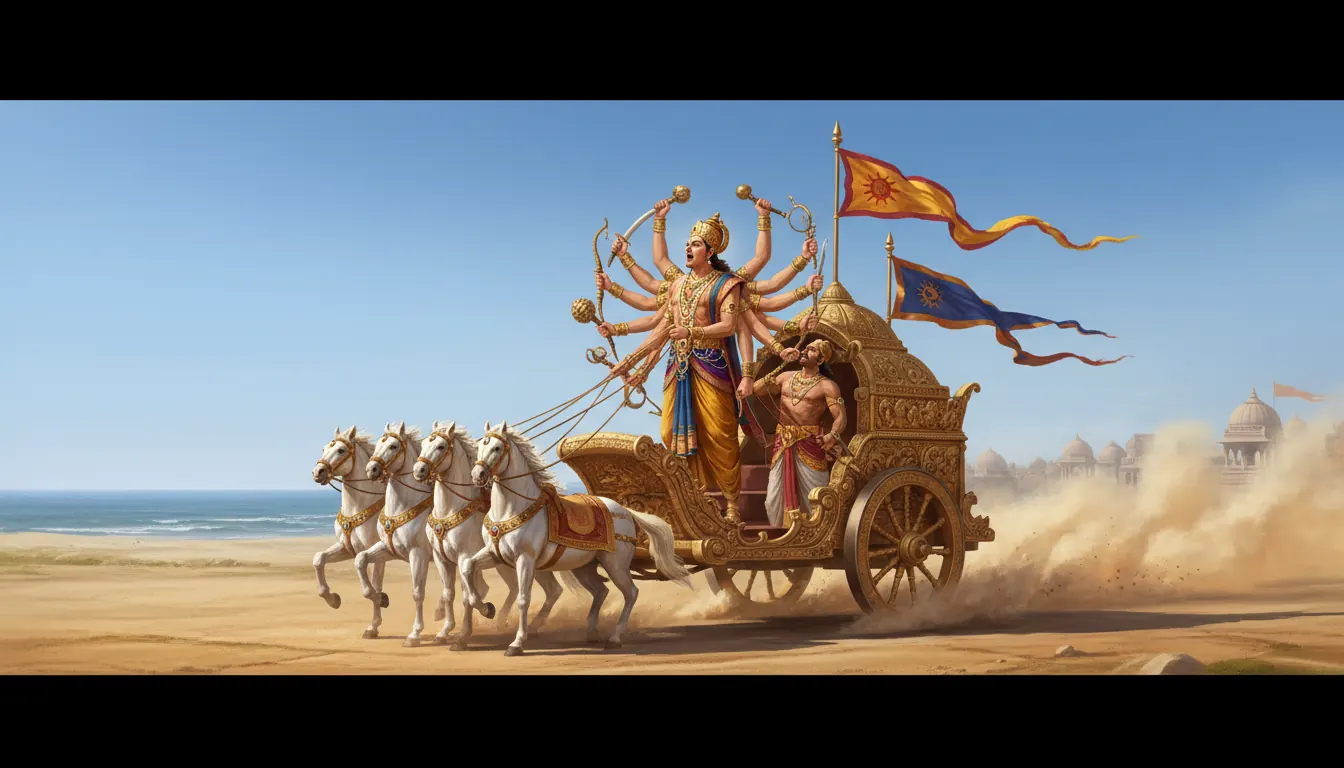
Kartavirya of the Haihayas, lord of Mahishmati, thousand-armed, had ridden out and asked aloud who on earth was his equal, and the god of wind had answered him out of the empty sky. That answer had turned into a catalogue. Every time the king opened his mouth to claim something, Vayu named a brahmana who had done more, and then told the whole of that brahmana's feat, and then asked the same question at the end of it.
He had already told him about Kashyapa, who saw the Earth herself preparing to leave the world and entered her body by yoga to hold her in place for thirty thousand celestial years. He had already told him about Utathya of the race of Angiras, whose wife Varuna stole out of the Yamuna, and who solidified the waters and drank them off, and dried the six hundred thousand lakes of Varuna's palace into sterile ground, and got her back.
"Tell me the name of the kshatriya who can be held superior to Utathya," the wind had said.
"At this," Bhishma said, "king Arjuna remained silent."
That sentence is the hinge of the whole conversation, and it comes back after every story like a drumbeat. The king was not being shouted down. He was being told, in order, the things that men with no armies and no chariots had done for the world, and each time he was invited to produce a warrior who had done as much, and each time he found he had nothing to say.
So the god of wind went on.
"Now listen, king," he said, "to the story of the greatness of the brahmana Agastya."
The Gods Who Wandered the Earth
There was a time when the asuras beat the gods outright, and the wind described the defeat by what it cost rather than by the battle.
The sacrifices of the deities were seized. The Swadha of the Pitris, the offering that goes to the fathers, was misappropriated, so that the dead were being robbed along with the living. And all the religious acts and observances of human beings were suspended by the Danavas, which means that the whole traffic between earth and heaven had been shut down at both ends. Nothing went up. Nothing came back.
Divested of their prosperity, the gods wandered over the earth.
That is the picture to hold. Not gods besieged in a fortress of heaven, but gods walking about on the ground with nowhere to go, having lost the thing that made them gods, which was that men fed them.
One day, in the course of that wandering, they came upon Agastya.
He was a brahmana of high vows, full of great energy, and the splendour about him was as blazing as the sun's, and he was sitting in the middle of the ruined world doing what he had always done. The gods saluted him duly. They made the usual enquiries of politeness, which is a detail worth noticing: beaten, homeless and hunted, they still went through the greetings in order, because that is what one does on meeting a rishi.
Then they said what they had come to say.
"We have been defeated by the Danavas in battle," they said, "and so we have fallen from wealth and prosperity. Best of ascetics, rescue us from this terrible danger."
They did not ask him to pray for them. They did not ask him to intercede with a greater power. They asked a man sitting on the ground with nothing to do what an army had failed to do.
Thousands Dropping Out of the Sky
Informed of the plight to which the deities had been reduced, Agastya became highly incensed.
There is no weapon in what follows and no mantra either. Full of great energy, he at once blazed forth like the all-consuming fire at the time of the universal dissolution, and that was the whole of his attack. He did not aim it. He simply stopped holding it in.
With the blazing rays that emanated from the rishi, the Danavas began to be burnt. Thousands of them began to drop down from the sky. Burning with the energy of Agastya, they abandoned both heaven and earth together and fled towards the southern direction, and that is how the gods got their sacrifices back.
Some survived, and the reason they survived is recorded exactly. At that time the Danava king Vali was performing a Horse-sacrifice in the underworld, and those great asuras who were with him below, or who were dwelling in the bowels of the earth, were not burnt. They were not saved by their strength. They were saved by being underground on the day it happened.
The deities went back to their own regions with their fears entirely dispelled. Then, encouraged by what had been done for them, they came back to the rishi with one more request. Destroy the rest of them, they said. Finish the ones who took refuge under the earth.
Agastya answered them plainly.
"I am able to burn those who are hidden inside the earth," he said. "But if I burn them, my penances will be lessened."
And then, knowing the price to the grain, he used his own energy and burned the Danavas all the same. He had already burned an enemy off the face of two worlds, and now he paid out of his own austerities to reach the ones below. The power was real, and the accounting on it was exact, and he was the one who chose to pay.
"That is Agastya as I have described him," the wind said. "Shall I go on? Or will you say anything in reply? Is there any kshatriya who is greater than Agastya?"
At this, king Arjuna remained silent.
The Lake That Gave the Dead Back
"Hear, king," the god of wind said, "one of the great feats of the illustrious Vasishtha."
The gods were performing a sacrifice on the shores of the lake Manasa. Knowing his power, they thought of Vasishtha and made him their priest in imagination, which is to say they installed him at that altar without sending for him and without his knowing, because his name was enough to make the rite correct.
The Diksha they were undergoing, the long consecration that a sacrifice requires, had left them reduced and emaciated. Men and gods under that vow eat little and sleep less, and a race of Danavas called the Khalins, of statures as gigantic as mountains, saw the condition they were in and decided that this was the moment to kill them.
The Khalins could not be killed back. That was the difficulty. Those of them who were disabled or slain in the fight were plunged into the waters of the Manasa lake, and by a boon of the Grandsire they instantly came back to strength and life. Every corpse the gods made was returned to them the same day, standing up, armed.
And they fought with the landscape. They took up huge and terrible mountain summits, and maces, and trees, and they agitated the waters of the lake with them until the water swelled up to the height of a hundred yojanas. Then they ran against the deities, who numbered in the tens of thousands.
Afflicted, the gods sought the protection of their chief. Vasava was their answer to everything, and Vasava was soon afflicted himself, hammered by mountain-sized enemies who could not be made to stay dead. In his distress Indra sought the protection of Vasishtha.
So the rishi who had been made priest of that sacrifice in imagination was now being sent for in earnest, by the king of the gods, in the middle of a battle he had no part in.
The River That Came Through the Water
The holy rishi Vasishtha assured the deities and dispelled their fears, and the text gives his reason before it gives his act. Seeing that the gods had become utterly downcast, the ascetic did this out of compassion. Not through anger, as with Agastya. He looked at how frightened they were and could not leave them in it.
Then he put forth his energy and burnt, without any exertion, those Danavas called the Khalins.
Without any exertion. They had heaved mountain peaks into a lake and raised the water a hundred yojanas and come back from death as often as they were killed, on a boon from Brahman himself, and the man who ended them did it the way another man closes a door.
What he did next is the part that stayed on the map.
Rich in penances, the rishi brought the River Ganga, who had gone to Kailasa, to that spot. She came, and she appeared by piercing through the waters of the lake, one water rising through another. The lake was penetrated by that river. And as that celestial stream came up through the lake and out the other side, it flowed on under a different name, and the name was Sarayu.
The place where those Danavas fell came to be called after them.
So two things were left standing in the world when it was over, and both of them are geography. There is a river that anyone may go and look at, which began as Ganga and became Sarayu at the moment she came up through a lake to a rishi's summons. And there is a stretch of ground that carries the name of the giants who died on it, given to them by the people who came after.
"That is how those Danavas, who had received boons from Brahman, were slain by that great-souled rishi," the wind said. "Shall I go on? Or will you say anything? Was there a kshatriya who could be said to surpass the brahmana Vasishtha?"
At this, Arjuna remained silent.
Rahu's Arrows in the Dark
"Hear me, foremost of the Haihayas," the god of wind said, "as I tell you of the achievement of the great-souled Atri."
The gods and the Danavas were fighting each other in the dark. That is where the story starts, and it is worth stopping on, because a night battle in this epic is already the worst thing that can happen to an army even when the sky is behaving normally.
The sky was not behaving normally. Rahu pierced both Surya and Soma with his arrows.
The sun and the moon were not eclipsed in the ordinary way, passing behind something and coming out again on a schedule. They were shot. The two lights of the world were wounded and darkened where they hung, and there was nothing left overhead to fight by.
The gods, overwhelmed by darkness, began to fall before the mighty Danavas. Repeatedly struck by enemies they could not see, the denizens of heaven began to lose their strength, which is what happens to any army that is being killed from a direction it cannot identify.
Then they saw Atri.
He was a learned brahmana, rich in penances, and he was sitting in the observance of austerities in the middle of all this. He had conquered all his senses. In him, wrath had been extinguished, which is said of very few men in this book and is never said carelessly. Agastya had saved the gods by being angry. Atri had nothing of that kind left in him to use.
"Look, rishi, at these two, Soma and Surya, both pierced by the asuras with their arrows," they said. "Because of this, darkness has overtaken us, and the foe is striking us down. We see no end to our troubles. Lord of great power, rescue us from this great fear."
The rishi asked them one question, and it is the most practical question in the whole of Vayu's long argument.
"How, then, am I to protect you?"
Become the Moon, Become the Sun
They told him exactly what they wanted, and what they wanted was not help.
"Become Chandramas yourself," they said. "Become the sun as well, and begin to slay these robbers."
They were asking a man sitting on the ground in deerskins to take over the two offices that hold up the day and the night, because the officeholders had been shot and were bleeding light out of the sky.
At their request, Atri took the form of the darkness-destroying Soma. Because of his pleasant nature he began to look as handsome and delightful as Soma himself, and the text puts the reason in the temperament rather than in the power, as though the moon were a manner before it is a body.
Then, seeing that the real Soma and the real Surya had both been darkened by the shafts of the foe, he took the forms of those luminaries and began to shine out over the battlefield, helped by the power of his penances. Truly, Atri made the universe blaze with light, dispelling all its darkness.
And having lit the field, he fought on it. Putting forth his power, he overcame the vast multitudes of those enemies of the gods, and the gods, protected by Atri's energy and able at last to see what they were swinging at, began to dispatch them quickly. He burnt the great asuras and they finished them.
The wind ends the account with an inventory of the man who did it, and every item in it is a poverty.
He was aided by his sacred fire. He was a silent reciter of mantras. He was clad in deerskins. He subsisted upon fruits only.
"See, royal sage, what that rishi achieved," the god of wind said. "Putting forth his prowess and mastering all his energy, this is how Atri lit up the god of day, rescued the gods and slew the asuras. Shall I go on? Or will you say anything? Is there a kshatriya superior to this twice-born rishi?"
At this, Arjuna remained silent.
Three times now. A man with a thousand arms, who had gone out that morning to be told he had no equal, stood in his chariot listening to a voice with no body in it, and could not name one of his own kind who had ever done what a hungry man in a deerskin had done for the world.
Dharma Lesson
Each of these three rescues is made out of something the rescuer had no intention of spending. Agastya spends anger first and then penance, measuring to the grain what the second burning will take out of his austerities and paying it anyway because the gods asked. Vasishtha spends nothing at all, in the sense that the text says he burnt mountain-sized enemies without any exertion, and names compassion rather than power as the reason he bothered. Atri, in whom wrath had been extinguished, has no weapon left and so becomes the light itself, which is the only help a man can give who has stopped wanting to strike anybody. The king with a thousand arms had no answer to any of it, and his silence is the argument.