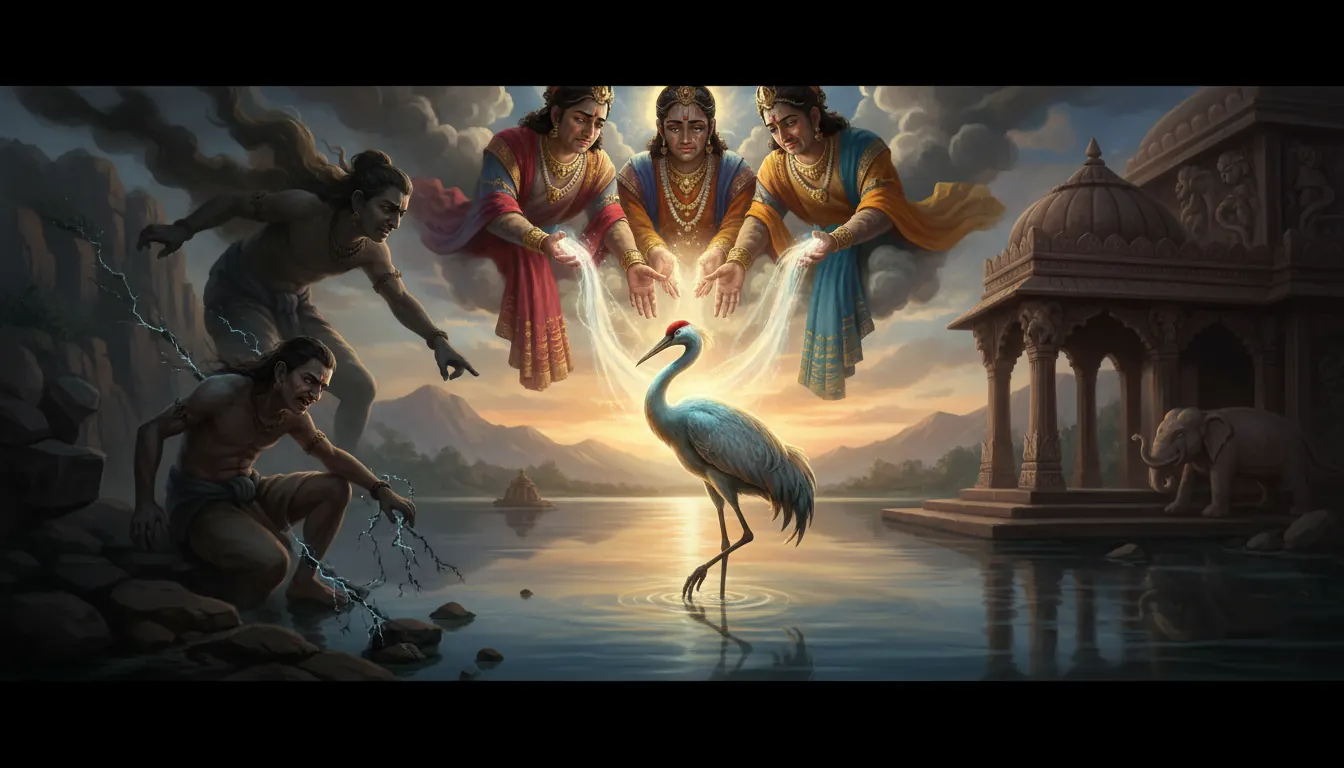
The Wife Who Cooled a Naga's Anger
Padmanabha would not go out to a waiting guest, until his wife named the ends of Ravana and Kartavirya
In short
Home from fifteen days at the chariot of Surya, the Naga chief Padmanabha is told that a brahmana has been waiting on the banks of the Gomati to see him, and his pride takes the summons as an insult. His wife answers him with what she has observed of the guest, with the image of the chataka bird that will drink only from the cloud, and with the short list of what righteous conduct earns and what turning away a suppliant costs. Padmanabha then names his own anger as the enemy of his penances, recalling Ravana who made himself the rival of Shakra and the sons of Kartavirya who were destroyed over the calf of a Homa cow. He goes down to the river and receives his guest as a guest should be received.
Told in the Shanti ParvaSet in Nagaloka, Kurukshetra and Lanka13 min read
Fifteen Days at the Chariot of the Sun
Bhishma lay on the bed of arrows and went on with the history of the Naga, and Yudhishthira sat where he had been sitting all morning and let him tell it in his own order.
The Naga's name was Padmanabha, and his work was the sun's. The great serpents take their turns at the chariot of Surya as other creatures take their turns at other labours, and Padmanabha had just finished a term of a full fifteen days dragging that chariot across the sky. When the term was over he took leave of Surya and came back to his own house.
His wife saw him coming and went out quickly to wash his feet and do the other things of that kind, and when those were done she sat down beside him. The Naga, rested from his labour, asked her what a man asks who has been away from his own roof for a fortnight. Had the gods been worshipped while he was away, as he had told her and as the scriptures lay down? Had she kept firmly to the duties of hospitality? Had she stayed within the bounds of duty and righteousness while he was in the sky?
She told him that nothing had slipped. The worship of the gods had been done in every respect. Guests who came to his house had been looked after without the slightest neglect.
And then she gave him the one piece of news the house had.
"Fifteen days ago a brahmana came here," she said. "He has not told me what he wants. He wants to meet you. Meanwhile he is staying on the banks of the Gomati, anxiously waiting for you to come back. That brahmana of strict vows is sitting there reciting the Vedas. Chief of the Nagas, I promised him that I would send you to him as soon as you came home."
A man had come to the house of a serpent, had been asked to wait, and had waited fifteen days on a riverbank without saying what he wanted.
The Naga did not go. He asked a question first, and the question had his whole nature in it.
We Are Not to Be Seen by Human Beings
"Sweetly smiling one," said the Naga, "who do you take that brahmana to be? Is he really a human being, or is he some god who has come here disguised as a brahmana?"
It is worth noticing what part of the message had stung him. Not the waiting. Not the fifteen days. What he could not get past was the direction of the traffic. Somebody had left word at his door that he was to go out to a riverbank and present himself.
"Famous lady, what human being would want to see me, or would even be able to? Could a human being who wanted to see me leave an order like that with you, to send me off to visit him where he is staying?"
Then he told his wife what a Naga is, which is the sort of thing a man only explains to his wife when he is angry, since she has known it for years.
"Gentle lady, among the gods and Asuras and celestial rishis, the Nagas have great energy. They are very swift, and they have an exquisite fragrance. They deserve to be worshipped. They can grant boons. Indeed, we too deserve to have others follow in our train. I tell you, lady, human beings cannot see us."
Every clause of that is true. The Nagas are swift, they are fragrant, they are worshipped, they do grant boons, and the eye of a man does not ordinarily fall on them at all. He had not overstated a single item. He had simply arranged a list of true things into a reason for leaving a guest sitting on a riverbank until the guest gave up or died there.
He was a righteous serpent in a house where the rites had been kept and the guests had been fed, and he had come home from the service of the sun, and he was on the edge of doing the one discourteous thing of his life because a brahmana had presumed to expect him.
His wife did not tell him he was wrong about the Nagas. She began somewhere else.
As the Chataka Waits for Rain
"From his simplicity and openness," she said, "I know that brahmana is no god who lives on air."
She had watched him for fifteen days and she gave her evidence first, before she gave her argument. There was no disguise in the man. Whatever a god pretending to be a brahmana looks like, it is not what she had been looking at from her door every morning while he sat by the Gomati reciting.
"Quick-tempered one, I know this too: he reveres you with all his heart. He has set his heart on achieving something that depends on your help. As the bird called the chataka, which loves the rain, waits eagerly for a shower, so that brahmana is waiting eagerly to meet you."
That is the image she chose, and she chose it exactly. The chataka is the bird that will not drink from the ground. It waits with its beak open for the cloud, and what falls from the cloud is the only water it will take, and if the cloud withholds it there is nothing else in the world that will serve. She was telling her husband that he was the cloud. The man on the bank was not asking him for one favour among many available favours. He was thirsty in the one direction where only a Naga could pour.
"Do not let any disaster befall him because he could not get to see you," she said. "No one born, like you, into a respectable family can be thought to stay respectable if he neglects a guest who has come to his house."
There is the sentence that turned him, and it turned him by using his own pride against his own pride. He had been arguing from his birth. Very well, she said, argue from your birth. A house is respectable because of what it does at its door, not because of what it is descended from, and a man born in such a house stops being what he was born as on the day he lets a guest sit outside it.
"Put aside that anger which comes so naturally to you, and go and see that brahmana. Do not let yourself be consumed by disappointing that brahmana."
That Is What the Righteous Say
Having said what the guest was, she said what a refusal costs, and then she set out, in order, what the alternatives earn. This is the short catalogue she gave her husband, and it is worth having in its own words rather than in a summary of them.
First, the price of turning a suppliant away. A king or a prince who refuses to wipe away the tears of those who come to him hoping for relief incurs the sin of killing an unborn child. That is the weight she put on it. Not discourtesy, not a lapse of manners. The killing of an unborn child, because a man who comes with a hope and is sent away with nothing has had something ended in him that had not yet been allowed to be born.
Then the earnings, which she listed one after another as the righteous list them.
By keeping silent, one gains wisdom. By giving, one wins great fame. By keeping to truthful speech, one gains the gift of eloquence and is honoured in heaven. By giving away land, one reaches the high end ordained for rishis who lead the sacred life. By earning wealth by righteous means, one wins many desirable fruits. By doing, in full, what is for one's own good, one can escape going to hell.
That is what the righteous say.
Notice the shape of the list. Silence, gifts, truth, land, honest earning, and then the last item, which is the odd one and the one she had been walking towards the whole time. Doing, in full, what is for one's own good. Not doing most of it. Not doing the parts that are pleasant, or the parts that are visible, or the parts that a Naga of good family finds consistent with his dignity. The whole of it, including the piece that is presently sitting on a riverbank waiting for a cloud.
A house where the rites are performed and the guest is left outside is a house that has done its own good in part. She did not say so. She put the item at the end of the list, and let it sit there, and stopped talking.
Ravana, and the Calf of the Homa Cow
"I had no arrogance born of pride," the Naga said. "But because of my birth, my arrogance was considerable."
That is as honest a sentence as anyone in the epic manages about himself. He was not a vain creature who had gone looking for reasons to think well of himself. He had simply been born into a race that is worshipped, and the arrogance had come with the birth, the way the fragrance and the speed had come with it.
"Anger, which is born of desire, blessed lady, I have none of now. It has all been burnt up in the fire of your excellent teaching. I can see no darkness thicker than anger, blessed lady."
And then he said the thing about his own people that a member of a people can say and a stranger cannot. Because the Nagas have too much anger, everyone looks down on them. The serpents are worshipped and the serpents are avoided, and he knew perfectly well which of their qualities had earned them the second of those.
Then he gave her the examples, because a man arguing himself out of anger reaches for the dead.
By giving in to anger, he said, ten-headed Ravana of great prowess became the rival of Shakra, and was slain by Rama in battle for it. The ten heads had not killed him. The prowess had not killed him. It was the temper that made him decide he was the equal of the lord of heaven, and once a creature has decided that, there is only one way the account can close.
The second example was a family. The rishi Rama of Bhrigu's line had gone into the inner apartments of Kartavirya's palace to take back the calf of the Homa cow that belonged to his father. That was the whole of the offence: a man walking into a house after a calf that was used for sacrifices and was his father's. The sons of Kartavirya, when they heard of it, gave in to anger and took the entry as an insult to their royal house, and as a result they were destroyed by Rama.
And their father after them. Kartavirya of great strength, like the Thousand-eyed Indra himself, was slain in battle by Rama of Jamadagni's line, and the cause given is not his strength and not his thousand arms. It is that he gave in to anger.
A calf. That is what the thousand-armed king and every one of his sons were finally spent on.
He Goes Down to the Gomati
"Truly, gentle lady, at your words I have held back my anger," the Naga said, "that enemy of penances, that destroyer of everything that is for my own good."
He had come home from fifteen days at the chariot of the sun, had been met at the door and had his feet washed, had questioned his wife about her conduct in his absence, and had been told about a guest. Within the space of one conversation he had gone from asking whether any human being was even competent to look at him, to naming his own anger as the enemy of his own austerities. Nobody had shouted at him. Nobody had shamed him in front of the household. His wife had told him what she had seen, quoted a bird, and read him a list.
"I think very highly of myself, large-eyed one, since I am lucky enough to have you for my wife, you who have every virtue and endless merits."
That is not quite a thank you, and it is better than one. He congratulated himself on his marriage. It is the only boast he makes in the whole exchange that his wife would have let stand.
"I will go now to the place where the brahmana is staying. I will certainly speak to that brahmana in proper words, and he will certainly go away from here with his wishes fulfilled."
And he went. He thought about the man the whole way down, wondering what business could possibly have brought a human being to the city of the Nagas, and when he came to the place where the guest was sitting he did not announce himself as the chief of a race that grants boons. He spoke first, and he spoke in sweet words, and the first thing he said was an apology for anger that had not even reached the riverbank.
"Brahmana, do not give way to anger. I come to you in peace. Do not be angry. Whom have you come here looking for? What do you want?"
The brahmana said that his name was Dharmaranya, that he had come to see the Naga Padmanabha, and that he had been waiting as a chataka waits for the clouds.
He was told he had found him. He was told to command his host in whatever he wished. He was told that he was certain to return with his object fulfilled. Bhishma, who had been laid low by a grandson he had raised, told all of this to a king who would shortly have to hold audiences of his own, and did not underline any of it.
Dharma Lesson
Padmanabha's list of the Nagas' excellences was accurate in every item, and he was assembling it into permission to leave a man sitting on a riverbank. Anger is rarely argued out of a person by contradiction; his wife did not deny one word of his pride, she only pointed out where a house of good birth stops being respectable, which is at its own door. The dead she cited had strength that nobody disputed, and a temper spent them anyway, one on a rivalry with heaven and the others on a calf. What is left when the wrath is set down is not humiliation but a walk to the river and a courteous question.