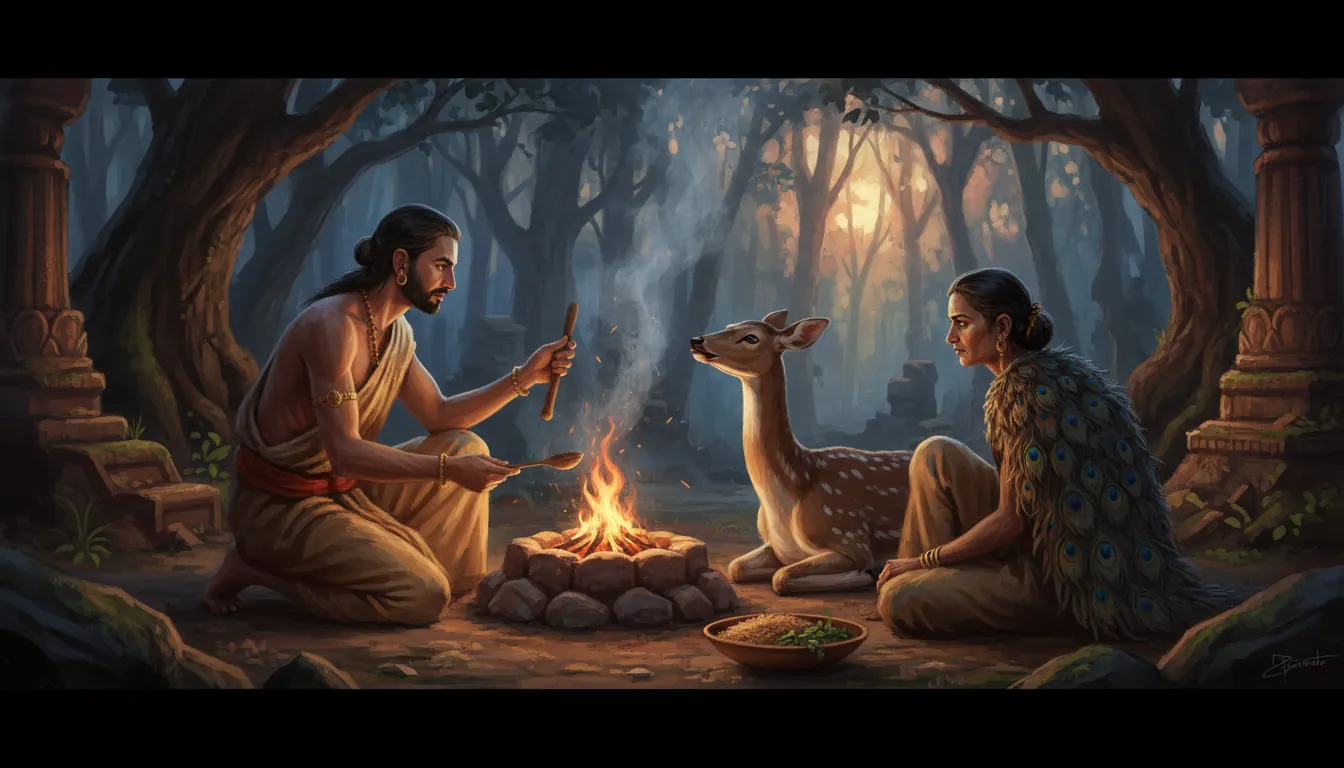
The Thousand Doors to Heaven
A guest who cannot answer counts the ways men have got in, then names one serpent worth asking
In short
A faultless householder of Mahapadma, torn between the Vedas, the Dharmasastras and the custom of good men, asks his learned guest for one course of duties he can reason his way into. The guest begins by admitting he is confounded too, and then recites the ways men have reached heaven: emancipation, sacrifice, the forest, the household, the duties of kings, restraint of soul, obedience, silence, service to parents, nonviolence, truth, death in battle, the gleaner's vow, the Vedas, and even simple men murdered by the wicked. A thousand doors, he says, all standing wide open. Then he stops counting and gives his host an address instead: the Naga Padmanabha, in the city in the Naimisha forest on the Gomati.
Told in the Shanti ParvaSet in Ganga, Naimisharanya and Kurukshetra13 min read
The Town Called Mahapadma
Bhishma began, in answer to Yudhishthira's question about the duties of the modes of life, with a householder who wanted to get out of his own house.
"In a fine town called Mahapadma," he said, "on the southern side of the river Ganga, there lived, best of men, a brahmana of composed mind."
Everything that happens afterwards happens to a man with nothing wrong with him. He was born in the lineage of the Moon and he was of a kindly nature. All his doubts had been cleared away, and he knew well the path he was to follow. He always kept to his religious duties and he had his anger under perfect control. Always contented, he was the complete master of his senses. He was devoted to penances and to the study of the Vedas, and he was honoured by all good men. He earned his wealth by righteous means, and his conduct in all things matched the stage of life he was in and the order he belonged to.
The family was as sound as the man: large and celebrated. He had many kinsmen and relatives, and many children and wives, and his behaviour was always respectable and faultless.
Seeing that he had many children, the brahmana set about performing religious acts on a large scale, and his religious observances followed the customs of his own family. The trouble started there, in the middle of doing everything correctly.
For he reflected that three kinds of duties have been laid down. First there were the duties the Vedas ordain for the order he was born into and the stage of life he was in, which is to say a brahmana living as a householder. Second there were the duties prescribed in the scriptures, the books especially called the Dharmasastras. And third there were the duties that eminent and revered men of former times have followed although they appear neither in the Vedas nor in the scriptures.
Which of these duties should I follow? Which of them, if I follow them, are likely to do me good? Which, truly, should be my refuge? Thoughts like these troubled him constantly. He could not settle his doubts.
While he was troubled by such thoughts a brahmana of composed mind, who followed a very high religion, came to his house as a guest. The householder honoured him properly according to the rules of worship laid down in the scriptures, and when he had seen his guest refreshed and seated at ease, he began to talk.
What the Host Asked For
"Sinless one," the brahmana said, "the sweetness of your conversation has made me very fond of you. You have become my friend. Listen to me, for I want to tell you something."
No man builds a preface like that unless what follows has never been said aloud in his own house.
"Best of brahmanas, I have handed over the duties of a householder to my son. Now I want to be set firmly on the path of the highest duty. What should I do, twice-born one? Relying on the soul, I want to be settled in the soul, and I would do nothing that binds me again to the ordinary qualities."
Then he told why he had come to it so late:
"My whole life until now has been spent in winning the fruit of sons. So now I want provisions for my journey into the next world."
He spoke of merit as of money that must be in hand before a man sets out. "The wish has risen in my mind to cross the ocean of the world. Alas, where will I find the raft of religion?"
Two sights had emptied his pleasures.
"I have heard that men in this world are bewildered, and that even those whose souls are full of goodness find it hard to come out of it. And above the heads of all creatures I have seen the garlands, flags and standards of righteousness held aloft. My heart no longer finds delight in the time it spends on pleasure."
The world is a place where even good men lose their way. And over every living head, in rows, like the banners of an army drawn up for the march, the standards of righteousness, held aloft and pointing somewhere else. A man who has seen the field that way does not get his appetite back.
And he had noticed who was already on the road. "I have seen that the mendicants set their hearts on the hereafter." He had watched them going from door to door with nothing in their hands and their eyes on the world to come, and he wanted what they wanted.
"My reverend guest, with the help of that religion which rests on intelligence and reason, set me on a particular course of duties and observances."
That is the request. Not comfort, not a blessing. A rule he could reason his way into, asked of a stranger who had eaten at his table an hour before.
Heaven Has Many Doors
The guest, a man of great wisdom, heard this righteous speech of his host's and answered in a sweet, melodious voice. And the first thing he said was that he did not know.
"I too am confused about this. The same thought fills my own mind. I cannot reach any firm conclusion."
He was the holy man from out of town, seated in the best place in the house, with the household waiting on him, and he began by saying that his host's question was his own question and that he had never settled it. Then, instead of stopping there, he did the useful thing. He started counting.
"Heaven has many doors."
"There are some who praise Emancipation." That is the first, and it is the one that does not lead to heaven at all but past it: moksha, release, wanted for itself, with no residence anywhere at the end of it.
"Some of the twice-born praise the fruits that come from performing sacrifices." The fire, the mantras, the fee to the priests, and a term of dwelling among the gods bought at a stated price and lasting a stated time.
"Some take refuge in the forest life." The third stage: the fires carried out of the village, roots and fruits, a hut, the wife brought along or left behind with the sons.
"Some, again, take up the life of the householder." And there it is, fourth on the list, the very life the host was trying to lay down. Not a lower thing that men do until they are ready for better. A door.
"Some rely on the merit that comes from keeping the duties of kings." The rod, the protection of subjects, the tax collected and spent rightly, and death in a war fought for a cause that was owed.
"Some rely on the fruits of the discipline that consists in restraining the soul." The inward discipline, practised by a man who may look from the outside as though he is doing nothing at all.
Six doors, and no two of them opening on the same street. The guest was not finished.
A Thousand, All Standing Wide Open
"Some think that faithful obedience to teachers and elders brings merit." No penance in that beyond staying where you are put and doing what the old man tells you.
"Some take up vows of restraint in speech." A door that costs nothing and is shut in most houses before breakfast.
And then the grammar of the list changes, and it is worth noticing when it does. Up to here the guest has been reporting what men think and rely upon. From here he reports where they have arrived.
"Some have gone to heaven by serving their mothers and fathers faithfully." Not think they will. Have gone.
"Some have risen to heaven by refraining from harm, and some by practising Truth."
"Some rush into battle, lay down their lives, and have reached heaven." That sentence was recited over a field where the greater part of two armies had gone through that door in eighteen days, by a man lying on the arrows that had sent them.
"Some, again, have succeeded by keeping the vow called Unccha, and have taken the road to heaven." The gleaners, who go into the reaped field after the reapers and the birds are done and pick up what was dropped, one grain at a time, and never ask and never store.
"Some have devoted themselves to the study of the Vedas. Blessed and wedded to that study, these men, intelligent, tranquil in soul, and with their senses under complete control, reach heaven."
And last, and strangest, one that nobody chooses.
"Others, marked by simplicity and truth, have been killed by wicked men. Pure in soul, such men of truth and simplicity have become honoured dwellers in heaven."
A door opened from the outside, by somebody else, at the worst moment of a harmless life. It is on the list with the rest of them, and it is on the list without a word of consolation attached, which is how the epic usually tells the truth about murder.
"In this world, it is plain, men go to heaven through a thousand doors of duty, all standing wide open."
Then the guest said the thing that the host had been dreading since the conversation began.
"Your question has troubled my understanding, like a fleecy cloud before the wind."
The man had asked for one road. He had been given a thousand, and told that the person handing them over was standing in the same field he was, with the wind going through him.
The Forest Where the Wheel Was Set Turning
"Still, brahmana, I will try to teach you as best I can."
That is the turn of the whole episode, and the next sentence explains how a man who has just confessed his own confusion can instruct anybody.
"Listen to me as I tell you what I heard from my teacher."
He did not answer out of himself. He passed on what had been given to him, which is the one honest thing available to a man in his position, and what he passed on was not a doctrine. It was an address.
"In the place where, in the course of an earlier creation, the wheel of righteousness was set in motion, in the forest known as Naimisha, on the banks of the Gomati, there is a city named after the Nagas."
Naimisha is the forest where the great recitations happen, the place the epic keeps returning to whenever something has to be told from the beginning, and it is being named here as the ground where dharma first started turning in an earlier creation. The guest then vouched for it twice more.
"There, in that region, all the gods once gathered together long ago and performed a grand sacrifice. There Mandhatri, the foremost of earthly kings, surpassed Indra, the chief of the gods."
Mandhatri is the emperor of the solar line whom the Shanti Parva keeps producing as its example of a mortal ruler at the very top of what a mortal ruler can reach, and what is recorded of that ground is that on it he surpassed the king of the gods. So: the wheel of righteousness began there, the assembled gods sacrificed there, and a man outshone Indra there. Three facts, and the guest laid them down like the address on a letter, so that his host would know he was not being sent into an ordinary wood.
"A mighty Naga of righteous soul lives in the city that stands in that region. That great Naga is called Padmanabha, or Padma."
The brahmana of Mahapadma, who could not choose between the Vedas, the Dharmasastras and the custom of good men, was being sent to a serpent.
Go and Put Your Questions to Him
"Walking the threefold path of action, knowledge and devotion, he pleases all creatures in thought, word and deed. He considers everything with great care, and he protects the righteous and punishes the wicked by the fourfold policy of conciliation, sowing dissension, gifts or bribes, and force."
That is statecraft, the four expedients of any king in the books, set down in the middle of a saint's character without apology. Padmanabha is no hermit. He rules, and the guest counts the ruling among his virtues.
"Go there and put to him whatever questions you wish. He will show you truly what the highest religion is."
Then the rest of him. "That Naga always loves guests. He is very intelligent, and he knows the scriptures well. He has every virtue one could wish for, such as you will not find in anyone else. By nature he always keeps the duties that are performed with water or in water. He is devoted to the study of the Vedas. He practises penance and self-control. He has great wealth. He performs sacrifices, gives gifts, refrains from harm and practises forgiveness. He is truthful in speech and free from malice, his conduct is good and his senses are well controlled. He eats only after feeding all his guests and attendants. He knows what is beneficial, what is simple and right, and what deserves blame."
And then one clause unlike the others.
"He takes stock of what he does and what he leaves undone."
Every other item on that list is a quality. That one is a practice, kept in both columns, the acts and the omissions. It is the only thing in the description that a man could begin tonight without moving house.
"He never acts with hostility toward anyone. He is always busy doing good to all creatures. He comes of a family as pure and stainless as the water of a lake in the middle of the Ganga."
Set that beside the description of the host in the first scene and it is nearly the same list: the Vedas, the penances, the controlled senses, the abstention from injury, the wealth honestly held, the faultless line. The householder was being sent across the country to a person who was, item for item, what he already was, and who had stopped being troubled by it.
The thousand doors stood open the whole time. What the guest could give him was not one of them. It was a river, a forest, a city, and the name of somebody to ask.
Dharma Lesson
The guest's honesty is the teaching. He does not pretend that one way is the way, and he does not reduce the thousand ways to a comfortable nothing either; he names them, keeps them distinct, and admits that the question moves his own understanding like wind through a cloud. What he can offer his host is not certainty but a direction and a person to ask, and that turns out to be enough to get a man out of his chair after years of sitting in it. A road you can walk to is worth more than an answer you cannot test.