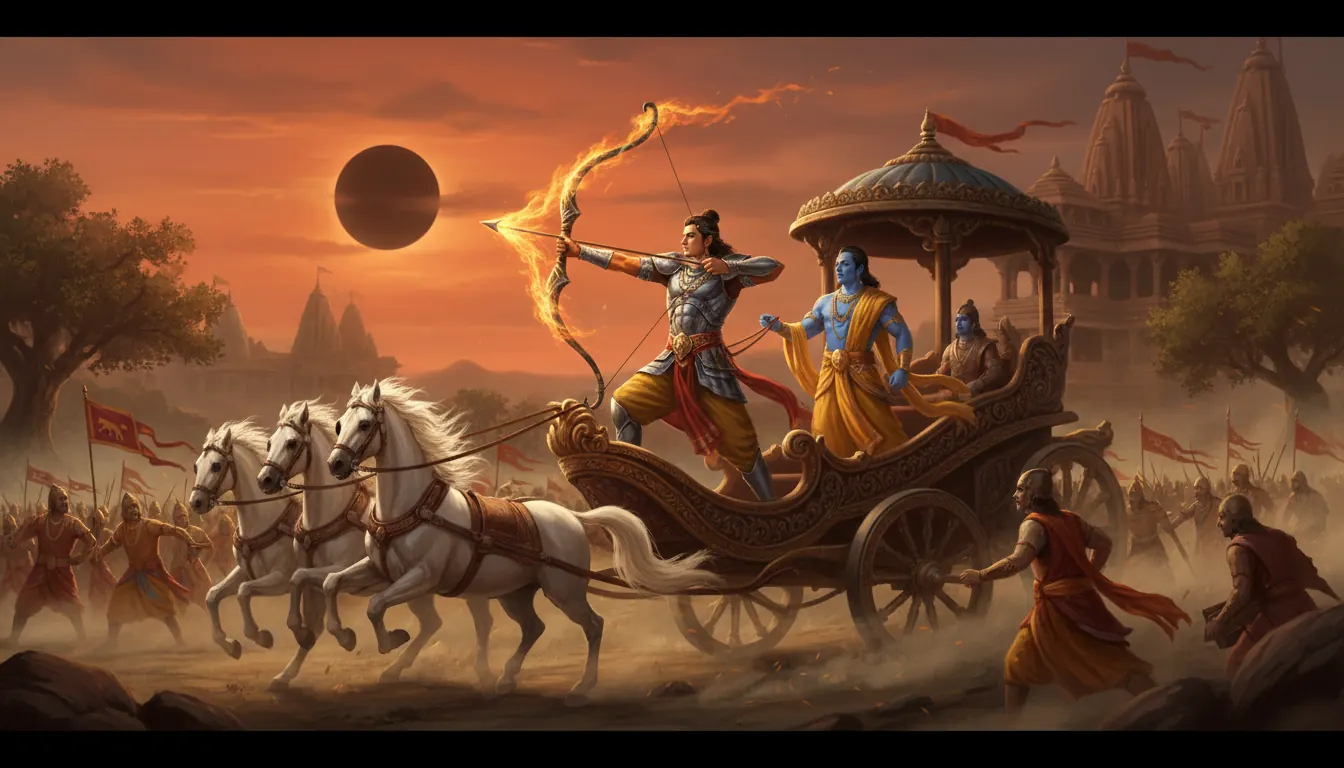
The Night Falls on the Fourteenth Day
Ashwatthama breaks the Panchalas after dark, Drona looses the wind weapon, and Krishna pulls Yudhishthira out of a fight he is winning
In short
Duryodhana asks Ashwatthama to destroy the Panchalas, and gets both an insult and an obedience. Drona's son invites a whole division to shoot at him, kills ten of their best, breaks Dhrishtadyumna's chariot apart and scatters the Panchalas twice, while the prince who was born to kill his father tells him to stay alive until dawn. As the darkness thickens Drona scatters his attackers with the Vayavya weapon, and Krishna, seeing Yudhishthira get the better of the teacher, orders the king away from him and over to Bhima's flank.
Told in the Drona ParvaSet in Kurukshetra17 min read
The Errand Given to Drona's Son
The fourteenth day of the war had already outlived its own sunset. Sanjaya, telling it afterwards to the blind king in his hall, had to keep saying so, because nothing about that stretch of the fighting behaved as a day should. Jayadratha was dead. The light had gone out of the west. Nobody had sounded the withdrawal.
Duryodhana had just come away from a quarrel in his own lines, where Karna had insulted Kripa and Ashwatthama had drawn a scimitar on Karna and been held back by the king's own hands. Now the king went to Ashwatthama again, and this time he came asking.
"Ashwatthama, be gracious to me and destroy my enemies. Neither the gods nor the Danavas can stand within range of your weapons. Slay the Panchalas and the Somakas and all their followers. We will slay the rest, with you to protect us. Look, brahmana, the Somakas and the Panchalas are ranging through my troops like a forest fire. You were born, mighty-armed one, to destroy the Panchalas. So the revered ones crowned with ascetic success have said."
That was the burden he laid on him: not a line to hold, not a flank to cover, but a people to end.
Ashwatthama was Drona's son, and there was nobody on that field with a more complicated position. His father was commander of the Kaurava army. His father had also taught the Pandavas archery and loved them, and the men Duryodhana wanted destroyed were the Panchalas, whose prince Dhrishtadyumna had been born out of a sacrificial fire for the express purpose of killing Drona.
He heard the king out. Then he set his heart on destroying the foe, said Sanjaya, like Indra bent on destroying the Daityas, and before he went he told Duryodhana exactly what he thought of him.
It Is Just as You Say
"It is just as you say, descendant of Kuru," Ashwatthama said. "The Pandavas have always been dear to my father and to me. And we are both dear to them. But not in battle. In battle we will fight fearlessly with all our might, careless of our lives."
Then he set out the arithmetic of the war as he saw it, and it was not flattering to anyone.
"Karna, Shalya, Kripa, Hridika's son and I could destroy the Pandava host in the twinkling of an eye, best of kings. And the Pandavas could destroy the Kaurava host in the twinkling of an eye, if we were not in the battle. We are fighting the Pandavas with all our might, and they are fighting us with all of theirs. Energy meets energy and is cancelled out, Bharata. The Pandava army cannot be defeated while the sons of Pandu are alive. I am telling you the truth. The sons of Pandu have great might. And they are fighting for their own cause. Why should they not be able to slay your troops?"
He had answered the strategy. Then he answered the man.
"But you, king, are very greedy. You are deceitful, Kaurava. You are vain and suspicious of everything. That is why you suspect even us. I think, king, that you are wicked, sinful at heart, sin itself in bodily form. Mean and sinful in your thoughts, you doubt us and everyone else."
And then, having called the king he served an embodiment of sin to his face, in his own camp, in the middle of a war, he told him he would go and do it anyway.
"As for me, I am ready to fight with resolve for your sake and lay down my life. I will go into battle for you at once, chief of the Kurus. I will fight the Panchalas, the Somakas, the Kaikeyas, and the Pandavas too. Scorched by my arrows today, the Chedis, the Panchalas and the Somakas will flee on every side like a herd of cows harried by a lion. Today the royal son of Dharma will see my prowess and think the whole world is full of Ashwatthamas."
Then he went.
All of You, Strike at My Body
He did not look for a gap in the Panchala line. He went to the front of it and offered himself.
"Mighty chariot-warriors," said the son of Gotama's daughter to the Panchalas and the Kaikeyas, "all of you strike at my body. Show me how light your hands are with weapons, and fight me coolly."
It was the invitation of a man who wanted to be shot at by everyone at once. They took it. At his words all those fighters poured showers of weapons upon Drona's son like clouds pouring torrents of rain, and for a moment he was lost inside it.
Then he turned that shower aside, and out of the men who had accepted his invitation he killed ten. Ten brave warriors, one after another, in the very sight of Dhrishtadyumna and of the sons of Pandu. Sanjaya does not name them and does not linger over them. The point of the account is the arithmetic of it, that a whole body of chariot-warriors was told to shoot at one target, that the target survived the volley, and that in the time it takes to tell it the ten foremost of the men who had shot were dead on the field.
The Panchalas and the Somakas, thus worked upon in battle, abandoned the son of Drona and fled in all directions.
That is the sentence Duryodhana had paid for. Understand what these men were. The Panchalas were Drupada's people, the Somakas their kinsmen, and between them they had furnished the Pandava army with its commander and its best divisions and its appetite for this war. They had stood against Bhishma for ten days. They had tried to follow Abhimanyu into the wheel formation. They were not troops who ran.
They ran now, from one brahmana in a chariot, in the last of the light, and they left the field open behind them.
Bees Into A Flowering Tree
Dhrishtadyumna was the son of the Panchala king, and he had watched his own men break.
He came at Ashwatthama surrounded by a hundred brave and unretreating chariot-warriors mounted on chariots decked with gold, the rattle of whose wheels was like the roar of rain-filled clouds, and he did not begin with arrows. He began with contempt.
"Foolish son of the teacher, what is the use of killing common soldiers? If you are a hero, fight me. I will kill you. Stand still a moment and do not run."
Then he struck him with many keen and terrible arrows that could pierce to the very vitals. They flew fast, golden-winged and sharp-pointed, in an unbroken line, and Sanjaya, who saw it, reached for the gentlest image in the whole of that night to describe it. Those shafts entered Ashwatthama's body like bees roaming free in search of honey, flying into a flowering tree.
Deeply pierced and swelling with rage, like a trodden snake, the proud and fearless son of Drona took an arrow in his hand and answered.
"Dhrishtadyumna, wait a moment, and do not leave my sight. Soon I will send you to Yama's abode with my keen arrows."
With that he covered the son of Prishata from every side with clouds of arrows, showing that lightness of hand which was the family's inheritance and which nobody in either army could match except his father and Arjuna.
And in the middle of that, hidden inside a moving wall of arrows, with a man who meant to kill him standing forty paces off, the prince of Panchala began to talk. What he said was the most important thing anybody said on that field after dark, and it was not a threat. It was a schedule.
After This Night Passes Away
"You do not know my origin, brahmana," said Dhrishtadyumna, "or my vow."
He was telling the truth about the origin. He had not been born like other men. Drupada, humiliated by Drona years before over a broken friendship, had gone to the brahmanas and bought a sacrifice, and out of that fire had come a young man in armour with a bow already in his hand, made for one purpose and no other. Everybody on that field knew it. Drona knew it, and had taken the boy into his own house and taught him arms anyway.
"Wicked-minded man, I will not kill you today while Drona himself is still alive, for Drona must die by my hand first. Wicked-minded man, when this night is over and the fair dawn has come, I will first kill your father in battle and then send you after him to the region of Spirits. That is my wish. So until then, stand before me and show me the hatred you bear the Parthas and the devotion you feel for the Kurus. You will not escape me alive."
Then he added the charge that brahmanas who fight had been hearing all their lives, and that Ashwatthama had heard from his own side of the field earlier the same evening.
"A brahmana who gives up the ways of a brahmana and takes up the ways of a kshatriya may be slain by any kshatriya, as you may, lowest of men."
He had told his enemy the order of operations. The father first, at dawn. The son afterwards. And he had told him to stay alive in the meantime so that the second half could be carried out.
Spoken to in words so harsh and insulting, that best of brahmanas Ashwatthama gathered all his rage and answered with two words.
"Wait. Wait."
And he gazed at Prishata's son, said Sanjaya, apparently burning him with his eyes.
A Gambling Match In Which The Stake Was Life
Sighing in rage like a snake, the teacher's son covered Dhrishtadyumna with a shower of arrows.
The prince did not tremble. Surrounded by all the Panchala troops, struck all over, he relied on his own energy and sent many arrows back, and the two of them settled into it. Both engaged in a gambling match in which the stake was life itself, says Sanjaya, and having chosen that image he does not apologise for it, though every man in that army knew what a gambling match had already cost this family.
They filled the sky and all the points of the compass with clouds of shafts, and created a thick gloom with them, and went on fighting inside it, unseen by any of us. That is Sanjaya's own admission. The two best swordsmen of the argument disappeared into a weather of their own making, and the armies watching could hear it and could not see it.
The Siddhas and Charanas and the other sky-ranging beings applauded them highly. Below, the men did the same. Lion-like shouts went up, and all the combatants blew their conchs, and hundreds and thousands of musical instruments began to sound, and the two hosts stood there in the dark cheering a duel they could only follow by ear, like two wild elephants heard fighting in a forest.
For a short time it seemed to be waged equally.
Then Drona's son made a rush, and it stopped being equal. He cut off the bow, and the standard, and the umbrella, and the two Parshni drivers who guard the flanks of a war chariot, and the principal driver, and the four horses of the high-souled son of Prishata, all of it, in one pass.
And then he turned on the men behind him. He made the Panchalas in hundreds and thousands run with his straight shafts. He slew a hundred of them with a hundred arrows and three foremost of men with three keen arrows, in the very sight of Drupada's son and of Arjuna, and the Pandava host began to tremble in fear.
The Panchalas and the Srinjayas left him and fled with their banners torn. Then the son of Drona gave a loud roar like a mass of clouds at the end of summer, and stood there in the ruin he had made, resplendent, said Sanjaya, like the blazing fire at the end of the Yuga after it has consumed all creatures.
The Kings Under The Fallen Umbrellas
Yudhishthira and Bhimasena came up and surrounded Drona's son on all sides, and Duryodhana, seeing it, brought his own troops in with Drona beside him, and the fight stopped being a duel and became a massacre in the dark.
Sanjaya tells it as a list of peoples, which is how a herald counts a battlefield. Yudhishthira in wrath began to send vast numbers of Ambashthas, Malavas, Vangas, Sivis and Trigartas to the domain of the dead. Bhima, mangling the Abhishahas and the Surasenas and other kshatriyas difficult to defeat, made the earth muddy with blood. Arjuna of the white horses sent the Yaudheyas, the Mountaineers, the Madrakas and the Malavas to the regions of the dead.
These were nations. They had come from the hills and the river country and the far east because a king they owed service to had asked for it, and on the fourteenth night they were being subtracted from the world by name, a people at a time, in a light too poor to fight by.
Elephants struck by swift arrows began to fall to the earth like double-crested hills. The field was strewn with the lopped-off trunks of elephants that still moved in convulsions, so that the earth seemed covered with moving snakes.
And over all of it lay the umbrellas.
Covered with the fallen umbrellas of kings that were adorned with gold, the field of battle looked resplendent like the sky at the end of the Yuga sprinkled with suns, moons and stars.
It is the strangest sentence in this part of the account and the truest. Every one of those parasols had been carried over a living king that morning as a mark of his sovereignty. They had come off their poles and off their bearers and were lying face up in the mud in their hundreds, catching what light there was, and from a chariot they looked like a night sky. A man had to be told what he was seeing to know that the stars were the roofs of dead kings.
The Wind Weapon
About this time a fierce uproar arose near Drona's chariot, and in the middle of it could be heard the words that carry furthest in a night battle. Slay. Strike fearlessly. Pierce. Cut in pieces.
They had found the old man in the dark and were closing on him.
Drona, filled with rage, invoked the Vayavya weapon, the astra of the wind god, and began to destroy the foes about him with it like a mighty tempest destroying gathering masses of clouds. There is no duel in that sentence and no name of any warrior he killed. A wind came off one chariot and everything standing near it went away.
Thus treated by Drona, the Panchalas fled in fear, in the very sight of Bhimasena and of Arjuna, who had to watch their own centre come apart a second time in one evening.
The two brothers checked the flight of their troops and turned them round and came at Drona's force with a large body of chariots, Arjuna attacking on the right and Bhima on the left, pouring two dense showers of arrows on the son of Bharadwaja from both sides at once. The Srinjayas and the Panchalas and the Matsyas and the Somakas followed them in. Duryodhana's best chariot-warriors came the other way to hold the ground round their commander's chariot.
And then the Bharata host broke.
Slaughtered by Arjuna and overcome and afflicted by the darkness, says Sanjaya, and he puts the two causes in that order and gives the darkness equal weight. Duryodhana himself and Drona both tried to rally them and could not. That vast host, in the hour when the world was wrapped in gloom, fled in all directions, and many kings abandoned the animals and the vehicles they rode and went off on foot into the dark, overwhelmed with fear.
Somewhere in that ruin Satyaki hunted down Somadatta of the house of Bahlika and killed him, and the Kauravas rushed at Satyaki with a great throng of chariots, and the night swallowed that too.
Kings Should Fight With Kings
Yudhishthira came back into it with the Prabhadrakas and a large force behind him and began, with his shafts, to strike and rout the troops of Bharadwaja's son at the very sight of the man himself. Drona, with eyes red in wrath, turned on him.
This was the thing Drona had promised Duryodhana he would do. He had sworn to take Yudhishthira alive, and for four days the whole shape of the war had been built around that promise, and here at last, in the dark, with nobody in the way, was Yudhishthira.
The teacher pierced the son of Pritha with seven keen arrows. Yudhishthira pierced him with five. Drona licked the corners of his mouth for a moment and cut off both the standard and the bow of the king, and the king, at a time when speed was of the utmost consequence, took up another bow that was sufficiently tough and hard, and put a thousand arrows into Drona and his horses and his driver and his standard and his chariot.
All this seemed very wonderful, says Sanjaya, and it should. Hurt by those arrows and in great pain, Drona, that bull among brahmanas, sat down for a while on the platform of his chariot.
Then he recovered his senses, and sighed like a snake, and invoked the Vayavya weapon a second time.
Yudhishthira, bow in hand, fearlessly turned aside that weapon with a weapon of the same name, and cut the brahmana's great bow in two, and when Drona took up another, cut that one also.
It was at that moment, with the eldest Pandava winning, that Krishna spoke to him.
"Listen to me, mighty-armed Yudhishthira. Stop fighting Drona, best of the Bharatas. Drona is always trying to seize you in battle. I do not think it right for you to fight him. The man who was created to destroy Drona will surely slay him. Leave the teacher and go where king Suyodhana is. Kings should fight with kings, not seek to fight those who are not kings. Go, son of Kunti, to where Dhananjaya and I, and Bhima too, are fighting the Kurus."
Yudhishthira thought for a moment.
Then he turned the chariot, and made the earth resound with its rattle, and went across the field to take up the flank of his brother Bhima, who was going through the enemy like the Destroyer with his mouth wide open.
He left the teacher standing. And Drona, on that night, began to consume his foes, the Panchalas.
Dharma Lesson
Ashwatthama tells Duryodhana to his face that he is covetous, deceitful and an embodiment of sin, and then goes out and slaughters the Panchalas for him, which is the whole tragedy of the Kaurava side in one man: clear sight paired with obedience, and no intention of letting the first change the second. Against that, Krishna's instruction to Yudhishthira looks almost small. Stop fighting the man you are beating, because he is not your work and because the tool for him has already been made and is standing forty paces away swearing at his son. Restraint here is not gentleness. It is the discipline of leaving a killing to the one whose whole life was shaped for it, and it is the only thing on that field anybody does on purpose.