The Oath to Conquer or Die
Bhishma on marching, arraying and swearing in an army, and the men a soldier may never strike
In short
Yudhishthira asks Bhishma how a king who wants victory may lead his troops even by offending slightly against righteousness. Bhishma answers with the whole practical apparatus of war: the armoury, the months for marching, the roads and forts and camps, the ground each arm of an army needs, and the long list of people no soldier may kill. He ends with the oath the principal warriors are made to swear together, never to desert one another, and with the order of the line and the horns that open the attack.
Told in the Shanti ParvaSet in Kurukshetra15 min read
The Question He Was Ashamed to Ask
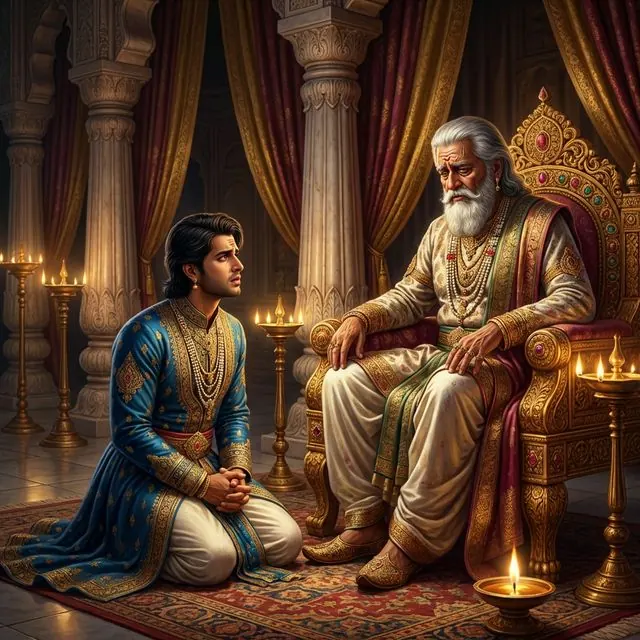
Bhishma had been lying on the arrows for many days by then, and the questions put to him had worked their way down from the nature of kingship to the running of an army. Yudhishthira sat at the head of the bed with his brothers behind him and Krishna at his side, and the field of Kurukshetra lay quiet all round them, cleared of its dead.
The question he asked that morning was not a comfortable one.
"Tell me, grandfather," Yudhishthira said, "how kings who want victory should lead their troops to battle, bull of Bharata's race, even if it means offending slightly against the rules of righteousness."
He had asked how to cheat, a little. It is worth pausing on who was asking, and on the fact that he had just finished a war in which nearly every rule he now wanted advice about bending had already been broken on both sides of the field.
Bhishma did not scold him for it.
"Some say that righteousness is made firm by truth," he said. "Some, by reasoning. Some, by good conduct. And some, by the use of means and devices. I will now tell you what the means and devices are that bring results at once."
He began with a reason for having them at all. Robbers, crossing every wholesome limit, very often destroy both property and religious merit. It is against such men that the contrivances indicated in the scriptures exist, and a king who has none of them has left the field to them.
"Both kinds of wisdom, straight and crooked, should be within the king's reach," Bhishma said. "But though he knows the crooked kind, he should not use it to injure others. He may use it to fight off dangers that come upon him."
Then the particular danger he had in mind.
"Enemies often injure a king by stirring up division among his ministers, or his troops, or his allies, or his subjects. A king who understands deceit may use deceit to counter those enemies."
That is the whole of the licence, and it is narrower than the question had been. Know the crooked road. Do not walk it to hurt a man. Walk it only to come back at someone already walking it toward you.
Leather, Iron, and the Month of Chaitra
From the crooked road Bhishma went straight to the storehouse, because the first contrivance of a king who intends to win is that he has the things.
He named them in the order a quartermaster would. Leather armour to protect the bodies of elephants, and armour of the same leather for bulls. Bones. Thorns. Keen-pointed weapons made of iron. Coats of mail. Yak-tails. Sharp and well-tempered weapons. All kinds of armour, yellow and red. Banners and standards of diverse hues. Swords, and lances, and scimitars of great sharpness, and battle-axes, and spears, and shields.
These, he said, should be made and stored in plenty.
Two instructions follow the list, and they are the ones that armies actually fail. The weapons should all be properly whetted, which is a thing that has to be done again and again to a thing already made, by men who would rather be doing something else. And the soldiers should be inspired with courage and resolution, which is not issued from a store at all.
Then the season, which Bhishma gave as plainly as a farmer would.
"The right time to set troops on the march is the month of Chaitra or Agrahayana," he said. "The crops ripen around then, and water does not run short. That time of year, Bharata, is neither very cold nor very hot. So that is when troops should be moved."
The reasoning has nothing to do with omens. Grain in the fields is grain your men can eat. Full tanks are water your horses can drink. Weather that does not kill is weather in which men will march. An army moves when the country it is crossing can carry it, and at no other time.
Except one.
"But if the enemy falls into distress, troops should march at once, without waiting for such a favourable time. These two are the best occasions for moving troops to subdue an enemy."
So there are exactly two right moments to march. When your own country is at its most generous, and when the other man's is not.
The Road, the Fort, and the Sky at Your Back
Having got the army out of its quarters, Bhishma put it on a road.
"Take the road that has plenty of water and grass along it, that is level and easy to march," he said. "The country on both sides of the road should be well scouted beforehand by skilled spies who know the woods intimately."
Spies, here, are not men who steal letters out of a rival court. They are men who know which way a stream runs and where the cane thickets stand, sent ahead to look at the ground the column will have on its flanks before the column is in it.
"Troops must not be marched through woodland like animals," Bhishma said, and the comparison is the argument. A herd goes where the trees let it. An army that does the same is a herd. "So kings who want victory should choose good roads for marching their troops. In the van should go a division of brave men, strong and of high birth."
Then the fort, described as one whose faults have been removed. Walls, and a trench full of water on every side, and only one entrance. That is the fort worthy of praise, and it is worthy of praise because with one entrance the defenders know where the fighting will be, and from inside it they can hold out against invaders.
Then the camp. Men who know war think ground near the woods much better than ground under the open sky, and the camp should be pitched not far from such a wood. Pitching the camp in such a place, posting the foot soldiers somewhere safe, and meeting the enemy as soon as he comes: those, said Bhishma, are the ways to ward off danger and distress.
And then a piece of advice about the sky.
"With the constellation called Ursa Major behind them, the troops should fight, standing firm like hills. In this way one may defeat even enemies no one can withstand. The troops should be placed so that the wind, the sun, and the planet Shukra blow and shine from behind them."
He even ranked them, since a field rarely lets you have all three.
"As a means of making victory sure, the wind is better than the Sun, and the Sun is better than Shukra, Yudhishthira."
Dust first. Glare second. The star last.
Ground for Horses, Ground for Elephants
Every kind of soldier, Bhishma said, has a kind of country that belongs to him, and the whole art of choosing a field is knowing which of your four arms you are choosing it for.
For cavalry, men who know war approve of ground that is not muddy, not watery, not uneven, and not full of bricks and stones. Horses want footing and nothing under the hoof that turns.
A field free of mud and holes suits chariot warriors. A chariot needs less than a horse does but forgives less; one hole takes a wheel.
Ground overgrown with bushes and large trees, and under water, suits elephant warriors. The ground that stops everything else does not stop them.
Ground with many places that are hard to reach, overgrown with large trees and thickets of cane, or a mountainous or wooded tract, suits infantry well. Where nothing can be ridden or driven, men walk, and the man on foot becomes the master of the place.
Then the seasons, which do the same sorting by another means. An army with a large infantry force is thought very strong. An army made up mostly of chariots and horsemen is thought most effective on a clear day without rain. An army made up mostly of foot soldiers and elephants is effective in the rainy season.
So the composition of a host decides when it should be fighting, and the ground decides where, and a commander who has attended to neither has an army that is strong only in the abstract.
"Once he has seen to these points," Bhishma said, meaning the nature of the different kinds of forces and the way of marching and quartering and leading them, "the king should turn his attention to the nature of place and time. The king who has seen to all these things, and sets out under the right constellation and on an auspicious day of the moon, always wins victory by leading his troops well."
The constellation comes last in that sentence, after the roads and the trenches and the mud, and it is easy to miss how far down the list it has been placed.
Whom You May Not Kill
He had been asked how to win by offending slightly against righteousness. Here is where he set the floor under the offence, and it is the longest single list in the teaching.
No one, Bhishma said, should kill those who are asleep, or thirsty, or exhausted. Nor those whose armour and gear have fallen away. Nor one who has set his heart on final emancipation. Nor one who is running away. Nor one who is walking unprepared along a road.
Nor one who is drinking or eating. Nor one who is mad, or one who is insane. Nor one who has been mortally wounded, or one who has been badly weakened by his wounds. Nor one who is staying trustfully, which is to say a man who has not troubled to be afraid of you, and who is therefore yours to disgrace yourself upon and nothing else.
Nor one who has begun a task and not been able to finish it. Nor one who is skilled in some special art, a miner or a maker or a man whose hands know a thing that the world will want after the war. Nor one who is in grief.
And then the list goes down through the army until it has left the fighting men entirely behind. Not one who goes out of the camp to fetch forage or fodder. Not the men who set up camps, nor the camp-followers. Not those who wait at the gates of the king or of his ministers. Not those who do menial work for the chiefs of the army, nor those who are chiefs of such servants.
Set them side by side and a single principle stands up out of them. A man may be killed while he is a soldier and not otherwise. Sleep is not soldiering. Neither is thirst, or grief, or a broken strap, or a mouthful of food, or a walk down a road, or fetching grass for the horses, or standing at a door because that is your work. The moment a man has stopped being able to fight you, or has never begun, he is out of the war and cannot be put back into it for your convenience.
The one who is running away is on that list, and so is the one who is mortally wounded. The foe who is already broken is the foe you have the least right to touch.
Let Us Swear to Conquer
Then Bhishma turned to the fighting men, and began with their pay.
Those of your warriors who break the enemy's ranks, or who rally your retreating troops, should have their pay doubled, and you should honour them with food, drink, and seats equal to your own. Those of them who command ten soldiers should be made commanders of a hundred. The watchful hero who commands a hundred should be made commander of a thousand.
Two deeds are named and no others: breaking the enemy's line, and rallying your own men when they have started to run. The second is paid as richly as the first.
Then the leading warriors should be gathered together and addressed. Bhishma gave Yudhishthira the words.
"Let us swear to conquer, and never to desert one another. Let those who are afraid stay here. Let those stay here too who would get their chiefs killed by failing to act heroically in the thick of battle. Let the men come who would never break away from battle or get their own comrades killed. Protecting themselves and their comrades, they are certain to kill the enemy in the fight."
The oath is not to be brave. It is not to leave.
Then what waits for the man who leaves. The consequences of running from battle are loss of wealth, death, infamy, and reproach. Bitter and cutting words must be heard by the man who runs from battle, who loses his lips and teeth, who throws away all his weapons, or who lets himself be taken captive by the enemy.
"May such evil consequences always fall on the warriors of our enemies. Those who run from battle are wretches among men. They only add to the count of human beings on earth. As for true manhood, they have none, here or hereafter."
And a picture of what you would be running from: victorious enemies going cheerfully after the fleeing fighters, with bards reciting their praises all the while.
"When enemies come to battle and tarnish a man's fame, the misery he feels is sharper, I think, than death itself. Know that victory is the root of religious merit and of every kind of happiness. What cowards think the greatest misery, heroes bear cheerfully. Resolved to win heaven, we should fight without a thought for life itself, and, determined to conquer or die, reach a blessed end in heaven."
Once they have taken such an oath, ready to throw away life itself, heroes should rush against the enemy's ranks.
The Needle's Mouth and the Cow-Horns
Sworn men still have to be put somewhere, and Bhishma ended with the arrangement.
In the van should go a division of men armed with swords and shields. In the rear should go the carts. In the space between should go the women who travel with the army. This, he said, should be the arrangement made for assailing the foe.
The veterans in the army should fight in the van; they will protect their comrades behind them. Those thought strongest and bravest should be placed in the van, and the others should stand behind them.
Which leaves the frightened, and Bhishma did not pretend there were none.
"Those who are afraid should be carefully comforted and encouraged," he said, and then gave the use such men are put to. These weaker fighters should be placed on the field, and not withdrawn, if only to show the enemy the size of the army.
It is a cold sentence and a merciful one at the same time. The man who is afraid is not sent home in disgrace and he is not sent to the front. He stands in the ranks and is counted, and the enemy, looking across, counts him too.
Then the shape of the line. If the troops are few, they should be drawn close together for the fight; at times, if their leader wishes, the close array may be extended wide. When a small number of troops is to fight with a great army, the array called Suchimukha should be formed, the needle's mouth, a narrow point that goes into a large body at one place rather than meeting it along its whole width.
And when a small force is engaged with a large one, Bhishma gave the leader something to say. He may shake hands with his men and shout loudly: "The enemy has broken! The enemy has broken!" The strong among them should hold off the enemy, calling loudly to their comrades: "Fresh friends have arrived! Strike your enemies without fear!"
Both cries are untrue when they are shouted. Both are the shortest road to becoming true.
Those who are ahead of the rest, he said, should shout loudly and make all kinds of noise, and should blow and beat Krakachas, cow-horns, drums, cymbals, and kettle-drums.
That is where the teaching stops. Not on a victory, and not on a rule, but on the noise a body of men makes when it has sworn not to leave one another and has begun to move.
Dharma Lesson
Bhishma was asked how to bend the rules and answered mostly by tightening them. The crooked kind of wisdom is to be kept within call and used only against a man already using it; everything else in the teaching is grass and water and whetstones and roads. The long list of those who may not be killed is the real answer to the question, because almost every name on it is a person who has already stopped being a soldier, and the oath the warriors swear is not to be brave but never to abandon one another. A war fought that way is still a war, but the men in it remain answerable to something outside it.