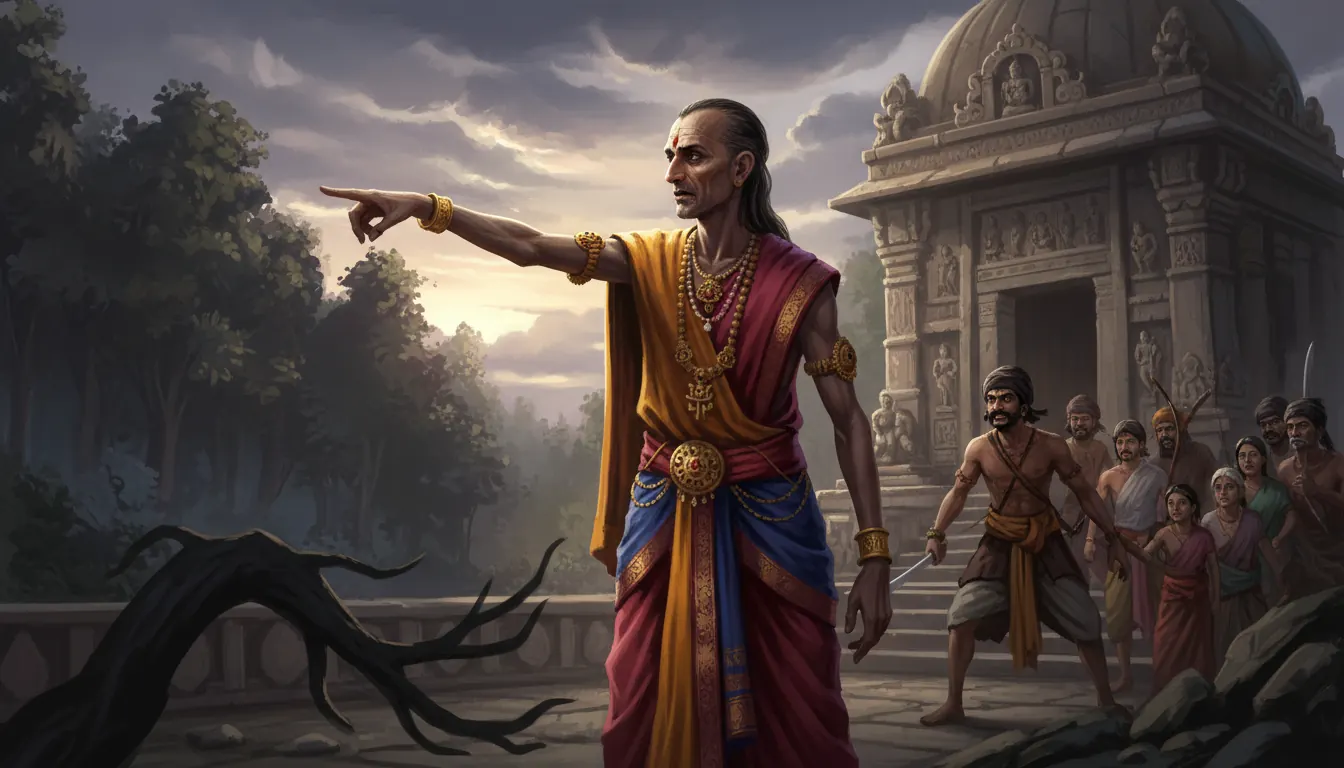
The Practices That Overcome Difficulty
Bhishma on when a truthful man may lie, and the long list of habits that carry a person through
In short
Yudhishthira asks Bhishma what truth is, what falsehood is, and on what occasions each should be spoken. Bhishma answers that there is nothing higher than truth, and then names the occasions on which even falsehood should be said, citing the hunter Valaka, who gained great merit by a killing, and Kaushika on the banks of the Ganga, who sought merit and committed a great sin. He then gives three definitions of righteousness, the rules for men who come asking questions in order to rob, and a long catalogue of the practices by which a person overcomes every difficulty, ending with Krishna sitting a few feet away.
Told in the Shanti ParvaSet in Kurukshetra and Ganga21 min read
The Question Under the Word Truth
Bhishma had just finished with the three fires. The father is the Garhapatya fire, he had said, the mother is the Dakshina fire, and the teacher is that fire upon which libations are poured, and the man who tends those three has tended everything worth tending. It was a clean answer and it closed a subject.
Yudhishthira did not let the quiet last long. He was sitting on the ground at Kurukshetra beside the bed of arrows, with his brothers behind him and Krishna a few feet away, and the question he asked next was not a beginner's question. It was the question of a man who has already been in a position where the right words and the true words were not the same words, and who has never stopped thinking about it.
"How, Bharata, should a person act who wants to hold to virtue? Bull of the Bharata line, learned as you are, tell me this, since I ask you. Truth and falsehood both exist, covering all the worlds. Which of the two, king, should a person who is firm in virtue take up? What, again, is truth? What is falsehood? What, again, is eternal virtue? On what occasions should a person tell the truth, and on what occasions should he tell an untruth?"
Read the last sentence again, because it is not the question people assume he asked. He did not ask whether a man may ever say what is untrue. He took it as settled that such occasions exist, and asked to be told which ones they were.
He was asking it of Bhishma, who had held one sentence spoken on a riverbank for a lifetime and let his house go childless rather than take a word of it back. If anyone alive was going to say that truth admits of no exception, it was the man on the arrows.
Bhishma said something else.
Nothing Higher Than Truth, and Then the Exception
"To tell the truth is consistent with righteousness," Bhishma said. "There is nothing higher than truth."
That is the whole of the ordinary doctrine, and he stated it without qualification, and then he put a warning label on what was coming next.
"Now, Bharata, I will tell you something that is not generally known to men."
Then the two clauses that the rest of the discourse hangs from.
"Where falsehood would assume the aspect of truth, truth should not be spoken. And where truth would assume the aspect of falsehood, even falsehood should be spoken."
The test he is proposing is not applied to the sentence. It is applied to what the sentence does when it lands. A statement that corresponds exactly to the facts, spoken to a man who will use it to destroy someone, has assumed the aspect of falsehood by the time it reaches him, whatever it was when it left the mouth. And a thing that is not so, said to keep such a man from what he came for, can carry truth into the world in a way that the fact could not.
"The ignorant person who speaks a truth cut off from righteousness," Bhishma said, "incurs sin."
That is a hard line and it is meant to be. It does not say the man is unlucky, or clumsy, or badly advised. It says he sins, and it calls him ignorant while it does so, and the ignorance in question is precisely the failure to see that a fact can be a weapon and that handing it over is an act with consequences that belong to the one who hands it over.
"The person who can tell truth from falsehood is the one who is said to know his duties."
Not the person who tells the truth. The person who can tell which is which. Bhishma had just moved the whole difficulty out of the mouth and into the judgment, where it is harder to see, harder to teach, and impossible to keep rules for. And having done that, he offered examples, and not one of them is comfortable.
The Hunter, the Fool, and the Owl on the Ganga
The cases came the way a lawyer cites decided matters, in a line, with the reasoning left out.
"Even a person who is not respectable, who is of uncleansed soul and very cruel, may earn great merit, as the hunter Valaka did by killing the blind beast."
Valaka killed animals for a living, which is the trade of his birth and no virtue at all, and Bhishma does not pretend otherwise. He calls him cruel and of uncleansed soul in the same breath in which he awards him the merit. The creature Valaka found at the water was blind, and it was going to destroy every living thing, and the hunter who had nothing else to his name put it down. There is no penance in the account, no repentance, no long preparation. A man of no merit did one thing that looked like slaughter and was not, and it was credited to him.
Then the same coin turned over.
"How extraordinary it is that a man of foolish understanding, though he wanted to gain merit by austere penances, still committed a sinful act."
The wanting was right and the doing was wrong. Bhishma marks it as extraordinary and moves on, because for his purposes the two cases only need to be set beside each other: intention pointing down and the act coming out clean, intention pointing up and the act coming out foul.
Then he gave that second man a name and a place, in one line. It was Kaushika, on the banks of the Ganga, who committed that great sin.
That is all of it. No season, no account of what he did on that bank or to whom. The man wanted merit, and the grandsire calls what he did a great sin, without softening, and the two are allowed to stand side by side without anybody being sent for to reconcile them.
He is not telling stories. He is producing evidence, and the evidence is deliberately bare, because the moment he supplied the circumstances a listener would start arguing about the circumstances instead of looking at what the cases have in common. A cruel man and a man who meant well. Neither of them holding a rule. Both of them, in the account, judged by the thing that actually happened.
"The question you have asked me is a difficult one," Bhishma said.
What Righteousness Is, Since You Have Asked
He said it plainly and he said it about himself as much as anyone.
"It is difficult to say what righteousness is. It is not easy to point to it. No one who speaks about righteousness can point to it exactly."
Coming from the man who had been discoursing upon righteousness for weeks on end from a bed of arrows, that is a considerable admission, and he does not use it as an excuse to stop. He gives three definitions instead, and each one is built the same way: from what dharma was for.
The first. Righteousness was declared by Brahma for the advancement and growth of all creatures. Therefore that which leads to advancement and growth is righteousness.
The second. Righteousness was declared for restraining creatures from injuring one another. Therefore that is righteousness which prevents injury to creatures.
The third is the one that lives in the word itself. Dharma is so called because it upholds. All creatures are upheld by righteousness. Therefore that is righteousness which is capable of upholding all creatures.
Three tests, and every one of them looks forward at the result rather than back at the text. Does it make things grow. Does it keep creatures from tearing at each other. Does it hold the world up. A rule that fails all three while satisfying the letter of some instruction has not been vindicated by the instruction.
Yudhishthira might reasonably have asked at that point where the scriptures had gone, and Bhishma answered before he could.
"Some say that righteousness consists in what the Srutis teach. Others do not agree. I would not censure those who say so. Everything, again, has not been laid down in the Srutis."
He declines to settle it. He will not call the second party heretics, and he will not pretend the first party has an answer for every case, and the reason he gives is the flattest sentence in the section: the books do not cover everything. Not that the books are wrong. That the world keeps producing mornings the books did not anticipate.
And on one of those mornings, Bhishma said, men come to your door and ask you a question.
The Men at the Door Asking Where the Money Is
"Sometimes men who want to get hold of someone's wealth ask questions to make the robbery easier."
Robbers, in short, standing in front of you, being polite, wanting to know where it is kept or which road the man took. Bhishma runs the case all the way through, and the ruling comes in steps, each one taken only when the step before it has failed.
First: one should never answer such enquiries. That is a settled duty, and he uses the word settled, which he does not scatter about.
Second: if by maintaining silence one succeeds in escaping, one should remain silent. Silence is the preferred instrument. It costs nothing and it gives nothing.
Third: if silence at a time when one must speak rouses suspicion, then it would be better on such an occasion to say what is untrue than what is true. This too, he says, is a settled conclusion. The moment the refusal to speak becomes itself an answer, the shelter of silence is gone, and a man may say what is not so.
Fourth: if one can escape from sinful men by even a false oath, one may take it without incurring sin. The oath is the last thing a truthful man will let go of, and Bhishma lets go of it, on that occasion, for that purpose.
And then the rule that closes the door behind all of this, so that nobody mistakes the permission for softness toward the men at the door: one should not, even if one be able, give away his wealth to sinful men. Wealth given to sinful men afflicts even the giver. Buying them off is not a virtuous alternative. It is a transaction that will find its way back to you.
Against that he sets a case where the temptation runs the other way. If a creditor wants to make his debtor pay off a loan by rendering bodily service, and summons the witnesses to the contract, and they will not say what should be said, then the witnesses are all liars. Sympathy for the debtor does not license them. The pressure there is to keep quiet out of pity, and Bhishma names silence in that chair for what it is.
Then he lists the occasions themselves. When life is at risk. On occasion of marriage. To save the wealth and prosperity of others. For religious purposes. A man who seeks virtue does not commit a sin by saying an untruth on those occasions, and the list is short, and it is closed.
Deceit Answered With Deceit
Having said when a man may break his word, Bhishma spent the rest of the section on men who never intended to keep one.
Once a man has promised to pay, he said, he is bound to keep his promise. If he fails, let the man who has taken what is not his be forcibly enslaved until it is made good. If a person behaves improperly and does not fulfil a righteous engagement, he should certainly be punished with the rod for behaving so.
Then the portrait, and it is drawn without pity. The deceitful man falls away from all duties and abandons those of his own order, and takes up the practices of the asuras to keep himself alive. Such sinful men think there is nothing in this world higher than wealth. That is the whole of their creed and Bhishma states it twice, because everything else about them follows from it.
They should never be tolerated. No one should eat with them. They should be regarded as fallen through their own sins, fallen away from the condition of humanity, shut out from the grace of the gods, and living like evil genii among people who look the same as they do. Without sacrifices, without penances. Keep away from their company.
And there is one more line about them that is neither a threat nor a rebuke but a piece of observation. If their wealth is lost, they even take their own lives, which is very pitiable. The man who has arranged his whole soul around a number has nothing left standing when the number goes.
"Among those sinful men," Bhishma said, "there is no one to whom you can say, this is your duty, let your heart turn to it."
That is why the sentence that follows is so cold. The person who killed such a creature would incur no sin. He who kills him kills one that has been already killed by his own acts. If slain, it is the dead that is slain. He who vows to destroy such senseless people should keep his vows.
Such men, he said, are like the crow and the vulture, dependent on deceit for their living, and after the dissolution of their bodies they take rebirth as crows and vultures, so that the shape at last matches the diet.
And then, in one sentence, the principle that has been under the whole discourse from the beginning.
"One should, in any matter, behave towards another as that other behaves in that matter. He who practises deceit should be resisted with deceit, while one that is honest should be treated with honesty."
How Does a Man Get Through It
Yudhishthira's next question was not about a case. It was about the weather of being alive.
"Creatures are seen to be afflicted in many ways and almost without end. Tell me, grandfather, how one can overcome all those difficulties."
What he got back was not a story and not an argument. It was a litany, and it has a shape that a listener notices within three lines, because every single item in it ends with the same five words: succeed in overcoming all difficulties. Bhishma had been asked how a man gets through, and he answered by naming, one after another, the kinds of men who do, and letting the repetition do the work that reasoning does elsewhere.
Those of the twice-born who duly practise, with restrained souls, the duties laid down in the scriptures for the several modes of life, succeed in overcoming all difficulties.
Those who never practise deceit, whose behaviour is held in by wholesome restraints, and who control all worldly desires, succeed in overcoming all difficulties.
Those who do not answer when spoken to with evil words, who do not injure others when they themselves are injured, who give but do not take, succeed in overcoming all difficulties.
Those who always give guests a hospitable welcome, who do not indulge in malice, and who are always engaged in the study of the Vedas, succeed in overcoming all difficulties.
Those who know their duties and behave towards their parents as they should, and those who do not sleep during the day, succeed in overcoming all difficulties.
Those who commit no sin of any kind in thought, word or deed, and who never injure any creature, succeed in overcoming all difficulties.
Notice what is not in the list so far. Not one item is a rite. Not one is a place of pilgrimage, or a fee, or a fast. The man who has just spent an hour explaining that a truthful sentence can be a sin is now listing the practices that carry a person through affliction, and they are almost entirely about what he does with his mouth, his temper, his sleep, and the people already inside his house.
Kings, Wives, Fire, and Fair Battle
The litany went on, and it began taking in the offices men hold.
Those kings who do not, out of passion and greed, levy oppressive taxes, and who protect their own dominions, succeed in overcoming all difficulties. Two duties, one negative and one positive, and Yudhishthira was newly crowned and heard both.
Those who go to their own wedded wives in season without seeking the company of other women, and who are honest and attentive to their Agni-hotras, succeed in overcoming all difficulties.
Those who have courage and who, casting away all fear of death, go into battle seeking victory by fair means, succeed in overcoming all difficulties. The qualifying phrase is not decoration. Courage and contempt of death are named and then fenced, and the fence is the manner of the victory, and it was said over a field where the manner of several victories would not have passed.
Those who always speak the truth in this world even when their life is at stake, and who are examples for all creatures to follow, succeed in overcoming all difficulties. He has not forgotten the earlier section. The permission to say an untruth when life is at risk was a permission, not an instruction, and here is the higher road named as the higher road.
They whose acts never deceive, whose words are always agreeable, and whose wealth is always well spent, succeed in overcoming all difficulties.
Those brahmanas who never study the Vedas at hours not meant for study, and that practise penances with devotion, succeed in overcoming all difficulties.
Those brahmanas who take up a life of celibacy and Brahmacharya, who perform penances, and that are cleansed by learning, Vedic knowledge, and proper vows, succeed in overcoming all difficulties.
Those who have checked all the qualities that belong to Passion and Darkness, who are high-souled, and that practise the qualities that are called Good, succeed in overcoming all difficulties.
And then one that stops the ear, because it describes a condition rather than a practice.
Those whom no creature fears, who themselves fear no creature, and who look on all creatures as their own selves, succeed in overcoming all difficulties.
Nothing afraid of you. You afraid of nothing. Every creature read as yourself. Three clauses, and the third is the reason for the first two.
The Ones Who Are Not Grieved by Another Man's Luck
Those bulls among men who are good, who never feel grief at the sight of other people's prosperity, and that abstain from all kinds of ignoble behaviour, succeed in overcoming all difficulties.
It is worth stopping on that one for a breath. Of all the ways a man can be afflicted, Bhishma has picked out the affliction that arrives when nothing whatever has happened to him. Somebody else did well. The grief is real, and it is named as grief, and the men who are free of it are put at the head of this stretch of the list.
Those who bow to all the gods, who listen to the doctrines of all creeds, who have faith, and whose souls are tranquil, succeed in overcoming all difficulties. Listening to the doctrines of all creeds is set down as a practice, not a danger, in the middle of a discourse on how to keep one's footing.
Those who do not want honour for themselves, who give honour to others, and who bow down to those who deserve their worship, succeed in overcoming all difficulties.
Those who perform Shraddhas on the proper lunar days, with pure minds, from desire of offspring, succeed in overcoming all difficulties. The dead are attended to on the days that belong to them, and the reason given is the living who are still to come.
Those who restrain their own anger and calm the anger of others, and that never get angry with any creature, succeed in overcoming all difficulties. Two jobs there, not one. Hold your own temper down and go and put out somebody else's.
Those who abstain from birth from honey and meat and intoxicating drinks, succeed in overcoming all difficulties.
Those who eat only to keep alive, who seek the company of women only for the sake of children, and who open their lips only to speak what is true, succeed in overcoming all difficulties.
Three appetites in one sentence, and the same instrument applied to all three: take what the purpose requires and stop there. Food to keep the body going. Marriage to make children. The mouth opened for what is so.
That is the last of the practices. What Bhishma named next was not a practice at all, and he did not have to point far to find it.
This Krishna Here
"Those who worship with devotion the god Narayana, that Supreme Lord of all creatures, that origin and destruction of the universe, succeed in overcoming all difficulties."
And then Bhishma stopped listing and used the word this.
"This Krishna here, with eyes red as the lotus, clad in yellow robes, mighty of arm, this Krishna who is our well-wisher, brother, friend, and relative, is Narayana of unfading glory."
He was speaking on a field where he had spent ten days trying to kill the army that man was driving for, and he named him to the king as a relative before he named him as God. The whole weight of the sentence is in the first word. Not Narayana somewhere, worshipped by somebody, in a rite performed at the right hour. Narayana on the ground beside the arrows, in yellow cloth, listening.
"He covers all the worlds like a leather case, at his own pleasure. He is the mighty Lord, whose soul is beyond thought. He is Govinda, the foremost of all beings."
Then the sentence that puts him back in the family. This Krishna, who is always busy doing what pleases and benefits Jishnu, and you too, king, is that foremost of all beings, that irresistible one, that home of eternal happiness. Jishnu is Arjuna, and everyone in earshot had watched the foremost of all beings hold his reins for eighteen days.
"Those who with devotion seek the refuge of this Narayana, called also Hari, succeed in overcoming all difficulties."
And having brought the litany home, Bhishma did one more thing with it, which was to hand it over.
"Those who read these verses about overcoming difficulties, who recite them to others, and who speak of them to brahmanas, succeed in overcoming all difficulties."
The list itself is now on the list. The man who cannot yet keep his temper, or his tongue, or his hours of study, can at least carry the words to somebody else, and Bhishma counts that as a way through, which is a considerable kindness from a man who had been lying on iron since the tenth day.
"I have now, sinless one, told you all the acts by which men may overcome all difficulties both here and hereafter."
He called him sinless. The king who had asked, only a little earlier, when a man is permitted to say what is not so.
Dharma Lesson
Bhishma does not lower the value of truth; he says there is nothing higher than it, and then refuses to let it be handled as a rule that works by itself. A fact given to a man who came for it in order to rob has become a lie by the time it reaches him, and the sin belongs to whoever handed it over. What he puts in place of the rule is judgment, which cannot be taught in a sentence, and then a list of unremarkable habits - not answering abuse, not sleeping in the day, not grieving at another man's good fortune - as the actual means by which people survive their lives.