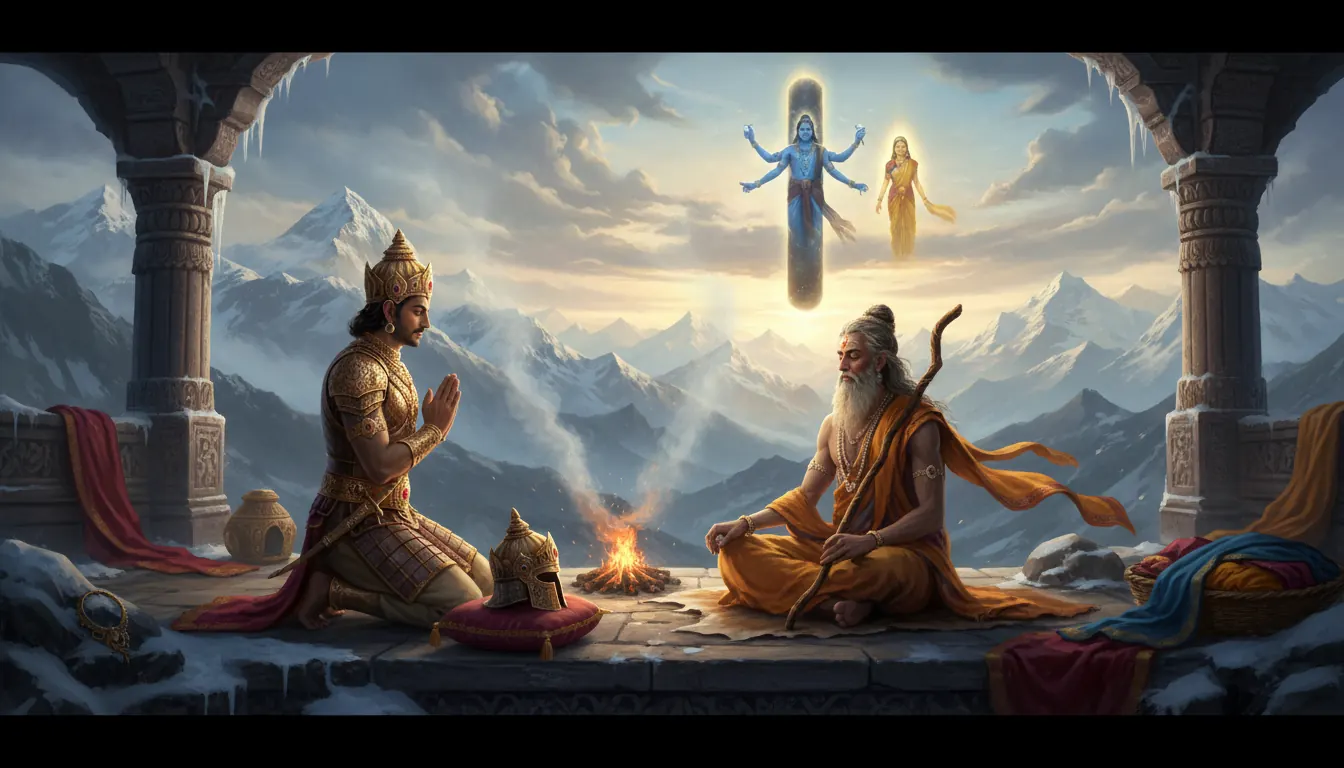
Kamandaka and the Sinning King
A king who repents asks a rishi by what acts a sin is destroyed
In short
Yudhishthira asks Bhishma how Virtue, Wealth and Pleasure are rooted in one another, and Bhishma traces the chain down to Will and appetite before naming the dross of each: reward-seeking in virtue, hoarding in wealth. He then cites the old discourse of the rishi Kamandaka and King Angaristha, who confessed a sin committed in lust and folly and asked how it could be undone. Kamandaka shows him the descent that begins when a man keeps pleasure and drops the other two, and ends with subjects living under their king like men in a room with a hidden snake. The cure is a list of public acts, ending with the words a king is to say to everyone: I am yours.
Told in the Shanti ParvaSet in Kurukshetra and Forest Hermitage16 min read
The Question After the Rod
Bhishma had just come to the end of the history of Vasuhoma.
That was the king among the Angas who had gone up to the peak called Munjaprishtha and lived there on penances until the brahmanas spoke of him as they speak of a celestial rishi, and it was to him that the emperor Mandhata had climbed in order to ask where Chastisement came from and into whose hands the rod had passed. The answer had been a long one. It had gone through the sneeze of the Grandsire and the birth of Kshupa and the confusion that fell upon the world in the interval when there was no restraint anywhere in it, and it had ended in a set of plain rules: that chastisement is to be inflicted with discrimination and not by caprice, that fines and forfeitures are meant to strike alarm and not to fill a king's treasury, and that a man should not be maimed or killed for a trivial cause.
All of that was about what a king does to other men.
Yudhishthira, sitting on the field beside the bed of arrows, asked next about what a king does with himself. He had a kingdom now, handed to him over a great many bodies, and the grandsire on the arrows was working through the whole science of ruling in the time he had left before the sun turned north.
"I wish, sir, to hear the settled conclusions on Virtue, Wealth, and Pleasure," he said. "On which of these does the course of life depend? What are the roots of Virtue, Wealth, and Pleasure? And what are the results of those three? Sometimes they are seen to mingle with one another, and sometimes to exist apart, each on its own."
That is the trivarga, the triple aggregate, dharma and artha and kama, the three things every man is understood to be spending his life on. The king was not asking which of them is best. He was asking how they are joined, because he had noticed the thing that anybody who has ever held an office notices, that on some days the three pull together and on other days they come apart in a man's hands.
Bhishma began with the days when nothing is wrong.
Where the Three Agree
"When men in this world try with good hearts to win Wealth with the help of Virtue," Bhishma said, "then those three, Virtue, Wealth, and Pleasure, may be seen to exist together, united in time, cause, and action."
Three unions are named, and they are worth taking one at a time. Union in time: the man is not being righteous this year and rich the next, he is doing both in the same hour. Union in cause: the same reason lies behind the virtue and behind the getting. Union in action: it is one act and not three, and no part of it has to be hidden from any other part. That is the whole of the good case, and Bhishma disposes of it in a sentence, because a life in which the three agree does not need much instruction.
Then he laid out how they stand to one another when they are working properly.
Wealth has its root in Virtue. Pleasure is said to be the fruit of Wealth. So the order is not a matter of taste. A man does not choose between them the way he chooses between two roads; they grow out of one another in a fixed direction, and a man who tries to take the fruit without the root is not being bold, he is being stupid about how the thing is put together.
And all three, said Bhishma, have their root in Will.
Will is concerned with objects. All objects, in turn, exist entirely to satisfy the desire for enjoyment. On these, then, the aggregate of three depends. Follow that chain down and it does not stop at virtue at all. Underneath righteousness, underneath wealth, underneath pleasure, there is the act of wanting, and underneath the wanting there is a world full of things that are there to be wanted. The triple aggregate is not a structure standing on the ground. It is a structure standing on appetite.
Which is why the next sentence is the one that the rest of the discourse has to answer for.
"Entire abstraction from all objects," said Bhishma, "is Emancipation."
He had just told a king who had inherited a kingdom that the road out of the world runs in exactly the opposite direction from the road he was on.
Remote and Proximate
Bhishma did not leave the king standing there, and what he said next is the part of the teaching that a man with duties can actually use.
He took the three down to their honest sizes first. Virtue is sought for the protection of the body. Wealth is for the acquisition of Virtue. Pleasure is only the gratification of the senses. Nothing in that list is called holy. All three, he said, have the quality of Passion, which is to say that all three are the work of rajas, the restless strand, the one that keeps a man moving and getting and doing. Even righteousness, as most men practise it, belongs to that middle quality and not to the highest.
Then he made the distinction that decides everything.
Virtue, Wealth, and Pleasure, when sought for the sake of heaven or such other rewards, are said to be remote, because the rewards themselves are remote. When sought for the sake of Knowledge of Self, they are said to be proximate.
The acts are identical. The gift is the same gift, the rite is the same rite, the day's work in the treasury is the same day's work. What differs is the distance of the thing the man has his eye on. If it is a residence in heaven, then the fruit is somewhere far off in time and the whole life is a purchase made on credit. If it is knowledge of the self, the fruit is here, in the man who is doing the act, and the act touches him while he performs it.
"One should seek them when they are of that kind," said Bhishma. "One should not cast them off even in one's mind."
That is a restraint laid on the pious and not on the worldly. It forbids the private renunciation, the throwing away in the mind of duties that the body is still going through. And if virtue and wealth and pleasure are to be abandoned in earnest, there is a condition: one should abandon them when one has freed one's self by ascetic penances. First the freedom, then the abandonment. Not the abandonment in the hope of the freedom.
"The triple aggregate aims at emancipation," Bhishma said. "If only man could reach it!"
It is not a sentence spoken by somebody who thinks it easy.
The Dross of Each
Having built the neat chain, Bhishma then broke it himself, which is the sign of an honest teacher.
One's acts, undertaken and completed with the aid of intelligence, may or may not lead to the expected results. That comes first, and it is the plain truth of every administration ever run. Then the exceptions, one after another, against the rule he had just laid down that wealth has its root in virtue.
Virtue is not always the root of Wealth, for other things than Virtue lead to Wealth: service, agriculture, the ordinary trades by which ordinary men grow rich without troubling themselves about righteousness at all. There is again a contrary opinion, for some say that Wealth is earned through chance, or through birth, or through causes of that kind, which is a way of saying that a great many rich men were simply born in the right house. In some instances, Wealth acquired has been productive of evil, so that the getting of it was the beginning of the man's ruin. And things other than Wealth, such as fasts and vows, have led to the acquisition of Virtue, which costs nothing and needs no treasury behind it.
So the tidy order of root and fruit does not hold in every case, and Bhishma says so rather than pretend.
"On this subject, then," he said, "a dullard whose understanding has been debased by ignorance never manages to reach the highest aim of Virtue and Wealth, which is Emancipation."
Then he named what actually spoils each of the two, and the naming is the sharpest thing in the discourse, because in both cases the flaw is not in the thing but in the grip of the hand that holds it.
Virtue's dross consists in the desire of reward.
The dross of Wealth consists in hoarding it.
When purged of these impurities, they bring great results. Righteousness done for what it will fetch is ore with slag still in it. Wealth kept for the pleasure of having it is the same. Neither has to be given up. Both have to be smelted.
And here, as he always did when he had said something a king would have to live inside, Bhishma reached for an old story.
"On this," he said, "people tell the story of the conversation that took place long ago between Kamandaka and Angaristha."
The King Who Waited for the Hour
Angaristha was a king, and Kamandaka was a rishi, and the first thing recorded about their meeting is not what was said but how the king behaved before he said it.
One day king Angaristha, having waited for the right moment, saluted the rishi Kamandaka as he sat at his ease.
He waited. A king with a question does not usually wait; a king with a question sends for the man who has the answer, and the man comes. This one held his question until the sage was at leisure and sitting comfortably, and then he went in and made his salutation and asked it, which tells you before a single word of the teaching that Angaristha had already begun doing the thing he was about to be told to do.
And then he asked, and there were two questions, not one.
"If a king, forced by lust and folly, commits sins that he later repents, by what acts, rishi, can those sins be destroyed?"
That is a man speaking about himself, and there is no attempt in it to make the sin sound better than it was. Not forced by circumstance. Not compelled by policy or by the necessities of the throne. Forced by lust and folly, which are the two things a king is least able to plead in a court and least able to hide from a sage. He had done it, he was sorry, and what he wanted was not absolution but a method: by what acts.
The second question was larger, and it is the one that shows he was still a king and not merely a penitent.
"And if a man, driven by ignorance, does what is sinful believing that he is acting righteously, how is the king to put a stop to that sin once it has become common among men?"
This is the harder case. The first man knows he has done wrong and repents. The second does not know, thinks himself righteous, and therefore will not stop, and worse, will teach it to others, until the thing has become a custom and every man doing it can point to his neighbour doing the same. Angaristha was asking how a ruler cleans a sin out of a country when the country does not believe it is a sin.
Kamandaka answered both, and he answered the second one first, by tracing where such a country comes from.
The Snake in the Room
"The man who gives up Virtue and Wealth and pursues only Pleasure," said Kamandaka, "reaps as the fruit of such conduct the destruction of his intelligence."
He was describing a descent, and he took it one step at a time, and each step is caused by the one above it.
First, a man drops two of the three and keeps the third. He does not become wicked at that moment; he becomes stupid. The destruction of intelligence is the first loss, and it is a loss of the faculty that would have told him what was happening to him.
The destruction of intelligence is followed by heedlessness, and that heedlessness is at once destructive of both Virtue and Wealth. So the two he abandoned are not merely set aside for a while, waiting to be picked up when he tires of pleasure. They are being destroyed while he is not looking, and he is not looking because he no longer has the eyes.
From such heedlessness proceed dire atheism and systematic wickedness of conduct. Not an occasional lapse. System. The man has arrived at a settled way of behaving badly and a settled belief that there is nothing above him to mind.
Then Kamandaka turned the whole thing from one man to a kingdom, because a king was asking.
If the king does not restrain those wicked men of sinful conduct, all good subjects then live in fear of him like the inmate of a room within which a snake has concealed itself.
Read the comparison exactly. The man is not fleeing the room. He lives in it. He goes on sleeping and eating and doing his work inside four walls where a snake is somewhere, and he does not know where, and the fear is not an event but a condition. And notice whom the subjects fear. Not the wicked men. The king, because the king is the room.
After that the ruin is quick and it is entirely social. The subjects do not follow such a king. Brahmanas and all pious persons also act in the same way. As a consequence, the king incurs great danger, and ultimately the risk of destruction itself. Overtaken by infamy and insult, he has to drag on a miserable existence.
"A life of infamy, however," said Kamandaka, "is equal to death."
He had shown the king the bottom of the road. Then he told him how to walk back up it.
I Am Yours
"Men learned in the scriptures have pointed to these means of checking sin," said Kamandaka, and then he gave the list, and the list is the answer to both of the king's questions at once.
The king should always devote himself to the study of the three Vedas. He should respect the brahmanas and do them good service. He should be devoted to righteousness. He should make marriage alliances with high families. He should wait on high-minded brahmanas who have the virtue of forgiveness, and the qualification matters, since a penitent has no use for advisers who cannot forgive. He should perform ablutions and recite sacred mantras, and thus pass his time happily.
So far it is the ordinary discipline of a good reign. Then come the four items that are actually the cure.
Banishing all wicked subjects from himself and from his kingdom, he should seek the companionship of virtuous men. That is one act with two halves, and the first half is the harder: from himself, before the kingdom. The men who helped him sin are to go before the men who merely sinned.
He should please everyone with his words or with good acts.
He should say to all: "I am yours."
He should proclaim the virtues of even his foes.
Those last three are what a king does with his mouth, and they run against everything a throne teaches a man to do with it. To say I am yours to all is to say it to the ones with nothing to give him. To praise the virtues of an enemy in public is to hand away the one advantage a ruler holds over the man he has beaten. Kamandaka is not prescribing a private penance in a closed room. Every item on the list is performed in front of the people who watched the sin, which is why it also answers the second question: the sin that has become common among men is unmade by a king visibly living the opposite of it, in the sight of the same men.
"By such conduct he may soon cleanse himself of his sins and win the high regard of all," said the rishi. "Without doubt, by conduct such as this all his sins will be destroyed."
And then he stopped instructing the king in the third person and spoke to him directly, and the last words of it are a sage handing a repentant man back to the people he had been avoiding.
"You should carry out all the high duties your elders and teachers point out to you. You are sure to win great blessing through the grace of your elders and teachers."
Dharma Lesson
The epic does not tell the repentant king to withdraw and purify himself in private. Every act on Kamandaka's list is performed in the open, in front of the same people who watched the sin, and the hardest of them are done with the mouth: to say I am yours to men who can give him nothing, and to speak the virtues of his enemies aloud. Virtue spoiled by the desire for reward and wealth spoiled by hoarding are not to be thrown away but purged, and a sin that has become a custom among men is unmade the same way it was made, by a ruler being watched.