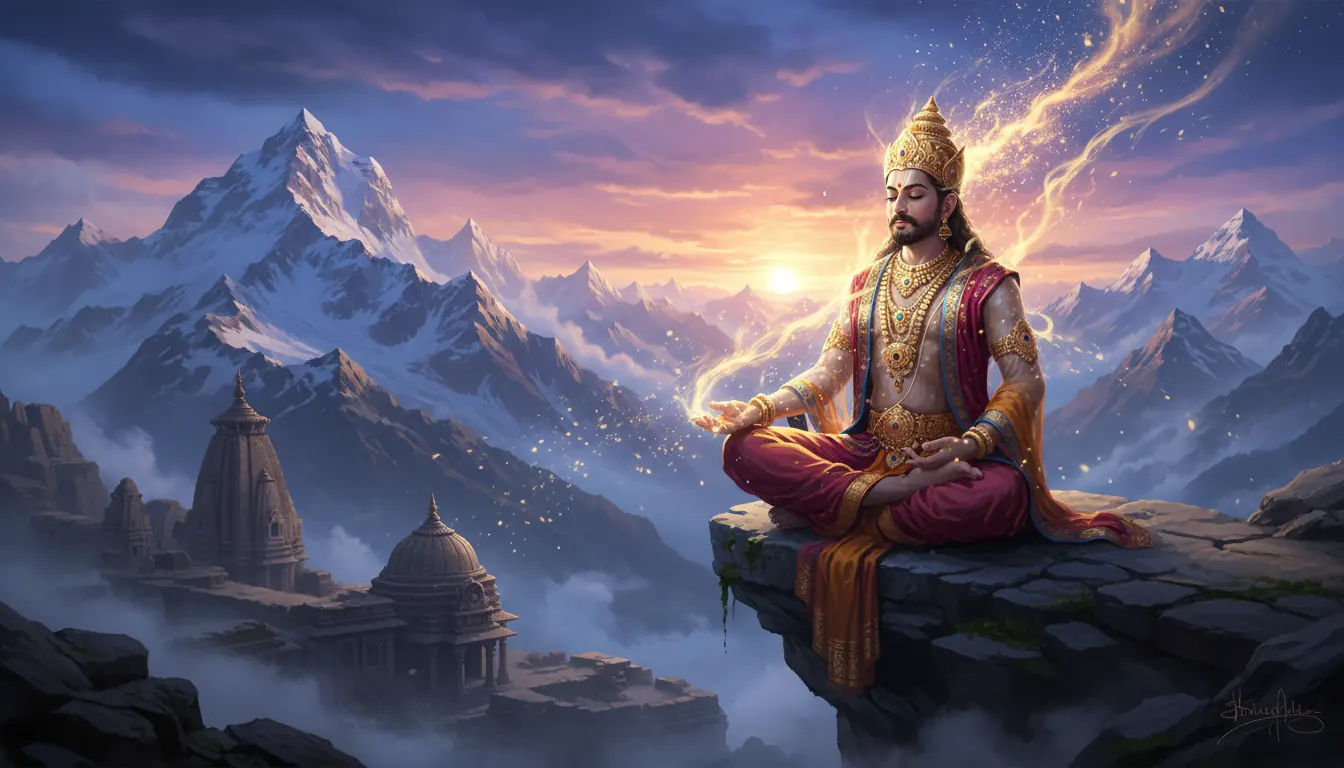
The Seven Winds
Vyasa halts a recitation on the Himavat and names the winds that move the worlds
In short
His disciples having gone down to the Earth to spread the Vedas, Vyasa recites alone on the Himavat with his son Shuka. A violent wind shakes the mountain and the recitation is stopped, and Shuka asks where the wind comes from. His father answers with the whole account of the seven winds, from the breath that drives the clouds to the one that carries life away and cannot be resisted.
Told in the Shanti ParvaSet in Himavat, Kurukshetra and Ganga20 min read
Permission to Go Down
Bhishma had been telling the story of Shuka since the morning, and by now it had carried the two of them a long way from the field where he was lying.
Shuka was the son Vyasa had struck out of the fire sticks. He had gone to Mithila with a question about emancipation, he had heard king Janaka answer it, and he had asked nothing further. He had gone north instead, to the mountains of Himavat, swift as the wind and like the wind, and at the foot of those mountains, in a secluded spot, he had found his father teaching the Vedas to four disciples: Sumantu, Vaishampayana, Jaimini of great wisdom, and Paila of great ascetic merit. Shuka came in among them like an arrow let fly from a bow, so light on the ground that he did not seem to touch the trees or the rocks, and he touched his father's feet and told him everything that had passed in the court of the king.
So there were five students on that mountain, and the recitation went on there day after day, and one day the four disciples had asked their teacher for a boon and had been given instead the rules by which the Vedas are to be taught: that they are for the man who is willing to become a disciple, that a student is to be tested as gold is tested by heat and cutting and rubbing, and that no teacher should set his students tasks that are full of danger.
They heard him out, and then they embraced one another.
"What our illustrious teacher has said for our future good will stay in our memory," they said to each other, "and we will certainly act on it."
Then they came back to him in high spirits, masters of words that they were, and asked for the thing they had been working toward all along.
"If it pleases you, mighty one, great ascetic, we would like to go down from this mountain to the earth to divide the Vedas."
Vyasa did not keep them.
"You may go to the earth or to the regions of the gods, as you like. Always be careful, for the Vedas are easily misunderstood."
They walked round him, bowed their heads, and went down.
A Mountain Without Vedic Sound
On the earth the four did exactly what they had asked leave to do. They performed the Agnishtoma and the other sacrifices. They officiated at the rites of brahmanas, kshatriyas and vaishyas. They passed their days happily as householders and were held in great respect by the brahmanas, and they grew famous and prosperous, teaching and tending sacrificial fires all over the world. The Vedas spread, which is what their teacher had told them to do.
Behind them the hermitage went quiet.
Vyasa stayed there with only his son for company. He passed his days in anxious thought, and he kept silent, sitting in a secluded corner of the hermitage, a man of great wisdom with nothing in front of him to say it to.
Into that silence came Narada, who goes everywhere, and who noticed at once what was missing.
"Twice-born rishi of Vasishtha's line, why has the sound of the Vedas fallen silent? Why are you sitting alone and silent, lost in meditation like a man absorbed in some deep thought? Without the echo of the Vedas this mountain has lost its beauty, like the moon robbed of its splendour when Rahu seizes it or dust veils it. Celestial rishis live here, yet without the sound of the Vedas the mountain is no longer beautiful: it looks like a village of Nishadas. The rishis, the gods and the Gandharvas no longer shine as they did, because they are without the sound of the Vedas."
The Island-born answered him without defending himself.
"Great rishi, you know what the Vedas declare, and everything you have said is welcome to me. It is right for you to say it to me. You know all things and have seen everything. All that has ever happened in the three worlds is known to you. So give me your commands. Tell me what to do. Parted from my disciples, my mind has become very gloomy."
Narada gave him a list of four things and a single instruction.
"The stain of the Vedas is the halting of their recitation. The stain of the brahmanas is their failure to keep their vows. The Bahlika race is the stain of the earth. Curiosity is the stain of women. Recite the Vedas with your intelligent son, and drive away the fear of Rakshasas with the echo of their sound."
Vyasa, who was devoted heart and soul to reciting the Vedas, was overjoyed and said, "So be it."
The Wind That Stopped the Recitation
So the sound came back to the mountain, and it came back from two throats instead of six.
Father and son set themselves to recite the Vedas in loud, ringing voices, keeping every rule of pronunciation, letter by letter and accent by accent, and between them they filled the three worlds with that sound. Both of them knew every duty well. Neither of them hurried. This went on for days.
Then one day, in the middle of a recitation, a violent wind rose.
It did not come like the ordinary wind of a mountainside. It seemed to be driven by the gales that blow on the bosom of the ocean, and it came up the slope of the Himavat and shook it, and the whole of that great mountain moved under a thing that could not be seen.
Vyasa stopped at once. He understood from what was happening what the hour had become, and he told his son to stop the recitation, and the Vedic sound broke off in the middle of the mountain that had just got it back.
Shuka fell silent because he had been told to. Then he became filled with curiosity, which is a thing the story has been careful to record about him more than once.
"Twice-born one, where does this wind come from? Tell me everything about the ways of the Wind."
Vyasa was filled with amazement.
It was not the question that amazed him. It was who was asking it. This was the son who had already been told by a king what emancipation was and had needed nothing further, who had come up the mountain barely touching the ground, who was completely detached from all objects of the senses. Such a man is not supposed to still want to know where a wind comes from. And yet the wind had shaken a mountain in the middle of a Veda, and the boy had asked, and there was an answer, and the answer was long.
His father began by telling him first that this was an omen: a sign that the recitation of the Vedas was to be suspended. Then, instead of stopping there, he told him the rest.
Two Paths, and the Breath That Fathered Breath
"You have gained spiritual vision," Vyasa said. "Your mind too has cleansed itself of every impurity. You have been freed from the qualities of Passion and Darkness, and you now abide in the quality of Goodness. You see your Soul with your Soul, as a man sees his own reflection in a mirror. Stay in your own Soul, and reflect on the Vedas."
Then he laid down the two roads before describing the winds that blow along them.
"The path of the Supreme Soul is called Deva-yana, the path of the gods. The path that is made up of the attribute of Tamas is called Pitri-yana, the path of the Pitris. These are the two paths in the world hereafter. By one, people go to heaven. By the other, people go to hell.
"The winds blow over the face of the earth and in the sky. They blow in seven courses. Listen, and I will tell you of them one by one."
He began not with the sky but with the body, because the two are the same account told at two sizes. The body is furnished with senses, and those senses are ruled by the Sadhyas and by many great beings of mighty strength, and from that source came a son who could not be conquered, and his name was Samana. From Samana sprang Udana. From Udana sprang Vyana. From Vyana arose Apana, and last of all, from Apana, sprang the wind that is called Prana.
And Prana, that invincible destroyer of all enemies, remained childless. The line stops there. There is no eighth breath waiting to be born.
"The wind is the cause of the different functions of all living creatures," Vyasa said, "and because living creatures are able to live by it, the wind is called Prana, which is to say life."
That is the hinge of the whole teaching, and it is worth holding on to before the catalogue begins. What is about to be described is weather. Clouds, lightning, the rising of the moon, rain, storms that break trees, the wind that holds up the celestial Ganga. And every one of them is also something happening inside the chest of the man being told about it, at that moment, on that mountain, while he holds his recitation.
"Now I will tell you the different functions of those winds."
Pravaha, and Avaha
"The wind that comes first in the list, called Pravaha, drives the masses of cloud born of smoke and heat along the first course. As it moves through the sky and meets the water held in the clouds, it shows itself in brightness among the darts of lightning."
That is the first of the seven, and it is the one a man sees on any hot afternoon without knowing what he is looking at. The clouds that pile up out of smoke and heat do not walk to their places. Something drives them along a road. And when that same something meets the water they carry, it does not stay invisible: it shows itself, briefly, as the light inside the lightning. The wind is in the flash. It is the same wind that was moving the cloud a moment before, and the flash is the only part of the whole operation that the eye is allowed to catch.
Vyasa had said that within the body the winds carry other names, and Pravaha is the one the wise call Samana, the breath at the middle of a man, the one that keeps the fire of digestion going where the food is. What drives cloud along the sky drives food through the body, and what strikes as lightning is the same power, on a smaller stage, doing the same work.
"The second wind, called Avaha, blows with a loud noise. It is this wind that makes Soma and the other lights rise and appear. Within the body, which is the universe in small, the wise call that wind Udana."
The moon does not simply come up. It is raised. So are the other lights, planet and star alike, and the wind that lifts them is not a quiet one: it goes with a loud noise, which is why the sky is never silent even on a still night if a man knows how to listen to it.
And the same wind, in a body, is Udana, the breath that goes upward. It is the one that carries speech out of a man's throat. So the power that lifts the moon over the ridge of the Himavat is the power that was lifting the Vedas out of Shuka's mouth an hour earlier, and there is no difference between them except scale.
Udvaha, and Samvaha
"The wind that sucks up water from the four oceans, gives it to the clouds in the sky, and then presents the clouds to the god of rain, is the third in the list and is called Udvaha."
Here is the whole water cycle, given as a chain of deliveries with a servant carrying the parcel at every stage. The wind goes down to the four oceans and draws the water up out of them. It hands what it has taken to the clouds. Then it does not stop there and let the rain happen by itself: it takes the loaded clouds and presents them, formally, to the god whose office is rain, the way a steward brings a full vessel to the master of a house. Nothing in the sequence is automatic. Every step of it is somebody carrying something to somebody.
"The wind that holds up the clouds and divides them into many portions, that melts them to pour down rain and then makes them solid again, that is heard as the roar of the thundering clouds, that takes the form of the clouds itself to preserve the world, and that carries the chariots of all celestial beings across the sky, is called Samvaha. It is the fourth in the list, and it is so strong that it can tear apart the very mountains."
The fourth wind is given more work than any of the others, and every item on its list is worth taking separately. It holds the clouds up. It breaks the mass of them into portions and drives the portions apart. It melts a cloud so that the rain falls out of it, and then it hardens the same cloud again so that there is something left to melt tomorrow. When thunder is heard, that sound is not a by-product of the cloud: the roar is the wind itself, perceived. And because the world would not last a season without rain, this wind exists for the preservation of the world, and to do that work it takes the form of the clouds, so that the thing carrying and the thing carried are one.
It has one more duty, and it is the one that shows what it is. The chariots of the celestials do not fly. They are borne along the sky by Samvaha. The wind that carries water is strong enough to carry gods, and strong enough, when it chooses, to rend a mountain apart.
Vivaha, and the Wind That Holds Up the Ganga
"The fifth wind has great force and speed. It is dry, and it uproots and breaks down all trees. The clouds that go with it are called Valahaka. That wind brings about disasters of many kinds and makes roaring sounds in the sky. It is called Vivaha."
This is the one everybody has met. It is dry, which is the first thing said of it and the worst, because a wind that carries no water takes water instead. It comes at speed. It pulls trees out of the ground by their roots and breaks the ones it cannot pull. The clouds that ride with it get a name of their own, Valahaka, and they are not the gentle sort. Its work is listed as calamitous phenomena of many kinds, and it announces itself with a roaring in the firmament before anybody sees what is coming.
Four of the seven, so far, have been busy with water and light and the movement of things through the sky. The sixth is different. Its whole office is to hold something back.
"The sixth wind carries all the celestial waters in the sky and keeps them from falling. It holds up the sacred waters of the celestial Ganga, and it blows to keep them from flowing downward."
Everything above is heavy, and it is not falling, and the reason it is not falling is a wind. The Ganga of the sky is held in the sky by nothing but this, and it blows continually to keep the river up.
Two other things follow from the same wind, and Vyasa gives them both.
"Blocked by that wind from a great distance, the Sun, which is really the source of a thousand rays and lights up the world, appears as a shining body of only one ray. Through the action of that wind the Moon, after waning, wanes again until he shows his full disc. That wind, foremost of ascetics, is called Parivaha."
So the sun a man looks at is not the sun. The thousand rays are all there, and this wind stands between at a great distance and lets one through, and the disc in the sky is what is left of a fire nobody could survive seeing whole. And the moon that thins away night after night is not dying. It is being worked upon by the same wind, and the wearing away runs on past the dark and comes back around into the full, so that waning and filling are one continuous action of one wind, and not two things at all.
Paravaha, the Last and Irresistible
"There is a wind that takes away the life of every living creature when its hour comes, whose track Death and Yama, the son of Surya, follow. It is the source of the immortality won by yogis of subtle sight who are always engaged in Yoga meditation. With its help the thousands of grandsons of Daksha, lord of creatures, born through his ten sons, reached the ends of the universe long ago. Its touch brings Emancipation, freeing a man from having to return to the world. That wind is called Paravaha. It is the foremost of all winds, and no one can resist it."
The seventh is the one that carries the breath out of a body at the appointed hour, and it is worth noticing the order in which it is described. The wind goes first. Death comes behind it, and Yama, the son of the Sun, comes behind that. Neither of them leads. They follow a track that has already been made, and the making of the track is not their work but the wind's, and it is done at the proper hour and not before.
Then the same sentence turns over, and the wind that ends life is called the source of immortality.
It is the road that the yogis of subtle sight take, the ones always engaged in meditation, and they go along it while alive. It was the road that the grandsons of Daksha travelled, the thousands of them born of his ten sons, who with its help reached the ends of the universe in ages past. And its touch, simply its touch, is enough to free a man from the obligation of coming back, which is what emancipation means and all that it means.
So the wind that kills and the wind that liberates are not two winds with a resemblance between them. They are one wind, doing one thing, met by different men in different conditions. It carries out whatever it comes to carry, and the difference is entirely in what it finds when it arrives.
"The foremost of all winds," Vyasa said again, because it needed saying twice, "no one can resist it."
There is no argument to make against it, no penance that holds it off, no weapon and no vow. Of the seven that move the worlds, six can be watched. This one can only be met.
The Breath of Vishnu's Nostrils
"These winds are wonderful," Vyasa said, "and all of them are the sons of Aditi. They go everywhere and hold up all things, and they blow all around you without ever clinging to you."
That is the seven finished, and it is also the whole answer to the boy's question about the conduct of the Wind. They go everywhere. They hold everything up. And of the man they are blowing around at this moment, on this mountain, they take no hold whatever, which is precisely the condition Shuka had spent his life trying to reach.
Then Vyasa came back to the particular gust that had interrupted them.
"But this is truly wonderful: that this greatest of mountains should be shaken so suddenly by the wind that has begun to blow. This wind is the breath of Vishnu's nostrils. When it is driven out with speed, it blows with great force, and the whole universe is shaken."
The Himavat had moved. That was the thing that had made him stop the recitation, and now the reason for it was on the table: what had come up the slope was not one of the seven going about its business but a breath, taken by somebody, and the somebody was Vishnu, and when that breath is driven out hard the universe shakes with it.
And there is a rule that follows from it, which is the rule that had shut Shuka's mouth an hour before.
"So when the wind blows violently, those who know the Vedas do not recite them. The Vedas are a form of wind. If they are uttered with force, the outer wind is tormented."
Two breaths were being driven at once, one out of a man's chest and one out of the nostrils of a god, and they are made of the same thing. The recitation is wind shaped into syllables. When the great wind is already blowing hard, a man who pushes his own out against it is not being pious. He is putting a strain on something enormous, and the mountain under him is evidence of what that something can do when it is agitated.
So they waited. The gale went over the Himavat and passed, and the trees stopped moving, and the air on the slope came back to rest.
Then the mighty son of Parashara told his son to go on with his Vedic recitation, and the sound started again in the place where it had broken off. And when it was going steadily, Vyasa rose and left that spot, and went down to plunge into the waters of the celestial Ganga, which are held up in the sky, and held there by the sixth wind.
Dharma Lesson
The seven winds are one power met in seven conditions, and the last of them, which takes life away at the appointed hour, is the same one whose touch sets a man free. Vyasa does not teach his son to master the wind or to stand against it; he teaches him to know when to stop reciting. The Vedas are themselves a form of wind, and forcing breath out against a breath already blowing is not devotion but strain. Wisdom here is a matter of timing rather than effort, and of recognising that what upholds everything holds on to nothing.