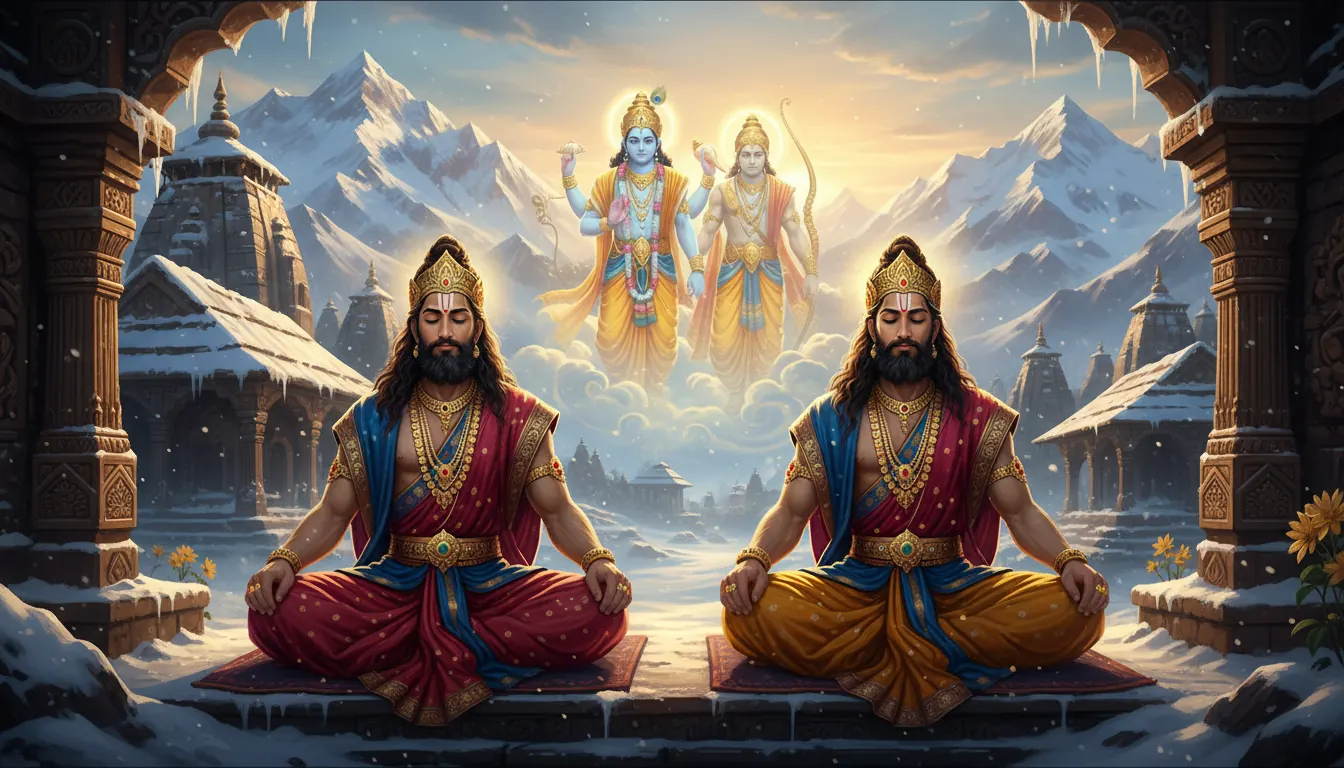
The Curses of the Rishis
Krishna names the marks that brahmanas left on gods, seas and mountains
In short
Arjuna asks Krishna how Agni and Soma came to be one in nature, and gets the creation of the world, the making of the brahmanas, and then a catalogue of what those brahmanas have done to their superiors. Indra's green beard, Rudra's third eye and blue throat, a sea filled with monsters by a priest who wanted clean water, the whirl on Vishnu's breast, the Sun called Martanda, trees forbidden to flower out of season, an undrinkable ocean and a Himalaya emptied of gems.
Told in the Shanti ParvaSet in Kurukshetra, The Ocean and Himavat19 min read
The Question About Agni and Soma
Vaishampayana was telling Janamejaya what Krishna had once told Arjuna, and the two of them, the king and the reciter, had come by then to the far end of the Narayaniya, where the names of Hari are explained one by one and each name turns out to have an old story folded inside it.
The last thing Krishna had said was that Agni and Soma, fire and the moon-plant, appetite and food, complete one another, that between them they fill the whole universe of moving and unmoving things, and that the gods have Agni for their mouth.
Arjuna would not let that pass.
"How did Agni and Soma, long ago, come to share one original nature?" he said. "This doubt has arisen in my mind. Dispel it, slayer of Madhu."
It is a question about the beginning of things, and Krishna answered it by going back to the point where there were no things at all.
"I will tell you an ancient story, son of Pandu, of things that sprang from my own energy. Listen to it closely."
When four thousand Yugas have passed, as the gods measure them, the dissolution of the universe comes. The Manifest disappears into the Unmanifest. All creatures, moving and unmoving, are destroyed. Light goes. Earth goes. Wind goes. Darkness spreads over everything and everything becomes one infinite expanse of water, and while that waste of water alone exists, like Brahman without a second, it is neither day nor night. Neither aught nor naught exists. Neither the manifest nor the unmanifest.
The Sruti says it flatly. Day was not. Night was not. Aught was not. Naught was not. In the beginning there was only Tamas, and Tamas is the night of Narayana.
Out of that darkness the foremost of Beings sprang, the eternal and immutable Hari, unborn, formless, without senses, having Brahman for his parent. And from that Purusha came into existence the Being called Brahman, the Grandsire, who wished to create creatures.
He created Agni and Soma first, and he caused them to spring from his own two eyes.
Soma in the Mouth, Agni in the Hand
After the two came out of Brahma's eyes, the creatures came, in their due order, as brahmanas and kshatriyas.
That is the part of the answer Arjuna had not expected. Agni and Soma are not only a fire and a plant. They came out of the Creator's face before anything else did, and when men were made they were made out of the same two things. He who came into life as Soma was none other than Brahma, and those born as brahmanas were all, in reality, Soma. Those who came into being as kshatriyas were none other than Agni.
The brahmanas had greater energy than the kshatras, and Krishna did not pretend the claim was modest. If you ask the reason why, he said, the answer is that this superiority is an attribute plain to the whole world. The brahmanas represent the eldest creation as regards men.
Then the rule that follows from it, which is a rule about hospitality and not about rank. A man who puts food into the mouth of a brahmana is held to be pouring libations into a blazing fire to please the gods. The sacrifices the brahmanas perform strengthen the gods, and the gods, so strengthened, make the Earth fruitful and so support every living creature. But what the foremost of sacrifices achieves can as well be achieved through the mouth of a brahmana. A man with no altar and no fee to pay has a fire in front of him whenever a learned guest is hungry.
Sanatkumara sang a verse to the same effect. Brahman, in creating the universe, first created the brahmanas. They become immortal by studying the Vedas and go to heaven through the aid of such study. Their intelligence, speech, acts, observances, faith and penances hold up the Earth and the heaven together, like slings of string holding up a vessel.
And Krishna described what a country looks like when it does not keep them. There the oxen do not carry the people or draw the plough. No vehicle of any kind bears them. Milk kept in jars is never churned for butter. The people lose every kind of prosperity and take to the ways of robbers.
There is no duty higher than Truth, he said. There is no superior more worthy of reverence than the mother. No one does more than the brahmana to bring happiness in this world and the next.
Then he said the thing the rest of the discourse would be spent proving. As I created the gods and the Asuras and the great rishis, so I have set the brahmanas in their places.
And he began to count what the brahmanas had done to the gods.
Four Marks Left on the Bodies of Gods
The list is short and it is not arranged as praise. It is arranged as evidence, and every item on it is a disfigurement.
For his lustful assault on Ahalya, Indra was cursed by Gautama, her husband, and by that curse a green beard grew on the face of the king of the gods. Through the curse of Kaushika he lost his testicles as well, and the other gods, unwilling to leave him so, made up the loss afterwards with the testicles of a ram. The lord of heaven walks about the three worlds carrying both repairs.
At the sacrifice of king Saryati, the great rishi Chyavana wished to make the twin Ashvins sharers of the sacrificial offerings, and Indra objected, because the physicians of the gods were not, in his judgment, fit to be given a portion. Chyavana insisted. Indra sought to hurl his thunderbolt at him. And the rishi paralysed his arms where they were, lifted, with the bolt in them.
Furious that Rudra had destroyed his sacrifice, Daksha took up severe austerities once more, and by the power he gained he made something like a third eye appear on Rudra's forehead, for the destruction of Tripura, the triple city of the Asuras. Read that carefully. The eye that the world thinks of as the god's own was put there by a rishi whose sacrifice the god had wrecked, and it was put there to be used.
And when Rudra set himself to the destruction of that triple city, the teacher of the Asuras, Ushanas, provoked beyond endurance, tore a matted lock from his own head and hurled it at him. From that lock sprang many serpents, and the serpents began to bite Rudra, and his throat turned blue. There is another account of that throat, belonging to the period of the Self-born Manu, in which it was Narayana who seized Rudra by it, and the mark of the hand stayed. Krishna gave both accounts and did not choose between them. Both of them explain the same blue.
A green beard. A ram's testicles. A third eye. A blue throat.
Four of the most famous marks in heaven, and not one of them was worn by choice.
The Muddy Water at the Churning
At the churning of the Ocean to raise the amrita, when every deity and every Asura in the three worlds was at the rope and the mountain was turning in the water, one brahmana had gone a little apart from the work to do his own.
Brihaspati of the race of Angiras, the priest of the gods, sat down on the shore of the Ocean to perform the rite of Puruscharana. It is a long preparatory discipline of repetition, and like every rite it begins with achamana, the sipping of a little water from the palm.
He took up a little water for it, and the water looked very muddy to him.
That is the whole of the offence. There was no insult offered and no refusal made. The sea was simply dirty on the day the chief priest of heaven bent down and put his hand into it, and he had come to it, as he saw the matter, for the express purpose of touching it.
"You stay this dirty," he said to the Ocean, "even though I have come to you to touch you. You have not made yourself clear and clean. So from this day on you will be tainted with fishes and sharks and tortoises and other creatures of the water."
Ever since, the waters of the ocean have swarmed with all kinds of sea-animals and monsters.
There is something worth sitting with in the shape of that curse. He did not dry the sea up and he did not poison it. He filled it. Every shark that has ever turned under a hull, every enormous slow thing that lives where the light stops, every creature the fishermen name in a lowered voice, is in the water because a man could not get a clean mouthful out of it one morning at the beginning of the world.
The gods went on churning. They got their nectar. And the sea they had been stirring was never afterwards a place a man could stand in without company.
A Handful of Water Thrown at a Passing Foot
Long ago, while the great rishi Bharadwaja was saying his prayers beside the celestial Ganga, the sky above him was interrupted.
Vishnu had taken his three-footed form and was measuring the worlds with three strides, and one of those three strides came down through the upper air and reached the spot where the rishi was standing in the water with his prayers half finished.
At that strange sight, Bharadwaja struck Vishnu with a handful of water.
He did not fall on his face. He did not sing. A foot the size of the sky came through his morning devotions and he did what a man does when something enormous shoulders into the place where he is working, which is that he threw water at it, and the water struck the god's breast, and it left a mark.
Where that mark fell, Vishnu's breast took on the whorl called Sreevatsa.
That is the sign the poets never tire of. It is on the chest of Narayana in every description of him, and Narada looked for it when he wanted to be sure whom he was talking to at Badari, and the whole of the White Island knows him by it. It got there because a startled brahmana splashed him.
Krishna added one more of the same kind, more briefly, because the outcome of that one is on every hearth in the world. Cursed by Bhrigu, greatest of rishis, Agni had to become a devourer of all things.
Before the curse, fire ate what was given to it with mantras. After the curse, fire eats anything. The god who carries the offerings to the gods will also take a house, a forest, a body, a book, whatever is put against him, without asking whether it was offered.
Two rishis, two gods, two permanent changes. One of them made the most beautiful mark in the scriptures and the other made the most dangerous thing men keep in their homes.
The Alms Aditi Would Not Give
Once upon a time Aditi, the mother of the gods, cooked food for her sons.
She had a reason for the cooking that went beyond a mother feeding her children. She thought that if the gods ate that food and were strengthened by it, they would succeed in killing the Asuras. The pot on her fire was a weapon of the war in heaven, and everything that went into it was going into the arms of her sons.
After the food had been cooked, and before the gods had come, Budha presented himself at her door.
He is the presiding deity of the luminary that bears his name, and he had just then completed the observance of an austere vow, which is the state in which a man is most nearly a fire himself and least able to be refused. He said what a guest of that kind says.
"Give me alms."
Aditi, though asked for food, gave him none. She was not being miserly and she was not being proud. She thought that no one should eat the food she had cooked before her sons, the gods, had eaten first. She had cooked for a purpose and the purpose had not yet been served, and she looked at the ascetic standing in her doorway and weighed him against the war, and told him to wait or told him nothing.
Angered that Aditi had refused him alms, Budha, who through the austere vow he had completed was Brahma's own self, cursed her.
He did not curse her sons and he did not curse the food. He went for the one part of her that had made the decision. Because she had refused him alms, she would have a pain in her womb when Vivaswat, in his second birth from Aditi's womb, was born in the form of an egg.
The curse waited a long time, as such curses do. When the time came, and the Sun was to be born of her a second time, Aditi remembered what had been said at her door and reminded Vivaswat of the curse of Budha. And he came out of her womb in that shape.
That is why Vivaswat, the god who is worshipped in the Shraddhas for the dead, is called Martanda, which is to say, the one born of a lifeless egg.
The mother of the gods had held back one meal, and the name of the Sun was changed by it.
The Trees That Flowered Out of Jealousy
On the northern slopes of Meru, a rishi named Sthulasiras was practising very severe austerities.
He was living on air alone, and ate nothing at all, and his body was scorched by what he was doing to it. Into that clearing a pure breeze came, charged with all kinds of delicious perfumes, and it began to blow across him and fan him, and the man who had given up everything else was delighted by it. It was the only pleasant thing left in his life and it cost nobody anything.
The trees around him saw him being pleased.
Krishna is precise about what moved them, and the word he uses is jealousy. The trees were jealous, so they put forth their flowers, all of them, out of season and all at once, to make a display and win his praise. They wanted the credit for the sweetness in the air. They wanted the ascetic to look up and notice them instead of the wind.
The rishi was displeased with the trees, because jealousy had made them do it, and he cursed them.
"From now on you will not be able to bloom at all times."
That is why the world has seasons of flowering rather than a permanent one. Every orchard that stands bare in the cold months, every tree a man walks past for eight months of the year without looking at it, is under the sentence of an ascetic who was annoyed at being flattered.
It is the smallest quarrel in the whole catalogue and it has the largest visible consequence. The green beard is on one god and the blue throat is on another. This one is on every hillside on earth, and it renews itself every spring, when the trees are let out for a while and then shut again.
They had done nothing at all except try to be admired at the wrong moment, by a man who was not looking at them and had not asked.
The Ocean That Did Not Come When It Was Called
Long ago, to do good to the world, Narayana was born as the great rishi Vadavamukha.
That is the detail to hold on to before the rest of it happens, because it changes the shape of what follows. The god who is telling Arjuna this story was, in that birth, the man in the story, and the thing he was about to curse was his own creation, and he was doing it, the text says, to do good to the world.
While he was practising severe austerities on the slopes of Meru, he summoned the Ocean to come to him.
The Ocean did not come. Whether it was pride, or the ordinary slowness of very large things, is not said. A rishi on a mountain sent for the sea and the sea stayed where it was.
Angered by this, the rishi did not go down to it. With the heat of his body alone, from where he sat, he made the waters of the Ocean as salty as human sweat.
Consider the exactness of that. Not bitter and not foul. The salt of a man's own body, which is what comes out of him when he works or is afraid, put into every sea on the planet, so that the taste of the ocean would be the taste of the labour of the one who called it and was not obeyed.
Then he sealed it. "From now on your waters will not be fit to drink. Only when the Equine-head that roams inside you drinks them will they be as sweet as honey."
Because of that curse the waters of the Ocean taste salty to this day, and no one drinks them but the Equine-head that moves in them.
Every man who has ever been thirsty within sight of an unlimited quantity of water has been standing inside that sentence. There is more of it than of anything else in the world, and there is a mouth somewhere in it for which it is honey, and that mouth is not ours.
The Mountains That Have No Gems
The last of them concerns a marriage that was already arranged.
The daughter of the Himavat mountains, named Uma, was desired by Rudra, and Himavat had promised her hand to Mahadeva, and the matter was settled in the way such matters are settled between a father and the bridegroom he has chosen.
Then the great rishi Bhrigu came to Himavat and said, "Give me this daughter of yours in marriage."
Himavat answered him plainly and without insult. "Rudra is the bridegroom already chosen by me for my daughter."
It was the only answer he could have given, and it was true, and Bhrigu heard in it a refusal and a slight.
"Since you refuse me your daughter's hand and insult me like this, you will no longer be rich in jewels and gems."
To this day, because of the rishi's words, the mountains of Himavat have no jewels and gems in them. Men go up into the greatest range in the world and come back with herbs and ice and stories. The stones are elsewhere.
"Such," said Krishna, "is the glory of the brahmanas."
Then he closed the ring he had opened, and gave Arjuna the answer to the question he had actually asked. It is by the favour of the brahmanas that the kshatriyas can possess the eternal, undecaying Earth as their wife and enjoy her. And the power of the brahmanas is itself made up of Agni and Soma. The universe is upheld by that power, and is therefore upheld by Agni and Soma united together.
Surya and Chandramas, he said, are the eyes of Narayana. The rays of Surya are my eyes. The one warms the universe and the other refreshes it, and because of that warming and that refreshing the two of them have come to be called the Harsha, the joy, of the world.
"It is because of these acts of Agni and Soma, which hold up the universe, that I have come to be called Hrishikesha, son of Pandu."
Arjuna had asked how fire and moon came to be one thing. He had been given a green beard, a paralysed arm, a third eye, a blue throat, a sea full of monsters, a whirl on the breast of God, a fire that eats everything, a sun called the child of a dead egg, an orchard that flowers only in its season, an undrinkable ocean and a range of mountains with nothing in it.
They are one thing, and every one of them is a mark left on the world by a man who owned nothing.
Dharma Lesson
The catalogue is not a boast about rank. Every curse in it was provoked by something small: a muddy palmful of water, a meal held back for an hour, a tree flowering at the wrong moment, a father who had already promised his daughter. What the epic is showing is how much permanent damage a concentrated life can do when it is crossed carelessly, and how little the one who does it seems to gain. The gods carry the marks, the sea carries the monsters, the mountains are empty, and not one of the rishis is described as satisfied.