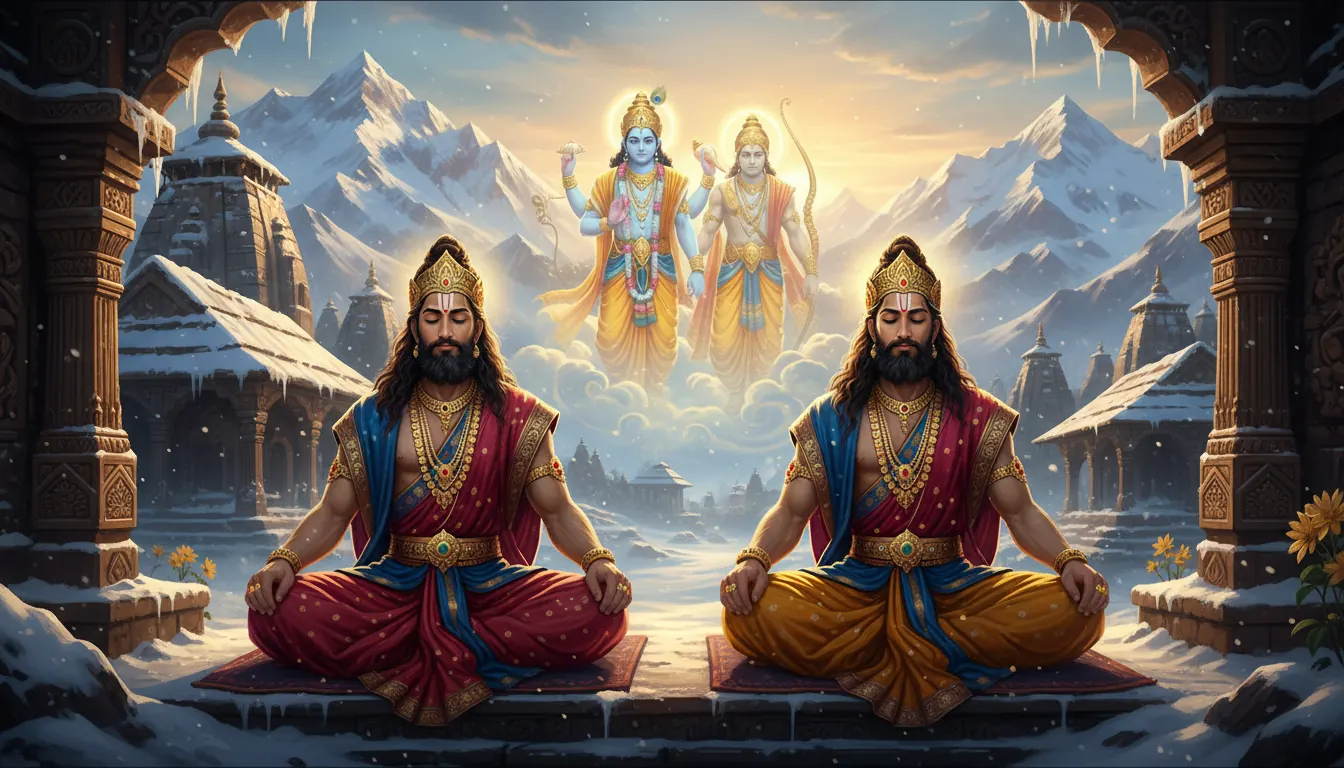
The Gold Mountain in the Ocean of Milk
Brahma tells Rudra of the one Purusha whom neither of them can see
In short
Janamejaya asks whether there are many Purushas or only one, and Vaishampayana answers with an old narrative. Brahma keeps his true residence not in his heaven of gods and Gandharvas but alone on Mount Vaijayanta, a gold peak in the Ocean of milk, where he meditates on the one universal Purusha. His son Rudra, dropping out of the sky, asks who is left for the self-born creator to meditate upon, and Brahma describes a Supreme Purusha whom he himself cannot comprehend.
Told in the Shanti ParvaSet in Kshira Sagara, Brahmaloka and Naimisharanya17 min read
The Question Janamejaya Asked
Janamejaya had heard a great deal about Narayana by then, and the question he asked next was the one that all of it had been circling.
"Twice-born one," he said, "are there many Purushas, or only one? Who is the greatest Purusha in the universe? And what is said to be the source of all things?"
Vaishampayana, who was Vyasa's disciple and who had the whole epic from his teacher's mouth, did not answer it out of his own head.
"The thinkers of the Sankhya and Yoga systems speak of many Purushas, jewel of Kuru's race," he said. "Those who follow these systems do not accept that there is only one Purusha in the universe."
That is the difficulty, stated plainly. Purusha means the person, the conscious one, the self that stands behind a set of eyes and looks out through them. Sankhya counts them and finds them innumerable, one to every creature. And yet the same books speak of a Purusha who is single and supreme. Vaishampayana did not pretend the two statements were the same statement.
"Just as the many Purushas are said to have one origin in the Supreme Purusha," he said, "so this whole universe may be said to be one with that single Purusha of higher attributes."
Then he bowed, as he always did before saying anything he had not earned himself, to his teacher Vyasa, greatest of rishis, who knew the soul, rich in penances, self-restrained, and worthy of reverent worship.
"This teaching on Purusha is found in all the Vedas, king. It is well known to be one with Rita and with Truth. Many rishis, Kapila the first of them, have given their views on it, both in general and in detail. By the grace of Vyasa of immeasurable energy, I will explain to you what Vyasa has said in brief on this question of the Oneness of Purusha.
"There is an old story on this, of a conversation between Brahma and the Three-eyed Mahadeva."
It is an old story even by the standards of the Shanti Parva, and it has only two people in it, and both of them are gods.
The Gold Mountain in the Ocean of Milk
In the midst of the Ocean of milk there is a very high mountain of great brightness like that of gold, known by the name of Vaijayanta.
Nothing else is said about it. No forests, no cities, no attendants, no gates. A gold mountain standing up out of a white sea, and that is the whole of the description, and the emptiness of it is the point, because of what the Grandsire used it for.
The illustrious god Brahma would often leave his own home of great splendour and happiness and go there all alone, to spend his time thinking on the course of Adhyatma. Adhyatma is the enquiry into the self, the turning of the mind back along the line of its own looking. The creator of the worlds had a habit of leaving the worlds and going out to sea to do it.
While the four-faced Brahma was seated there, his son met him one day in the course of his wanderings through the universe.
Mahadeva had sprung from his father's forehead. That is how Rudra came into being, and it is worth remembering while reading what follows, because everything the two of them say to each other is said between a father and a son who was born out of a thought. The Three-eyed Shiva, great in power and in Yoga, was travelling through the sky in those far-off days when he looked down and saw Brahma seated on that mountain, and so he dropped quickly onto its peak.
With a glad heart he came before his father and worshipped his feet.
Seeing Mahadeva prostrated at his feet, Brahma took him up with his left hand.
Then the one Lord of all creatures spoke to the son he had not seen for a long time.
"Welcome, mighty-armed one. By good luck I see you here with me after so long. I hope, my son, that all is well with your penances and your Vedic study and recitation. You always keep to the severest penances, so I ask you how those penances of yours are going."
It is exactly what any father asks. How is the work going.
Why the Grandsire Sits Alone
"Illustrious one," Rudra said, "by your grace all is well with my penances and Vedic studies. And all is well with the universe."
He had answered for himself and then, in the same breath, for everything that exists, because he is one of the few who can. Then he came to what he had actually dropped out of the sky to ask.
"I saw you a long while ago in your own home of happiness and brightness. I have come from there to this mountain where your feet now rest. I am very curious to know why you have withdrawn from your usual realm of happiness and splendour to such a lonely spot. There must be some great reason for it, Grandsire."
And he set out the comparison, item by item, so that his father could hear how strange the choice sounded from outside.
"Your own supreme home knows no pain of hunger or thirst, and gods and Asuras live there, and rishis of immeasurable splendour, and Gandharvas and Apsaras too. You have left that happy place to live alone on this greatest of mountains. The cause must be a serious one."
Read the list again and notice that it is a list of company. Hunger and thirst are named once and then dropped. What fills Brahma's own heaven is beings: gods, Asuras, sages of immeasurable splendour, the musicians, the dancers. It is the most populous place in existence and nothing in it can hurt you, and its owner had walked out of it to sit by himself on a rock in the middle of a white ocean.
Brahma's answer was four lines long and it did not apologise for anything.
"This greatest of mountains, called Vaijayanta, is always my home. Here, with my mind gathered, I meditate on the one universal Purusha, who is infinite."
Always my residence. Not a retreat, not an occasional practice. The heaven full of gods was the place he visited. This was where he lived.
Many Purushas, and One
Rudra heard the phrase and stopped on it, and the objection he raised is the objection anybody with a clear head would raise.
"You are Self-born," he said. "You have created many Purushas, and you are creating others still, Brahma. But the Infinite Purusha you speak of is one and single. Who is that greatest of Purushas you meditate on, Brahma? I am very curious about this. Please clear away the doubt that has taken hold of my mind."
The force of it lies in the first three words. Self-born. There is nobody above Brahma in the order of creation. He was not made; he makes. Every Purusha in the universe came out of him and more are coming out of him while the two of them are speaking. So when the maker of all the persons sits on a mountain in the middle of the sea and meditates on a Person, the son wants to know who is left for him to meditate on.
"My son," Brahma said, "there are indeed many Purushas, as you say. But the one Purusha I am thinking of is beyond all Purushas, and cannot be seen."
Then he gave the relation between the many and the one, which is the answer to the question Janamejaya had asked at the beginning.
"The many Purushas in the universe rest on that one Purusha. And since that one Purusha is said to be the source of all the countless Purushas, they can all, if they manage to strip themselves of attributes, enter into that one Purusha, who is one with the universe, who is supreme, the highest of the high, eternal, and himself free of all attributes and above them."
So the many are not a mistake in the counting and the one is not a figure of speech. The many are real and they are numberless and every one of them came from the same place, and there is a road back, and the toll on that road is everything by which a person can be described.
He Cannot Be Seen by You, or Me
"Listen, my son," Brahma said, "to how that Purusha may be described."
What follows is a description offered by someone who says in the middle of it that he cannot see the thing he is describing.
"He is eternal and unchanging. He does not decay, and he cannot be measured. He pervades all things. Best of all creatures, that Purusha cannot be seen by you, or me, or others."
Not by you. Not by me. The Grandsire put himself on the same side of the line as his listener, and then named the only ones who are shut out entirely: those who have the understanding and the senses but lack self-restraint and tranquillity of soul. The Supreme Purusha, it is said, can be seen only with the help of knowledge.
"Though He has no body, He dwells in every body. And though He dwells in bodies, He is never touched by what those bodies do. He is my Antaratma. He is your inner soul. He is the all-seeing Witness who dwells in every embodied creature and watches its acts. No one can ever grasp or comprehend him."
Then the images, which are the oldest way anyone has found to say this.
"The universe is the crown of his head. The universe is his arms. The universe is his feet. The universe is his eyes. The universe is his nose."
And then the name, arrived at by an argument rather than announced. Alone and single, he roves through all Kshetras, unrestrained by any limits on his will and as he likes. Kshetra is another name for body, a field. And because he knows all Kshetras, as also all good and bad deeds, therefore he who is the soul of Yoga is called by the name of Kshetrajna, the knower of the field.
"No one succeeds in perceiving how he enters into embodied creatures and how he goes out of them."
Then the admission.
"In the Sankhya way, and with the help of Yoga and the proper keeping of its ordinances, I think on the cause of that Purusha. But alas, I cannot comprehend that cause, excellent as it is."
The creator of the worlds, on the golden mountain, at his own practice, reporting failure. And then going on anyway.
"Still, as far as my knowledge reaches, I will tell you of that eternal Purusha, his Oneness and his supreme greatness."
Fire in a Thousand Places
"The learned call him the one Purusha. That one eternal Being deserves the name Mahapurusha."
Then Brahma gave his son five examples, and they are all examples of the same shape, drawn from things a person can stand and look at.
"Fire is an element, but it may be seen to blaze up in a thousand places under a thousand different circumstances. The Sun is one and single, but his rays extend over the wide universe. Penances are of various kinds, but they have one common origin from which they have flowed. The Wind is one, but it blows in various forms in the world. The great Ocean is the one parent of all the waters in the world seen under various circumstances."
Fire, sun, penance, wind, water. Nobody counts fires. A man with a lamp and a man with a forge and a village with a hundred hearths are not the owners of a hundred fires, they are places where the one thing is occurring.
"Without attributes, that one Purusha is the universe spread out without end. The infinite universe flows from him, and when the time of its destruction comes it enters again into that one Purusha, who is beyond all attributes."
Then he named the price of the road he had spoken of before, and it is stated in three clauses and not one of them is comfortable.
"By casting off the awareness of body and senses, by casting off all acts, good and bad, by casting off both truth and falsehood, a person strips himself of attributes."
Good acts go with the bad ones. Truth goes with falsehood. Not because there is nothing to choose between them, but because a man who is still the sort of thing that can be described as truthful is still a thing with attributes.
"Whoever realises that inconceivable Purusha, understands his subtle existence in the fourfold form of Aniruddha, Pradyumna, Sankarshana and Vasudeva, and through that understanding reaches perfect peace of heart, enters into that one auspicious Purusha and becomes one with him."
Some learned people, he said, speak of him as the supreme soul. Others regard him as the one soul. A third class of learned men describe him as the soul. The truth is that he who is the Supreme Soul is always free of attributes. He is Narayana. He is the universal soul, and he is the one Purusha.
"The fruits of acts never touch him, just as water thrown on a lotus leaf never soaks it."
The Knower and the Thing Known
There is a second soul in the account, and Brahma kept it separate.
"The Karanta, the acting Soul, is different. That Soul is sometimes engaged in acts, and when it manages to cast off acts it attains Emancipation, that is, oneness with the Supreme Soul. The acting Soul has the seventeen possessions."
Seventeen: five senses of knowledge, five of action, five vital breaths, the mind, the understanding. That is the whole inventory of a person as the Sankhya counts him.
"So it is said that there are countless kinds of Purushas, each in its order. In reality, though, there is only one Purusha."
Then the list that shuts every door.
"He is the home of every ordinance that governs the universe. He is the highest object of knowledge. He is at once the knower and the object to be known. He is the thinker and the object of thought. He is the eater and the food that is eaten. He is the smeller and the scent that is smelled. He is at once the one who touches and the object that is touched. He is the agent that sees and the object that is seen. He is the hearer and the object that is heard. He is the conceiver and the object that is conceived. He has attributes and is free from them."
Every pair in it is one that experience keeps apart. The eye and the thing looked at. The mouth and bread. Say both sides are the same and nothing is left over to be a second thing.
"What was named Pradhana earlier, the mother of the Mahat tattwa, is nothing but the Brightness of the Supreme Soul, for He is eternal, indestructible, without end and forever unchanging. It is He who lays down the first ordinance for Dhatri himself. Learned brahmanas call Him Aniruddha. All the gods and all the rishis, their souls at peace, take their places at the altar and offer him the first share of their sacrifices."
Then the Grandsire put himself and his son into the line of descent, in one sentence, in that order.
"I, Brahma, the first master of all creatures, was born from Him, and you were born from me. From me have flowed the universe with all its moving and unmoving creatures, and all the Vedas, my son, with their mysteries."
Rudra had come to ask why his father sat alone on a mountain, and was being told that both of them stood rather far down a line that began somewhere else.
Awakened by His Own Knowledge
"Divided into four parts," Brahma said, "He takes His pleasure as He likes. That illustrious and divine Lord is even such, awakened by His own knowledge."
Awakened by His own knowledge. Nobody woke him. There was nothing else there to do it.
"So I have answered your questions, my son, in the way the Sankhya system and the Yoga philosophy explain the matter."
And that is the end of the discourse. There is no vision granted at the close of it and no boon and no transformation. The Three-eyed one had prostrated himself, been raised by the left hand, asked his question, and received an answer that included the sentence that Purusha cannot be seen by you, or me, or others. Then the story simply stops, on a gold mountain in the Ocean of milk, with a father and a son sitting where they had been sitting.
What the two of them had settled between them was Janamejaya's question, and Vaishampayana had chosen the narrative because of who is in it. If the answer had come from a sage it could have been doubted. It came from the self-born maker of all persons, delivered to the god who wanders the universe and sees everything in it, and what he said was that above the creator there is one who is not created, whom the creator meditates upon and cannot comprehend, whose cause he had been trying to think his way to for ages and had not reached.
The many Purushas are real. They are as many as there are bodies, and every one of them is a field with a knower sitting in it. The one Purusha is real, and he is the field and the knower both, and the way from the many to the one runs through the surrender of everything by which a person could be picked out from another person.
That is what Brahma was doing out there, alone, with the ocean all round him and the worlds he had made somewhere behind his back.
Vaishampayana turned back to the king who had asked, and left it where the old narrative left it, and went on to other things.
Dharma Lesson
The creator of every person in the universe spends his time contemplating a Person he admits he cannot see or comprehend, and he says so to his own son rather than pretending otherwise. Devotion here is not certainty; it is the willingness of the highest being there is to keep sitting with a question that is larger than he is. The many souls are not an illusion to be dismissed, but the road back to their source is paid for by giving up everything that distinguishes one soul from another, good acts along with bad, truth along with falsehood.