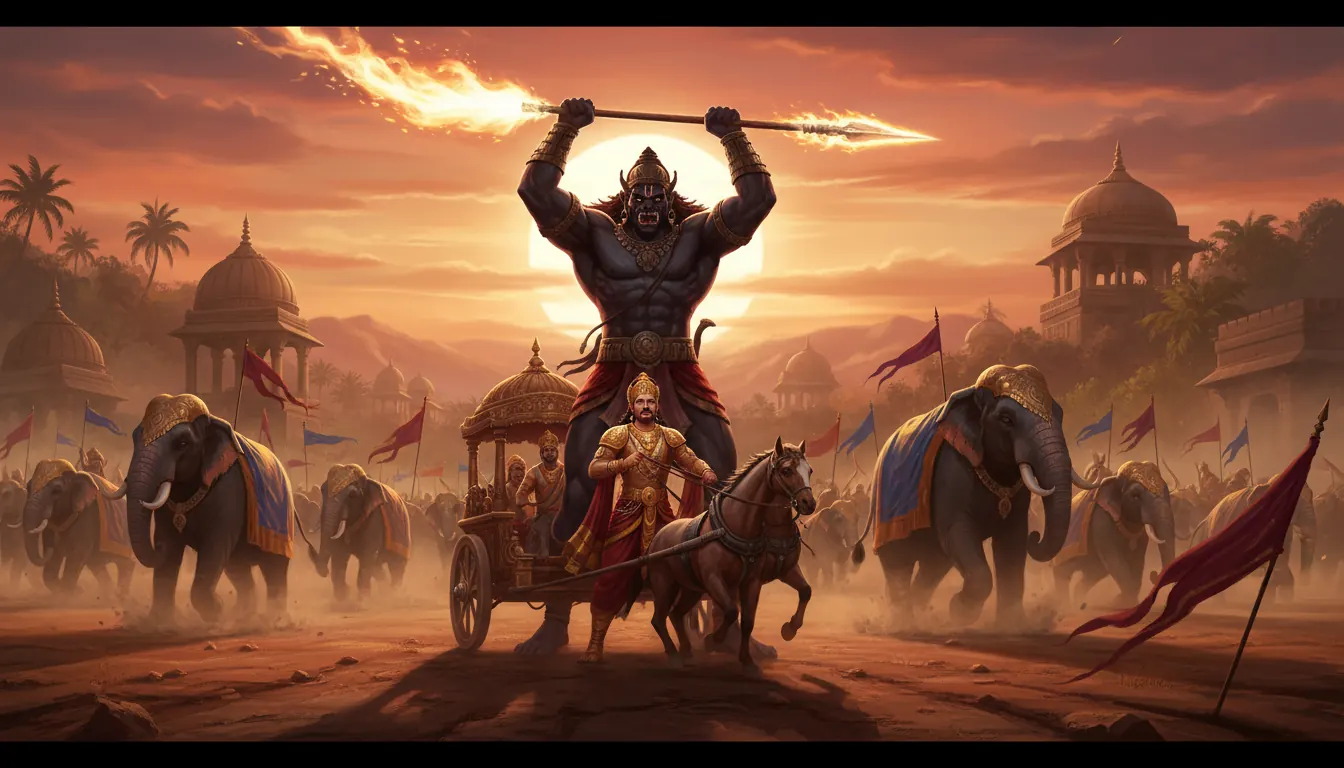
The Three Columns
At midday on the eighth day the Pandava army splits into three attacking bodies, Arjuna's son Iravan is killed, and Bhishma sends thirteen warriors to pull Duryodhana out of the fire.
In short
Dhritarashtra, hearing that Bhima has killed another handful of his sons, asks what Bhishma and Drona were doing, and Sanjaya answers him with Vidura's old warning about the dice. Then at midday Yudhishthira divides his host into three columns, one thrown entirely at Bhishma, one at the allied kings, one at the Kaurava princes. In the cavalry fighting on the flank Arjuna's naga-born son Iravan destroys six brothers of Shakuni before Alambusha kills him by illusion, and Ghatotkacha's answering roar brings Duryodhana himself out to fight. When the king is nearly overwhelmed, Bhishma sends the greatest warriors of the army to save him.
Told in the Bhishma ParvaSet in Kurukshetra and Hastinapura20 min read
The Question the King Asked at Midday
The eighth day of the war was half gone when Sanjaya broke off his account, and the blind king in the hall at Hastinapura put a question to him that was not really a question about tactics.
"Sanjaya, my sons are so many, and I see them killed by a single man. What were Bhishma and Drona and Kripa doing in the battle? Day after day, Suta, my sons are being killed. I think an evil destiny has overtaken them completely, since my sons never win and are always beaten."
Dhritarashtra then named the men who were supposed to prevent exactly this. Drona and Bhishma. The great-hearted Kripa. Somadatta's heroic son. Bhagadatta. Ashwatthama. Other brave warriors whose names he did not trouble to say.
"My sons stand in the midst of those heroes who never retreat, and they are still being killed in battle. What can that be but fate?"
Having laid the thing on fate, he laid it somewhere else in the very next breath.
"Wicked Duryodhana would not understand our words before, though I warned him, my son, and Bhishma and Vidura warned him too. Gandhari was forever forbidding him, for his own good, and still that foolish, wicked man never woke from his folly. Now that conduct has borne fruit, since day after day Bhimasena, in a rage, sends my senseless sons to the realm of Yama."
Sanjaya was the king's charioteer and reporter, and he had been listening to this king for a long time, and he did not let it stand where it had been put.
"Those wise words of Vidura, spoken for your good, which you did not understand then, have now come true. Vidura said: keep your sons away from the dice."
That was the whole of the charge, and it was aimed at the man who had asked the question and not at his son.
"Like a man whose hour has come and who refuses the right medicine, you would not listen to the friends who wished you well and gave you counsel. The words of the righteous have now come true before your eyes. The Kauravas are being destroyed because they rejected the words of Vidura and Drona and Bhishma and your other well-wishers, words that deserved to be accepted. These very consequences were already in motion on the day you refused to listen."
Then he went back to the field, because that was his office and not his opinion.
"But now hear my account of the battle, exactly as it happened."
The Army Divides in Three
At midday the battle became terrible, and the slaughter was great.
What Sanjaya had to describe from that hour was not a duel. It was an arrangement. Yudhishthira, the son of Dharma, gave one command, and the whole Pandava army moved at once, and it moved in three separate pieces, each with its own object.
The first column went at one man. Dhrishtadyumna and Shikhandi and the mighty chariot warrior Satyaki, with their forces, went against Bhishma alone. Virata and Drupada, with all the Somakas, rushed against Bhishma alone. The Kaikeyas, and Dhrishtaketu, and Kuntibhoja, in their mail and backed by their forces, rushed against Bhishma alone. The phrase is repeated three times in the account because the thing itself was repeated three times, army after army thrown at a single old archer who had been grinding them down since sunrise.
The second column went at the kings. Arjuna, the sons of Draupadi and the mighty Chekitana went against all the rulers fighting under Duryodhana's command, which was the largest and least glorious part of the Kaurava strength and the part that could actually be broken.
The third went at the brothers and the rest. The heroic Abhimanyu, the mighty chariot warrior who was Hidimbi's son, and Bhimasena in a rage rushed against the other Kauravas.
So the Pandavas, in three bodies, began to slaughter the Kauravas, and the Kauravas in their turn began to slaughter their enemies.
Drona took the first column's flank. In a rage, that greatest of chariot warriors rushed against the Somakas and the Srinjayas, meaning to send them to Yama's realm, and loud cries of grief went up among the brave Srinjayas as Bharadwaja's son cut them down, bow in hand. Great numbers of kshatriyas struck down by Drona could be seen writhing like people in the agony of disease. All over the field there were moans and shrieks and groans without pause, like the cries of the starving.
And mighty Bhimasena, in a rage, like a second Yama, made a terrible slaughter among the Kaurava troops.
There in that dreadful battle, as the warriors killed one another, a terrible river began to flow, its waves made of blood. And that battle between the Kurus and the Pandavas, fierce and terrible, began to swell the population of Yama's kingdom.
The Field in Its Ornaments
Bhima went for the elephants.
He fell on the Kaurava elephant division with tremendous force and began to send many of them to the realm of Death. Struck by Bhima's arrows, some of those beasts fell, some stood paralysed, some shrieked in pain and some ran off in every direction. Huge elephants, their trunks cut off and their limbs mangled, screaming like cranes, began to crash to the earth.
Nakula and Sahadeva fell on the cavalry, and the twins did to the horses what their brother was doing to the tuskers. Horses with garlands of gold on their heads, their necks and breasts adorned with gold, could be seen killed by the hundreds and the thousands. The earth was strewn with fallen horses. Some had lost their tongues, some breathed hard, some moaned low, and some were dead.
Sanjaya said a strange thing then, and he said it twice. The earth looked beautiful with those horses of so many kinds. At the same time she looked fiercely splendid with the great number of kings Arjuna had killed in that battle.
Then he gave the inventory, because the beauty was in the inventory. Broken chariots. Torn banners. Brilliant umbrellas. Ripped yak-tail whisks and fans. Mighty weapons broken to pieces. Garlands and necklaces of gold, bracelets, heads still wearing their earrings, headdresses knocked loose from heads, standards, the beautiful floors of chariots, traces and reins.
Strewn with all of it, the earth shone as brightly as she does in spring when she is strewn with flowers.
That is the image the account leaves on the field at the height of the eighth day, and it is not offered as consolation. It is offered because a man watching from a height that afternoon would in fact have seen a plain covered in gold and colour, and would have had to come down to know what it was made of.
And the destruction ran both ways. That, said Sanjaya, was how the Pandava army suffered when Bhishma son of Shantanu, Drona the greatest of chariot warriors, Ashwatthama, Kripa and Kritavarma were blazing with anger. And in the same way the Kaurava army suffered the same destruction whenever the Pandava heroes were in a rage.
Neither side, that hour, was doing anything to the other that was not being done back.
Horses Out of Every Country
Into that, on the Kaurava side, came the horsemen.
The glorious Shakuni, son of Subala, rushed against the Pandavas, and so did Hridika's son Kritavarma of the Satvata race, that killer of enemy heroes. Smiling as they came, they surrounded the Pandava army with a mass of cavalry that Sanjaya took the trouble to describe breed by breed, as a man describes wealth: the best of the Kamboja stock, horses born in the country of the Rivers, horses of Aratta and Mahi and Sindhu, the white horses of Vanayu, and lastly the horses of the hill countries, and others of the Tittri breed, very swift, fast as the very winds.
Against that came another mass of horses, clad in mail and decked with gold, the best of their kind, and at their head rode a young man most of that army had never seen.
His name was Iravan, and he was Arjuna's son.
The account stops the battle to say who he was, because he had not been raised among the Kurus and nobody there was likely to know him. His mother was a daughter of the king of the Nagas. Her first husband had been killed by Garuda, and she was left helpless, childless and heartbroken, and the great-hearted Airavat gave her to Arjuna, and Partha accepted her as she came to him. The boy was born of that union. His wicked uncle, who hated Partha, cast him out, so he grew up in the land of the Nagas under his mother's protection, handsome, strong, accomplished, his prowess impossible to check.
When he heard that Arjuna had gone to Indra's realm, he went there. He stood before his father with joined hands and said, "I am Iravan. Blessings on you, lord, I am your son," and he reminded him of how he had met his mother, and Arjuna remembered all of it exactly as it had happened and embraced him.
There was one instruction. "When the battle comes, you must help us."
"Yes," said Iravan, and went away, and now the battle had come, and so had he.
His horses, decked with gold, of many colours and tremendous speed, suddenly swept over the field like swans on the face of the great deep.
The Sons of Subala and a Man on Foot
The two cavalry masses met chest to chest.
His horses fell on the Kaurava horses and struck chests and noses against them, and battered by the force of their own collision both sides suddenly went down, with a noise like the noise of Garuda's swoop. The riders crashed into one another and began to kill one another fiercely. Horses that broke free of the press ran wildly over the field. Brave warriors, weakened by one another's arrows, their horses killed under them and worn out with the effort, died fast, hacking at one another with swords.
When both divisions were thinned and only a remnant was left, six younger brothers of Shakuni rode out of the Kaurava array to the front of the battle. Gaya, Gavaksha, Vrishava, Charmavat, Arjava and Shuka, on fine chargers that were like the storm itself in speed and in the violence of their rush, well-trained and neither old nor young. Those Gandhara warriors, in mail, skilled in battle, fierce to look at, longing for heaven and for victory and full of delight, broke into the Pandava cavalry and drove deep into it.
Iravan watched them come in and turned to his own men, decked with all kinds of ornaments and weapons, and gave them the only order he is recorded as giving.
"Find a way to destroy these warriors of Dhritarashtra, all of them, with their weapons and their horses."
"Yes," they said, and set about it, and the sons of Subala could not bear to watch their own men go down. They surrounded Iravan on all sides, ordered their followers to take him with lances, and swept over the field, throwing everything into confusion.
Pierced with lances and bathed in the blood that ran from his wounds, Iravan looked like an elephant pierced with the hook. Wounded deeply in the chest, the back and the flanks, one man against many, he never lost his natural steadiness. He tore the lances out of his own body and struck the sons of Subala with them.
Then he drew his polished sword, took up a shield, and got down off his horse to finish it on foot.
They were mounted and he was not, and still their fast horses could not give them a chance to strike him. When they closed in to take him alive, he struck off their right and left arms with the sword and mangled their other limbs, and those gold-decked arms fell to the earth with the weapons still in them.
Only Vrishava, covered in wounds, got out of that alive.
The Rakshasa Who Could Be Reborn
Duryodhana looked at his uncle's brothers lying on the field and sent for a rakshasa.
Alambusha, the son of Rishyasringa, was a great bowman, terrible to look at and skilled in illusion, and he carried an old grudge against Bhimasena for the killing of Vaka. Duryodhana put the grudge to use.
"Look, hero, at the harm Phalguni's mighty son has done me. He is a master of illusion, and he has destroyed my forces. You too can go wherever you wish, and you are master of every weapon of illusion. You too hate Partha. So kill this man in battle."
"Yes," said Alambusha, and went with a lion's roar.
He made two thousand phantom chargers ridden by terrible rakshasas armed with spears and axes, and Iravan's men killed all of them, and then the two were left facing each other with their forces gone, like Vritra and Vasava. Iravan cut the rakshasa's blazing sword with his own and smashed his shield into five pieces. Alambusha rose into the sky. Iravan, who could take any form at will and knew where the vital parts of a body lie, rose after him and cut his limbs to pieces, again and again, and each time the rakshasa was reborn young, because for them illusion is natural and age and form are matters of will. Hacked with the axe, he poured out blood in torrents and roared until the roars became deafening.
Then Alambusha took on a huge and fierce form and reached out to seize the son of Arjuna, and Iravan called on his mother's people. A Naga of his mother's line came to him, took on a huge form as mighty as Ananta himself, and covered the rakshasa in serpents.
Alambusha took the shape of Garuda and ate them.
That was all. With the Naga of his mother's line devoured by illusion, Iravan was bewildered, and while he stood like that Alambusha killed him with the sword and struck his head to the earth, the head with its earrings and its diadem, beautiful as a lotus or the moon.
The whole Kaurava army, said Sanjaya, was freed from grief.
Arjuna, somewhere in the second column, killing kings who were protecting Bhishma, did not know that his own son had been slaughtered.
The Roar That Made the Earth Tremble
Ghatotkacha found out first.
He was Bhima's son by Hidimbi, a rakshasa on his mother's side and a Pandava on his father's, fighting in the third column with Abhimanyu, and when he saw Iravan killed he let out a shout. The earth, with the ocean for her robe and with her mountains and her forests, began to tremble violently. The sky trembled, and all the directions, the main ones and those between. The thighs and other limbs of the troops began to shake at the sound, sweat broke out on them, and every fighter on the Kaurava side lost heart. All over the field warriors stood still, like an elephant that has heard a lion.
Then he came on, roaring like thunder, in a terrible form, a blazing spear raised in his hand, surrounded by many great rakshasas of fierce shapes armed with every kind of weapon, like the Destroyer himself at the end of the Yuga.
Duryodhana rode out to meet him.
That should be said plainly, because it is not the way he is usually remembered. His own troops were running from the rakshasa, and the king took up his bow with an arrow on the string and went at Ghatotkacha, roaring like a lion himself. Behind him came the ruler of the Vangas with ten thousand elephants huge as hills, the juice of rut running down every one of them.
Ghatotkacha saw the elephant division rise on the field like a cloud and burned with rage, and his rakshasas rushed at it, weapons in hand, roaring like lightning-charged clouds. With arrows and darts and swords and long shafts, with spears and mallets and battle-axes and short arrows, with mountain peaks and large trees, they began to strike down that elephant army. Some of the beasts had the domes of their foreheads smashed, some were bathed in blood, some had their limbs broken or cut through.
When the elephant army was broken and thinned, Duryodhana did not withdraw. In his rage he rushed at the rakshasas without a thought for his own life, sent clouds of sharp arrows at them, and killed many of their best warriors. With four arrows he killed four of the chief rakshasas, Vegavat and Maharudra and Vidyujihva and Pramathin, and then loosed showers of arrows on the rest that could hardly be withstood.
When he saw the king do that, the mighty son of Bhimasena blazed up.
The Debt I Owe My Fathers
He drew his great bow, bright as lightning, and charged at Duryodhana like Death sent by the Destroyer, and the king did not shake at all.
His eyes red with anger, Ghatotkacha spoke first, and what he said was not about the day's fighting.
"Today I will be free of the debt I owe my fathers, and my mother too, whom your cruelty kept so long in exile. You beat the sons of Pandu in that game of dice. You had Drupada's daughter Krishna brought into the assembly when she was unwell and wearing a single garment, and you, most wicked of men, tormented her in many ways. While she was living in her forest retreat, your friend, that wicked wretch the ruler of the Sindhus, persecuted her again, with no regard for my fathers. For these wrongs and others, you disgrace to your race, I will have my vengeance today unless you leave the field."
Then he drew his gigantic bow, biting his lower lip and licking the corners of his mouth, and covered Duryodhana with a heavy shower of arrows, like a mass of clouds pouring torrents of rain on a mountainside in the rainy season.
The king bore it, said Sanjaya, as a giant elephant bears a shower out of the blue. Then, full of anger and sighing like a snake, in very great danger, he shot twenty-five sharp, keen-pointed arrows, and they fell on that great rakshasa like angry snakes of deadly poison on the slopes of Gandhamadana. Blood ran down Ghatotkacha's body, and he looked like an elephant with split temples.
Then the man-eater set his heart on destroying the Kuru king. He took up a huge dart that could pierce even a mountain, blazing with light, bright as a great meteor, flaming like lightning itself, and raised it.
The ruler of the Vangas saw the dart go up. He drove his hill-sized elephant across the front of Duryodhana's chariot and covered the chariot completely with the animal's body.
Ghatotkacha's eyes went red, and he threw the dart at the elephant instead. Struck by it, the beast fell, covered in blood and in great agony, and died, and the king of the Vangas jumped clear and landed on his feet.
Duryodhana looked at the dead lord of elephants and at his own troops giving way, and was filled with anguish. Out of regard for a kshatriya's duty, and out of his own pride, he stood firm like a hill, though he had been beaten.
Go There and Protect the King
He aimed a sharp arrow like the fire at the end of the Yuga in its energy and sent it at that prowler of the night. Ghatotkacha saw it coming, blazing like Indra's thunderbolt, and dodged it by the sheer speed of his movements, and then, his eyes red with anger, he shouted again.
Bhishma heard it from where he stood and went to Drona.
"These fierce roars we hear are the roars of rakshasas, and they can only mean that Hidimbi's son is fighting King Duryodhana. No creature can defeat that rakshasa in battle. Go there, and blessings go with you, and protect the king. Our noble Duryodhana is under attack from that mighty rakshasa. This, you scourges of the enemy, is now our highest duty."
They went at once, and the list of who went is the measure of what one half-rakshasa was worth that afternoon. Somadatta. Bahlika. Jayadratha. Kripa. Bhurishravas. Shalya. The prince of Avanti with Brihadbala. Ashwatthama and Vikarna. Chitrasena and Vivinsati. Drona himself, and many thousands of chariot warriors behind them, all to rescue one man who was hard pressed.
Ghatotkacha watched that invincible division come and stood firm like the Mainaka mountain, a huge bow in his hand, his kinsmen around him with clubs and mallets and other weapons.
Then the battle began that made the hair stand on end. The twanging of bows was heard on every side like the crackle of burning bamboo, and the lances hurled by brave arms looked like darting snakes as they flew through the sky.
He took them in order.
With a crescent-headed arrow he cut the teacher's bow. With a broad-headed arrow he brought down Somadatta's standard, and yelled. Three arrows into Bahlika's chest, one into Kripa, three into Chitrasena. One arrow into Vikarna at the shoulder-joint, and Vikarna sat down on the floor of his chariot covered in blood. Fifteen arrows at Bhurishravas that went through his armour and into the earth behind him. The charioteers of Vivinsati and Drona struck so that both men pitched forward and let go of the reins. Jayadratha's standard with its gold-decked boar cut down with one crescent-headed arrow, and his bow cut with the next. Four arrows for the four horses of the king of Avanti. One well-tempered arrow into Brihadbala, who sat down on his chariot, deeply pierced.
Then, in a great rage, the prince of the rakshasas shot many bright, keen-pointed arrows like snakes of deadly poison, and those arrows pierced even Shalya, master of battle as he was.
Thirteen of the greatest warriors on earth had been sent to save Duryodhana, and every one of them was busy saving himself.
Dharma Lesson
Dhritarashtra asks what his commanders were doing, and Sanjaya answers by naming a conversation about dice that happened years before anyone drew a bow. The eighth day is the shape of that refusal working itself out: an army so pressed that it must be split three ways, a boy killed on a flank his father never reaches, and thirteen of the finest warriors alive pulled off their own fights to keep one king breathing. Duryodhana stands firm like a hill when his elephants are broken, and the courage is real, and it is spent entirely on holding a position that should never have been taken.