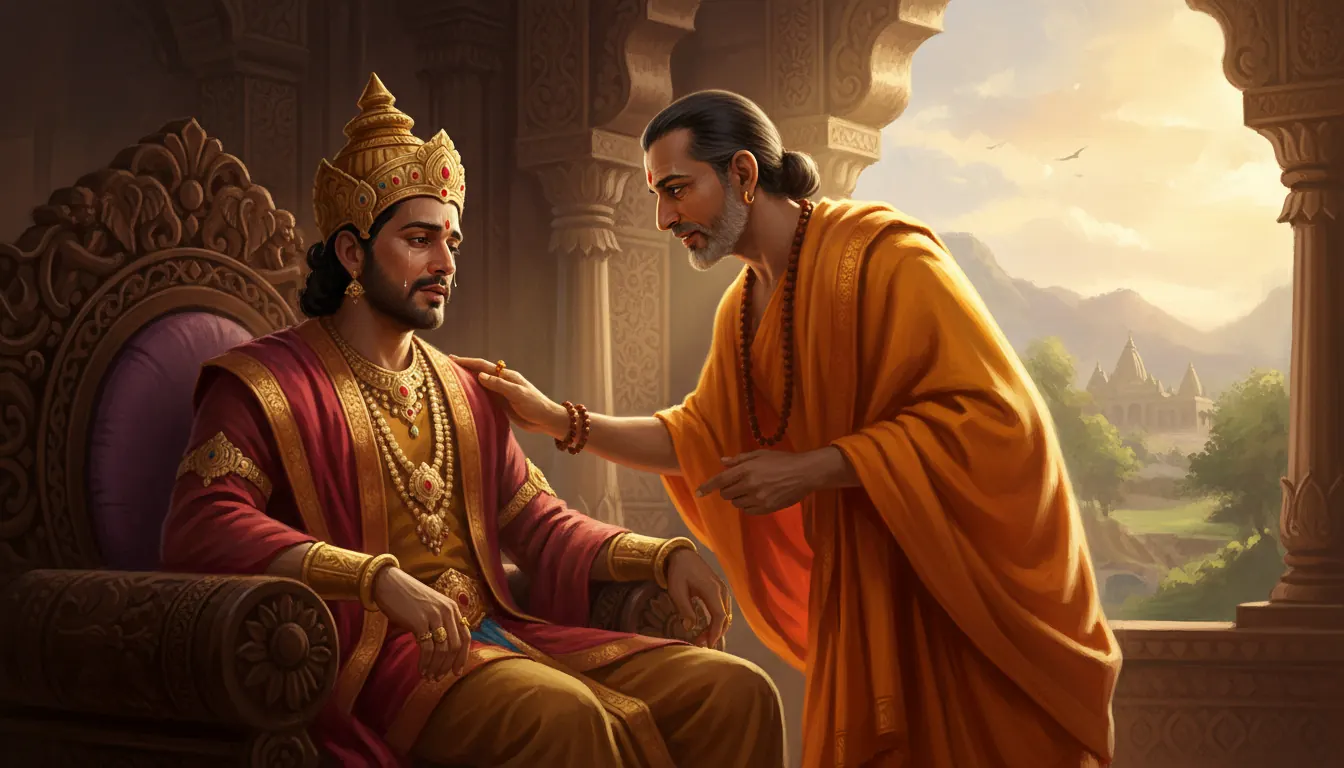
The Gods and the Salavrikas
Vyasa answers Yudhishthira's guilt with the war heaven fought for thirty-two thousand years
In short
Still refusing the throne, Yudhishthira tells Vyasa that he alone caused the death of every kinsman and king who fell at Kurukshetra, and asks what penance can be enough. Vyasa answers that Time, not the Pandavas, took those lives, and then recalls the first war of all: the gods against their elder brothers the Asuras, thirty-two thousand years of it, and the eighty-eight thousand Salavrika brahmanas who took up arms for the Danavas and were killed to the last man by the gods. From that he draws the rule about killing one to save many, prescribes the Horse-sacrifice that made Indra Satakratu, and sends the king to put the sons and daughters of the dead back on their thrones.
Told in the Shanti ParvaSet in Kurukshetra, Amaravati and Hastinapura16 min read
The Count He Could Not Stop Making
The war was over and the king had still not taken the throne.
Vaishampayana, who told the whole of it long afterwards to Janamejaya, the great-grandson of Arjuna, said that Yudhishthira sat among his brothers near the field where it had happened and would not be comforted, and that when he finally spoke it was to make a list.
"Sons and grandsons and brothers and fathers and fathers-in-law," he said, "and teachers and maternal uncles and grandfathers. Many great-souled kshatriyas. Many relatives by marriage, friends, companions, sisters' sons, kinsmen. And many of the finest men, come from many countries. All of them, grandsire, have fallen."
The man he called grandsire was Krishna Dvaipayana Vyasa, the island-born rishi who had begotten Dhritarashtra and Pandu and Vidura at the asking of a queen, and who was therefore the ancestor of both the armies that had just destroyed each other. He had come to the field to argue the king out of his grief, and he had been at it for some time without success.
"I alone had all these killed," Yudhishthira said, "because I wanted a kingdom. I have had so many heroic kings killed, men always devoted to righteousness, every one of whom had drunk Soma at sacrifices. What end will I come to? When I think that the earth has lost so many lions among kings, all of them in the fullness of their prosperity, I burn without stopping, even now."
Then he went past the dead to the living, which was the part he could not get around.
"What will become of those noble ladies who have lost their sons, their husbands and their brothers? They will revile the Pandavas and the Vrishnis as cruel murderers, and, wasted and sunk in grief, they will throw themselves on the ground. When they can no longer see their fathers and brothers and husbands and sons, they will give up their lives in their sorrow and go to the house of Yama. I have no doubt of it.
"The way of right conduct is very subtle. It is plain that this will stain us with the guilt of killing women. We have killed our kinsmen and friends and so committed a sin that nothing can wash away, and we will have to fall into hell head downwards.
"So we will waste our bodies with the harshest penances. Tell me, grandsire, what way of life I should take up then."
Vaishampayana said that the island-born rishi reflected keenly for some time before he answered.
Time Has Neither Mother Nor Father
"Remember the duties of a kshatriya, king," Vyasa said, "and do not give way to grief. All those kshatriyas fell doing their proper duty. Those great men, every one of them mortal, were seeking great prosperity and great fame on earth, and they have perished through the power of Time."
Then he took the killing out of Yudhishthira's hands and named the four men sitting nearest to him.
"You did not kill them. Nor did Bhima here, nor Arjuna, nor the twins. It was Time that took their lives, by the great law of change."
And having said it, he described the thing he was handing the blame to, because a man is not consoled by a word he does not understand.
"Time has no mother, no father, no one he is inclined to favour. He is the witness of what every creature does. It was he who took them away. This battle was only an occasion he ordained. He has creatures killed by means of other creatures. That is how he uses his irresistible power."
It is not a doctrine of accident. Vyasa was careful about that, and the care is the whole of the argument. Time, he said, is dependent upon the bond of action and is the witness of all actions good and bad. It is Time that brings about the fruits of what we do, whether bliss or woe.
"Think of the deeds of the kshatriyas who have fallen. Those deeds caused their destruction, and it is because of them that they perished. Think too of your own deeds, of your vows and your disciplined soul. And think how the Supreme Ordainer forced you to do this thing.
"A tool made by a smith or a carpenter is controlled by the man who handles it, and moves as he moves it. In the same way this universe is controlled by deeds done in Time, and moves as those deeds move it. Since creatures are born and die without any cause one can point to, and wholly at random, grief and joy are entirely needless."
Yudhishthira did not answer. Vyasa looked at him and conceded the point that arguments do not settle.
"This tangle in your heart is only a delusion. Still, if you wish, king, perform the rites of expiation. But first hear a story that is told of the gods."
Thirty-Two Thousand Years
"It is heard, Partha, that the gods and the Asuras fought against each other," Vyasa said.
He began with the fact that decides everything in such a quarrel, and it is a family fact rather than a moral one.
"The Asuras were the elder, and the gods the younger brothers."
That is the shape the whole of the Mahabharata has been standing in for eighteen days. An older line and a younger line, born of the same father, with one inheritance between them. Yudhishthira was being told that the first war in the world had the same plan as his own, and that in that one the younger brothers were the gods.
"Covetous of prosperity, fierce was the battle fought between them," Vyasa said. "The fight lasted for two and thirty thousand years."
Set that beside the war that had just ended. Eighteen days had emptied the earth of its kings, killed the sons of a hundred houses, filled the field outside with what the jackals were still working through, and left the victor unable to stand up and be crowned. Eighteen days had done that. The gods had fought for thirty-two thousand years.
Vyasa gave one image of it and no more.
"Making the earth one vast expanse of blood, the gods slew the Daityas and gained possession of heaven."
The earth is not even where they were fighting for. Heaven was the prize, and the earth was only the floor they stood on while they took it, and by the end of it that floor was one unbroken sheet of blood from edge to edge. The gods whom Yudhishthira had been invoking every morning of his life, to whom the dead kings around him had all poured Soma, had waded through that for three hundred centuries and had come out the other side owning the sky.
Nobody in the account is punished for it. There is no expiation mentioned at that point in the story, no penance, no hell with the head downwards. The gods slew the Daityas and gained possession of heaven, and the sentence ends there and moves on.
It was the moving on that Vyasa wanted him to notice. But there was a second part to it, and the second part was the one that answered what Yudhishthira had actually asked.
The Eighty-Eight Thousand
"Having taken possession of the earth," Vyasa said, "a great number of brahmanas learned in the Vedas, blinded by pride, took up arms, and the Danavas helped them in the fight."
Every word of that has a weight on it.
They were brahmanas. Not fallen men, not impostors, not the sort of creature that only wears the thread. They were learned in the Vedas, which is the highest thing that can be said of a man of that order, and the one qualification that in every other passage of the epic puts a person permanently beyond the reach of a weapon. To kill such a man is the sin for which the books can barely find an expiation. Yudhishthira knew that better than most, having spent the whole war being reminded of what Drona was, and having lied once to bring him down.
And these men picked up arms. They armed themselves blinded by pride, and they went over to the Danavas, the children of Danu, who were the enemy, and they fought on that side in a war for the possession of the world.
"They were known by the name of Salavrika," Vyasa said, "and they numbered eight and eighty thousand."
The name is not a family and not a country. A salavrika is a wolf, and the name fits men who have gone over into being something else, and eighty-eight thousand of them stood in the line with the Danavas holding weapons.
Then Vyasa said what happened to them, in one short sentence, without any softening at all.
"All of them, however, were slain by the gods."
Not driven off. Not disarmed and sent back to their fires. Not cursed, which is the usual instrument for a brahmana who has gone wrong. Eighty-eight thousand men who knew the Vedas were killed by the gods on a battlefield, and the gods are still the gods afterwards, and men still pour offerings to them.
"Wicked men who want to destroy virtue and set sin in motion," Vyasa said, "deserve to be killed, just as the gods killed the furious Daityas."
He let that sit in front of the king who had been saying, all morning, that he could not be forgiven.
Sin Sometimes Assumes the Form of Virtue
Having shown him the deed, Vyasa gave him the rule that governs it, and he gave it as arithmetic.
"If killing one person can save a family, or killing one family can save the whole kingdom, such killing is no transgression."
That is the whole of the permission, and it is worth noticing how narrow it is. It is not a licence to kill enemies. It is a calculation with a saved thing on the other side of it, and the saved thing has to be larger than the killed thing, and the man doing the sum has to be honest about which is which. Nothing in it excuses a war fought for a kingdom by a man who wanted the kingdom.
Then came the sentence that Yudhishthira had been trying to get somebody to say to him for days, and it did not comfort him, because it is not a comfortable sentence.
"Sin, king, sometimes takes the form of virtue, and virtue sometimes takes the form of sin. But the learned know which is which."
There is no test given. No mark, no sign, no way of telling from outside. The learned know, and everybody else is guessing, and a man may perform a rite in perfect confidence and be doing murder, and a man may kill and be doing his duty, and the two look identical while they are happening.
"So take comfort, son of Pandu, for you know the scriptures well. You have only followed the path the gods themselves once walked. Men like you never go to hell. Comfort your brothers here and all your friends, scourge of your enemies."
And then Vyasa drew the line that separates his listener from the men who really are damned, and it is not drawn where Yudhishthira had been drawing it. It has nothing to do with the number of the dead.
"The man who sets out to do sinful things, and feels no shame when he does them but goes on just as before, is called a great sinner in the scripture. There is no expiation for him, and his sins never grow less."
Then, to the man in front of him: "You were born into a noble line. The faults of others forced you to do this, and you did it very unwillingly, and now that it is done you repent of it."
The grief the king had been offering as evidence against himself was being entered on the other side of the ledger.
How Indra Became Satakratu
"The Horse-sacrifice, that grand rite, has been named as your expiation," Vyasa said. "Prepare for that sacrifice, king, and you will be freed from your sins."
And because a prescription is easier to swallow when somebody else has taken it first, he named the patient.
"The divine chastiser of Paka defeated his enemies with the help of the Maruts, then performed a hundred sacrifices one after another and became Satakratu."
The chastiser of Paka is Indra, who killed the Asura of that name, and the Maruts are the storm-gods who ride with him, and Satakratu is the title a god earns by completing a hundred rites. It is one of the commonest names in the hymns. Yudhishthira had used it himself, probably without thinking about what stands behind it, all his life.
What stands behind it is a war. Indra vanquished his foes first, with the storm at his back, and only then began the sacrifices, and the sacrifices went on until there were a hundred of them, and the hundredth one gave him the name that men have been calling him by ever since. The greatest of the gods of heaven had needed a hundred rites to work off what he did to win heaven. He had not been too holy to require them, and he had not been too proud to perform them.
"Freed from sin, having won heaven and many regions of bliss, with great happiness and prosperity," Vyasa said, "Shakra shines in beauty among the Maruts and lights every quarter with his splendour. The Apsaras adore the lord of Shachi in the heavens. The rishis and the other gods all worship him with reverence."
That is the end of the road Vyasa was pointing at. Not a man scoured clean of his history, but a king who did the thing, and then did the work, and is now shining at the top of the world with everyone singing to him, and the blood of thirty-two thousand years somewhere back at the beginning of the account and never denied.
"You have won the earth by your prowess," Vyasa said. "By your prowess, sinless one, you have defeated all the kings. Now there is the other half of it."
Put Their Sons on Their Thrones
The other half was not a rite. It was a list of errands, and it began with the houses the Pandavas had emptied.
"Go with your friends to their kingdoms, king, and put their brothers, sons or grandsons on their thrones."
Every one of those kingdoms had sent a king to Kurukshetra and had got nothing back. Vyasa was telling the victor to go to each of them in person, with his friends beside him, and find the nearest surviving male of the house, and seat him in the chair his father had died out of. Not annex them. Not garrison them. Put the dead man's family back on the dead man's throne.
"Be kind even to the children still in the womb, make your subjects glad and happy, and rule the earth."
The children in the womb are the ones whose fathers are already dead on the field and who have not yet been born to find it out. They are the last people on earth with a claim on a conqueror, and they are named specifically, because it is exactly the sort of claim a tired government forgets.
Then the instruction that has no parallel anywhere near it in the epic.
"Where kings have left no sons, put their daughters on the throne. Women love pleasure and power. That way they will cast off their sorrow and be happy."
Where a king has left no son, the daughter takes the seat. Vyasa gives a reason for it that is briskly worldly rather than lofty, and the effect of the reason is to make the thing ordinary: she wants what any ruler wants, she will be consoled by having it, seat her.
"When you have comforted the whole empire in this way, Bharata, worship the gods with a Horse-sacrifice, as the virtuous Indra did long ago."
And last, once more, the thing he had said at the beginning and would keep saying until it was heard.
"It is not right for us to grieve for those great-souled kshatriyas. Dazed by the power of the destroyer, they perished doing the duties of their own order. You have done the duty of a kshatriya and won the earth with not a thorn left in it. Keep to your own duties, son of Kunti, and you will find happiness in the next world."
The king had asked what mode of life he should take up. He had been told: this one. Go and be the king, and put the sons of the men you killed back in their fathers' chairs, and hold the sacrifice, and stop.
Dharma Lesson
Vyasa does not tell Yudhishthira that the killing was clean. He tells him that the gods did it too, on a scale that dwarfs Kurukshetra, and that they went on afterwards to perform a hundred sacrifices before anyone called them shining. The permission he gives is narrow, a life for a family and a family for a kingdom, and the warning attached to it is that sin and virtue can wear each other's faces and only the learned can tell them apart. What separates a king from a great sinner, in this account, is not the body count but whether he feels the shame and does the work, and then goes back and seats the children of the men he killed in their fathers' chairs.