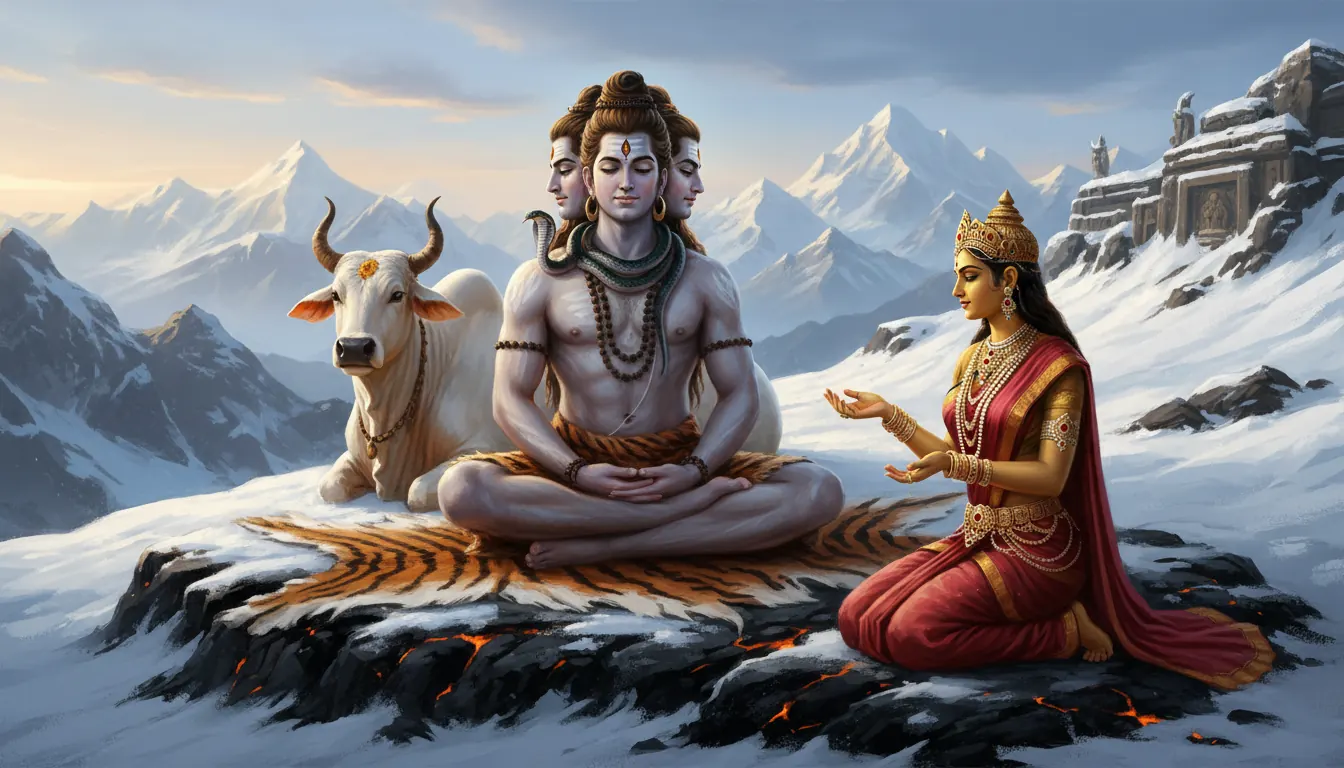
The Vow of Ten and Two Years
Krishna keeps a twelve year vow on the mountain and a fire walks out of his mouth
In short
Yudhishthira asks Bhishma for discourses on Religion and Profit in Krishna's own presence, and Bhishma answers with the time Krishna kept a vow of twelve years on a mountain. The rishis who came to honour the vow are still talking about duty when a fire rises out of his mouth, burns the summit bare of every living creature, and returns to touch his feet like a disciple. Krishna restores the mountain with a look and then explains what the fire was, where it had gone, and what the Grandsire told it. Afterwards he asks the ascetics to tell him something wonderful, and they appoint Narada to speak.
Told in the Anushasana ParvaSet in Kurukshetra and Himavat18 min read
The Question Asked in Krishna's Hearing
The old man on the arrows had been answering questions about gifts. What kinds there are, who should receive them, what each is worth. Yudhishthira had heard the five classes named and set out, and then he changed the subject, and the way he changed it is worth noticing.
"Grandsire, your wisdom is great," he said. "You know every branch of learning through and through. In our great race you alone are filled with all the sciences. I want to hear from you discourses woven of Religion and Profit, that lead to happiness hereafter and fill every creature with wonder."
Then he gave his reason, and the reason was not curiosity.
"The time that has come is one of great distress. Its like does not often fall on kinsmen and friends. Apart from you, best of men, we now have no one else who can take a teacher's place."
That is a king who has won a war saying, in front of everyone, that there is nobody left alive to teach him. The men who would have taught him are in the ash on the field outside. What remains is one dying man held above the ground on the points of arrows, and the days he has left are being counted.
And then Yudhishthira pointed at the person sitting nearest.
"This is Narayana, who has every prosperity and is honoured by all the kings. Even he waits on you, indulges you in everything and honours you greatly. Out of your affection, speak to me, for my good and my brothers' good, in the presence of Vasudeva himself and of all these kings."
It is an argument and a courtesy at once. If God himself sits here attending on you, said the king, then what you have to say is worth the attention of the rest of us.
Vaishampayana, telling all this long afterwards to Janamejaya, says that Bhishma, the son of the river called after Bhagiratha, was filled with joy at the words, out of affection for the monarch and his brothers, and that he answered.
Three Things Bhishma Promised to Tell
"I will certainly tell you delightful discourses, king," Bhishma said, "about the power of this Vishnu as it was shown long ago, as I heard it from my teachers."
He was pointing while he said it. The power of this Vishnu. The man sitting at the foot of the arrow-bed with his hands folded, whom the kings all honoured and who had spent the war driving somebody else's chariot, was the subject of the discourse that was about to be delivered in his presence.
Then Bhishma named the second thing.
"Listen also while I describe the power of that great god whose emblem is the bull."
And then the third, which is the strangest promise of the three.
"And listen while I tell you of the doubt that filled the mind of Rudra's wife, and of Rudra himself."
A doubt in the mind of a god. Not an error, and not ignorance of the ordinary human kind, but a question standing unanswered in the mind of the deity who destroys the worlds, and another standing in the mind of his wife. Bhishma offers this as a thing worth hearing about, and he offers it in the same breath as the powers of Vishnu and of Mahadeva, as though the three were one subject rather than three.
They are one subject. That is the whole design of what follows. The two great gods appear in this discourse not as rivals to be ranked but as two halves of a single account, and the joint of the account is a question that one of them could not answer for himself and had to be told.
Then Bhishma began, and he began not with a god on a mountain but with a man on a mountain, and the man was the one sitting in front of him.
"Once," he said, "the righteous Krishna kept a vow that lasted ten and two years."
Ten and Two Years
Twelve years, and the number is given in the old manner, ten and two, the way a man counts something he intends you to feel the length of.
A vow of that duration is not a resolution. It is a residence. It begins with Diksha, the rite of initiation, after which the man who has undertaken it is no longer at liberty to be anyone else until the term is finished. His food is fixed. His seat is fixed. His speech, his sleep, the hours at which he pours his fire, all of it is set out beforehand and then simply endured, day after day, through twelve turnings of the seasons on a mountain, and the whole apparatus is called a vow because there is nothing else to call it.
Who was doing this is the thing to hold on to. Not a forest recluse with nothing else to spend. The son of Devaki. The man who would later stand in a chariot between two armies and be asked what a soul is. He had gone up to a delightful and auspicious mountain and passed through the rite of initiation, and he was sitting out the term like any other ascetic, with the observance for his fuel.
The epic does not usually let us see him do this. We see him counselling, driving, laughing, arriving in the last moment before a disaster. Here he is doing the thing that everybody else in the epic does when they want something from heaven, and doing it the long way, for twelve years, in a place where the only witnesses would be whoever climbed up.
He wanted something. Bhishma does not say yet what it was, and the ascetics who came up the mountain did not know either. They came because a great vow was being kept and because it is proper to come and see a man who has gone through Diksha, and they arrived expecting to sit and talk about duty, which is what they did, until the mountain caught fire.
The Guests on the Coloured Seats
Narada and Parvata came to that place to see the man who had gone through the rite of initiation to keep his great vow.
Narada is the celestial rishi who goes everywhere and carries what he hears, the one visitor whom no gate in the three worlds is closed against, and Parvata is his nephew and his companion on those journeys. With them came the Island-born Krishna, which is the name the epic gives to Vyasa, who was born on an island in the Yamuna and who composed the account we are reading. Dhaumya came, that foremost of silent reciters, who had been the priest of the Pandavas in the forest and who knew as much about the endurance of long hard terms as anyone alive. Devala came, and Kashyapa, and Hastikasyapa.
Other rishis came too, men of Diksha and self-restraint, followed by their disciples and accompanied by many Siddhas and many ascetics of great merit, so that a mountain retreat where one man was keeping a silent term filled up with the most learned assembly it is possible to convene.
The son of Devaki received them with hospitality worthy of the highest praise, of a kind offered only to the gods. He was the one under the vow and he was the one waiting on the guests, and the account pauses over what he sat them down on.
Those great rishis sat down on seats, some green, some the colour of gold, some decked with peacock plumes, some perfectly new and fresh.
Seated there, they began to talk sweetly with one another about Religion and duty, and about many royal sages, and about the gods. It is the pleasantest scene in the whole of the Anushasana. Old men in a beautiful place, talking well, on the best subjects there are, in the company of a host who has nothing to do for twelve years but keep his vow and listen.
The Fire That Came Out of His Mouth
At that time the energy that was Narayana, in the form of fire, rose from the fuel of his strictly kept vow and came out of the mouth of Krishna of wonderful deeds.
Read the clause about the fuel again, because it is the mechanism of the whole episode. Twelve years of observance had been laid on a hearth like split wood, and what came off the hearth was fire, and the fire had a name. It was Narayana. The energy that went out of him was himself.
It did not stay near him.
That fire began to burn up those mountains, with their trees and creepers and little plants, and their birds and deer and beasts of prey and reptiles. The account does not soften what that meant on the ground. Soon the summit of that mountain was a distressing and pitiful sight. The animals of many kinds that lived there began to cry out in grief and pain, and soon the summit was empty of every living creature.
There is no enemy in this. Nobody had offended. No demon had come up the slope and no insult had been offered by anybody. A man had kept a vow well, and the merit of it came out of him as flame and went through the birds and the deer without any malice at all, the way a river drowns a village without hating it.
The rishis sat in the middle of it. They were men who had spent their lives subduing wrath and mastering their senses, and they had come up to a pleasant retreat to talk about duty, and the mountain they were sitting on burned to the rock while their host said nothing.
That fire of mighty flames burned up everything, leaving nothing behind, and at last came back to Vishnu and touched his feet like an obedient disciple.
That is the sentence that turns the scene. The thing that had just emptied a mountain of life came in at the end and put itself at the feet of the man it had come out of, in the posture of a student reporting to his teacher, because it had been sent somewhere and had now returned.
The Kindly Look
Krishna, crusher of foes, seeing the mountain burnt, cast a kindly look on it, and with that look brought it back to what it had been.
There is no rite in it, and no mantra, and no interval. He looked at the ruin kindly and the ruin stopped being a ruin. At once the mountain was adorned again with flowering trees and creepers, and once more echoed with the notes and cries of birds and deer and animals of prey and reptiles.
The list is deliberately the same list. The birds that had been named among the burned are named again among the living. Nothing has been replaced with something similar. The account is careful to walk back through the identical inventory, creepers, birds, deer, beasts of prey, reptiles, so that a reader cannot comfort himself with the idea that a new mountain has been provided in place of the old one. It is the old one, restored, down to the snakes.
Seeing that wonderful and inconceivable sight, all the ascetics were amazed. Their hair stood on end and their vision was blurred with tears.
These are not impressionable men. They are rishis with Diksha, Siddhas, ascetics of great merit, people who have seen the inside of heaven and are not easily moved by a display. What undid them was not the burning. Any sufficiently angry sage can burn a wood, and every one of them had met somebody who had done it. What undid them was watching a mountain be given back.
They wept and their hair stood up and they said nothing, and it was their host, sitting under his vow with the fire quiet at his feet, who spoke first, and what he said to them was a question, and he asked it in the sweetest voice he had.
"Why has wonder filled the hearts of this assembly of rishis, these ascetics who are always free of every attachment, who have no idea of mine, and who are fully versed in every sacred science?"
He was asking learned men why learning had not covered this. And he added something that ought to be impossible.
"Let these rishis, rich in penances and free of every stain, explain to me truly this doubt that has arisen in my mind."
You Are Winter, You Are Summer
The rishis answered him with what they knew, which was the largest thing they knew, and it did not help them.
"It is you who create all the worlds, and you who destroy them again," they said. "It is you who are Winter, it is you who are Summer, and it is you who are the season of rains. Of all the creatures, moving and unmoving, that are found on the earth, you are the father, you are the mother, you are the master, and you are the origin!"
That is the doctrine stated correctly and completely. They were not mistaken about a single clause of it. And having stated it, they arrived exactly at their difficulty.
"And yet this, slayer of Madhu, fills us with wonder and doubt. Source of all that is auspicious, resolve this doubt for us: the fire that came out of your mouth."
This is worth sitting with, because it is the honest position of every believing person who has ever been shown something. They could recite that he was the father and mother and origin of everything. They could not account for a flame coming out of his mouth that afternoon and burning the hill they were sitting on. Knowing what a thing is in general is no protection at all against seeing it happen in particular. The doctrine was in their mouths and their hair was still standing on end.
So they asked, and they attached an offer to the asking.
"Once our fears are gone, Hari, we will tell you what we have heard and seen."
They had something of their own to tell. They had come up that mountain carrying it, an account of something they had witnessed elsewhere on their travels, and they were holding it back until their host had settled them. It is a small bargain struck between the learned and the divine, and it is the hinge on which the rest of this discourse turns, though nobody in the clearing knew that yet.
The Son He Had Come to Get
"The fire that came out of my mouth, as splendid as the all-consuming fire at the end of the Yuga, which crushed and scorched this mountain," Vasudeva said, "is nothing but the energy of Vishnu."
Then he rebuked them, gently and in full.
"Rishis, you have conquered wrath, you have your senses under complete control, you are rich in penances, and you are like gods in power. And yet you have let yourselves be shaken and distressed!"
And then he told them the thing nobody on that mountain had known, which was why he was there at all.
"I came to this delightful and auspicious mountain to keep a strict vow. What brought me here was the wish to win, through penances, a son who would be my equal in energy."
Twelve years, on a summit, under initiation, for a child. Not for a weapon, not for sovereignty, not for the destruction of an enemy. The Lord of all the worlds went up a mountain and did what any king who wants a son does, and did it by the ordinary means, and took the ordinary length of time about it.
The rest of the explanation follows the fire on its errand.
"Because of my penances, the Soul in my body turned into fire and came out of my mouth. That fire had gone to see the Grandsire of the whole universe, the giver of boons."
It had gone to Brahma. The burning of the mountain was not the purpose of that flame and was not even noticed by it. The mountain was simply what lay in the path of an errand, and the errand was an answer.
"The Grandsire, best of ascetics, told me that I would have a son, that he would carry half of my own energy, and that he would be born as the one whose emblem is the bull."
Half of Krishna's own energy. The boon was granted out of the petitioner's own substance, and the son who would be born to him was named in the same breath with the god who has the bull on his banner, so that the two great gods Bhishma had promised to speak of were already joined in a single answer.
"That fire, back from its errand, has come to me and approached my feet like a disciple eager to serve me dutifully. It has cast off its fury and returned to me, to its own true nature."
"So I have told you, in brief, a mystery that belongs to Him whose origin is the lotus. Rishis rich in penances, do not give way to fear!"
The Honey He Asked Them For
When he had explained himself, he asked for his payment, and the manner of the asking is the reason this discourse exists.
"Now I ask you to tell me something truly wonderful that you have heard of or seen on earth or in heaven. I long to taste the honey of the words that will drop from your lips, honey I am sure will be as sweet as a stream of nectar itself."
He went on, and set out plainly what he could and could not get for himself.
"If I see anything on earth or in heaven that is truly delightful and wonderful to look at but unknown to all of you, rishis who look like gods, I say that is because of my own Supreme Nature, which nothing can obstruct. But anything wonderful that I know already, or learn by my own inspiration, stops seeming wonderful to me."
That is the confession of the one being in the world who can never be told anything. What he knows of himself is not news to him and cannot be. Wonder requires a gap, and he has no gap, and so the one pleasure he cannot manufacture is the pleasure of hearing something.
"Whatever is told by pious people, though, and heard from the good, deserves to be received with respect and faith. Such discourses last on earth a long time, as durable as letters carved in rock."
God asking to be told a story, and giving as his reason that what good men say aloud outlasts the rock it is compared to.
When they heard this, all those ascetics were filled with surprise. They began to gaze at Janardana with those eyes of theirs that were as beautiful and large as the petals of the lotus. Some of them glorified him and some worshipped him with reverence, and all of them sang the praises of the slayer of Madhu with words whose meanings were adorned with the eternal Riks.
Then they chose their speaker. They appointed Narada, that foremost of all persons skilled in speech, and they told him what to tell.
"Narada, describe to Hrishikesha in full, from the beginning, that wonderful and inconceivable event on the mountains of Himavat, which those of us who went there on our pilgrimage to the sacred waters saw with our own eyes."
So the host sat down among his guests on the mountain he had burned and mended, under his vow, and waited to be told what had happened on Himavat when the daughter of the mountain put her hands over her husband's eyes. And the divine Narada began.
Dharma Lesson
The merit of a long observance is not a private possession. It builds up in a man like heat in dry wood, and when it comes out it goes where it was sent, through birds and deer and creepers that had nothing to do with the vow. What distinguishes Krishna here is not that the fire obeyed him but that he looked at the wreck it left and put the mountain back, bird for bird and snake for snake, before anyone had asked him to. And having done a thing no ascetic in that assembly could have done, he asked those ascetics to tell him a story, on the ground that what good men say aloud lasts longer than the rock it is carved on.