The Brahmanas Who Deserve Worship
Narada tells Krishna whom he bows to, and Bhishma tells a king what it costs to forget
In short
Yudhishthira asks who in the three worlds is worthy of reverent homage, and Bhishma answers with an old conversation in which Narada, caught bowing, reads Krishna the whole roll of the brahmanas he worships. Bhishma then tells of king Vrishadarbha, who weighed his own flesh against a pigeon that had begged him for protection, and sets out the foremost duty of a king, the many kinds and occupations of brahmanas, and the kshatriya tribes that sank to the status of shudras once no brahmana was left among them. The Earth herself answers Vasudeva on how a householder cleanses his sins, and the verses the Creator sang close the teaching.
Told in the Anushasana ParvaSet in Kurukshetra and Kashi22 min read
The Question About Homage
By that stage the questions came one at a time and were answered at length, and nobody in the great circle on the field of Kurukshetra was in any hurry, because the old man on the bed of arrows was holding his death back until the sun turned north and there was nothing to do with the days but spend them.
"Chief of the Bharata line, who in the three worlds deserves reverent homage?" Yudhishthira said. "Tell me in detail. I never tire of hearing you speak on these things."
"On this point," Bhishma said, "people tell the old story of a conversation between Narada and Vasudeva."
Krishna was sitting there while he said it. That is worth noticing before the story begins, because the story is about a conversation Krishna himself had once had, and the grandsire recited it back to him in front of everyone without once turning his head to see whether the account was accepted.
Narada is the celestial rishi who goes everywhere, into the halls of the gods and the courts of kings and the clearings of hermits, carrying news and questions and, when it suits him, quarrels. He is not a man who is easily impressed, and he does not bow readily.
On one occasion Keshava saw him bowing. Narada was standing before a number of the foremost of the brahmanas with his hands joined at his forehead, worshipping them, and Krishna watched him do it and then asked him about it.
"Whom are you worshipping?" he said. "Which of these brahmanas, holy one, do you honour with such deep reverence? If it is something I may hear, I would like to hear it. Tell me, best of righteous men."
Narada took the question seriously, and he did not answer it briefly, and the first thing he said was that there was nobody better in the world to ask it.
"Listen, Govinda, scourge of your enemies, and I will tell you whom I am worshipping. Who in this world has more right to hear it than you?"
The First of the Roll
He began with the men who keep the fires burning for everyone else.
"I worship the brahmanas, mighty one, who are forever worshipping Varuna and Vayu and Aditya and Parjanya and the god of Fire, and Sthanu and Skanda and Lakshmi and Vishnu and the brahmanas, and the lord of speech, and Chandramas, and the Waters and the Earth and the goddess Saraswati."
That is the whole pantheon in one breath, and the brahmanas stand on the list twice, once as the worshippers and once among those worshipped.
"Tiger of the Vrishnis, I always worship the brahmanas who are rich in penance, who know the Vedas, who never neglect their Vedic study, and who are men of true worth. I bow my head to those who do not boast, who perform the rites for the gods on an empty stomach, who are always content with what they have, and who are quick to forgive."
Read that middle clause slowly. The offering is made before the priest eats. He stands at the fire hungry and feeds the gods first, and he does it every morning, and nobody applauds.
"I worship those, Yadava, who perform sacrifices, who are forgiving and self-restrained, who are masters of their senses, who worship truth and righteousness, and who give land and cows to good brahmanas. I bow to those who are devoted to penance, who live in forests on fruits and roots, who never store anything for the morrow, and who keep every act and rite the scriptures lay down.
"I bow to those who feed and look after their servants, who always welcome guests, and who eat only what is left over from the offerings to the gods. I worship those whom study of the Vedas has made irresistible, who speak eloquently on the scriptures, who keep the vow of Brahmacharya, and who never fail in their duty of officiating at other men's sacrifices and teaching their pupils. I worship those who feel compassion for every creature, and who study the Vedas until noon, until the sun is hot on their backs."
Never store anything for the morrow. It is set down between two ordinary clauses as though it were ordinary, and it is the hardest of the vows, because a man who keeps it has given up not merely wealth but the whole apparatus of prudence.
The Practice of Pigeons
The roll grew poorer as it went.
"I bow to those who work to win their teachers' favour, who toil to master the Vedas, who serve their elders dutifully, and who are free of malice and envy. I bow to those who keep silence, who know Brahman, who stand firm in truth, and who pour libations of clarified butter.
"I bow to those who live on alms, who are emaciated for want of adequate food and drink, who have lived in their teachers' houses, who go without every pleasure, and who own little of the goods of this earth."
Emaciated for want of adequate food and drink. Narada does not soften it. The men he bowed to were thin because there had not been enough.
"I bow to those who care nothing for the things of this earth, who pick no quarrels with anyone, who go unclothed, who want nothing, and who speak the Brahma. I bow to those who are devoted to compassion for every creature, who are self-restrained, and who live at peace. I bow to those who are devoted to the worship of gods and guests, who keep to the householder's life, and who follow the practice of pigeons in the way they get their living."
A pigeon takes up one grain at a time and keeps no granary. A man who subsists so has a wife and a house and a fire and children, and still gathers only what the day requires.
"I always bow to those who let no part of the aggregate of three grow weak in anything they do, who are free from greed, and who live righteously."
The aggregate of three is Righteousness and Wealth and Pleasure, and in these men none of the three has eaten the others.
"I bow, Madhava, to those who live on water alone, or on air alone, or on what is left of the food offered to gods and guests. I worship those who have no wives, and those who have wives and keep the household fire, who are the refuge of the Vedas and of all creatures. I bow, Krishna, to those rishis who created the universe, who are its elders, who drive away the darkness of ignorance, and who are the best of all who live in it.
"So you too, son of the Vrishnis, should worship these twice-born men I speak of every day."
He had told Krishna to bow where he was bowing, and Krishna did not interrupt.
They Who Cross All Calamities
"They deserve reverent worship," Narada went on, "and if you worship them, sinless one, they will give you happiness. The people I speak of always bring happiness, in this world and in the next. Honoured by all, they move about this world, and if you worship them they are sure to make you happy."
Having named whom he worshipped, Narada named what worship does, and the second list is built out of one repeated phrase.
They who are hospitable to all persons that come to them as guests, and who are always devoted to brahmanas and cows and to truth in speech and behaviour, succeed in crossing all calamities and obstacles. They who are devoted to peacefulness of behaviour, and they who are freed from malice and envy, and they who are attentive to the study of the Vedas, succeed in crossing all calamities and obstacles.
They who bow to all the deities without showing a preference for any, they who take one Veda as their refuge, they who are full of faith and self-restrained, succeed in crossing all calamities and obstacles. They who worship the foremost of brahmanas with reverence, and are firm in the observance of excellent vows, and practise the virtue of charity, succeed in crossing all calamities and obstacles.
They who are engaged in the practice of penances, they who are always observant of the vow of celibacy, and they whose souls have been cleansed by penances, succeed in crossing all calamities and obstacles. They who are devoted to the worship of the deities and guests and dependants, as also of the Pitris, and they who eat the remnant of the food that is offered to deities, Pitris, guests and dependants, succeed in crossing all calamities and obstacles.
They who, having lit the domestic fire, duly keep it burning and worship it with reverence, and they who have duly poured libations in Soma-sacrifices, succeed in crossing all calamities and obstacles.
And then the last item on the list, which is not a class of men at all.
They who behave as they should towards their mothers and fathers and teachers and other seniors, even as you, tiger among the Vrishnis, behave, succeed in crossing all calamities and obstacles.
Having said these words, the celestial rishi ceased speaking. He had run through every kind of holiness he could think of, and finished by pointing at the man he was talking to and saying, that one, the way he treats his elders, put him on the roll as well.
The Pigeon in the King's Lap
"So you too, son of Kunti," Bhishma said, "should always reverently worship the gods, the Pitris, the brahmanas, and any guests who come to your house, and if you live that way you are sure to reach a happy end."
Yudhishthira asked the next thing at once.
"Tell me truly, chief of the Bharata line, what merit is won by those who protect living creatures of the four orders when they beg for protection."
"Listen to this old story," Bhishma said, "about the great merit of protecting those who humbly ask for protection."
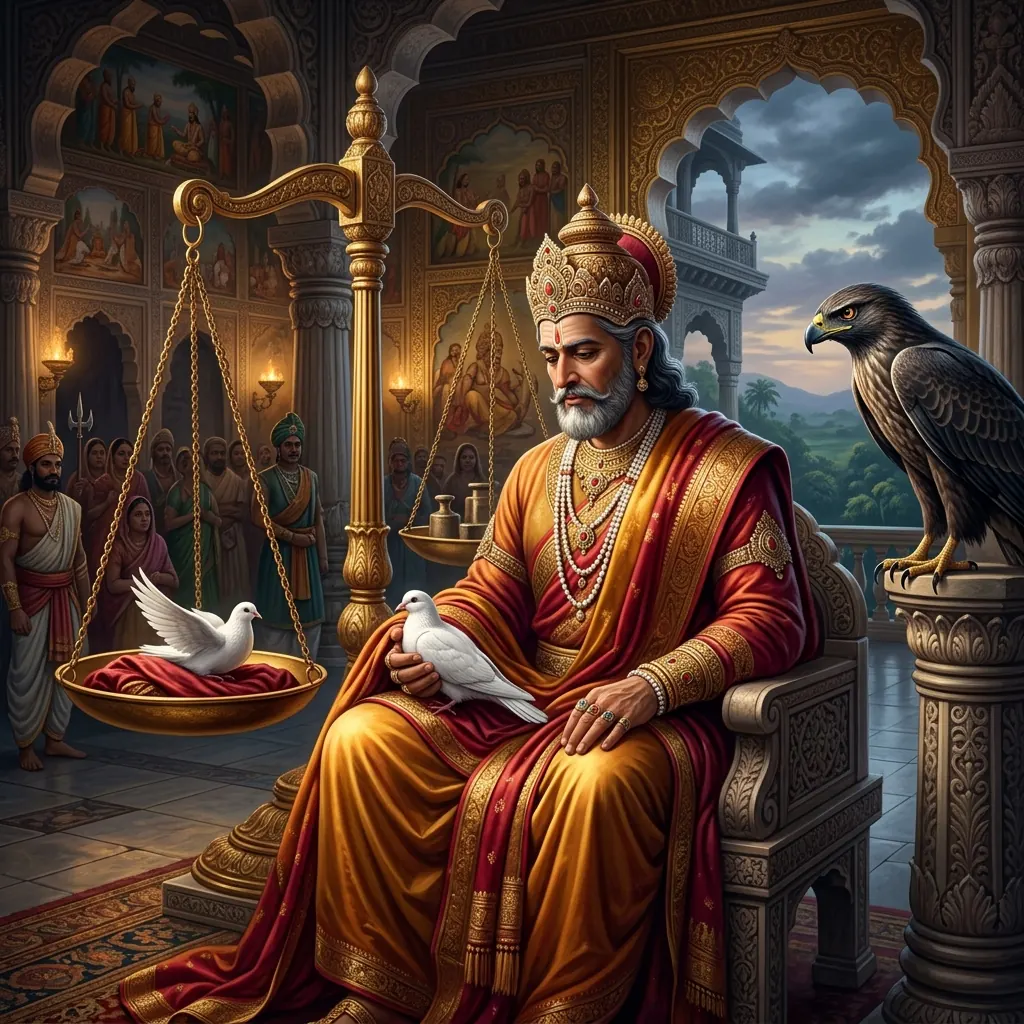
Once a beautiful pigeon, pursued by a hawk, dropped out of the sky and landed in the lap of king Vrishadarbha of Kashi, and would not leave it. The king looked at the bird shivering against him and spoke to it as one speaks to a frightened child.
"Take heart, bird. Do not be afraid. What has frightened you so badly? Your colour, beautiful bird, is like that of a freshly opened blue lotus. Your eyes are the colour of the pomegranate or the Asoka flower. Now that you have come to me for refuge, no one will dare even think of seizing you. For your sake I would give up the kingdom of Kashi itself today, and my life too, if need be."
The hawk came down after it and made an argument, and the argument was a good one.
"This bird was ordained to be my food. I chased him down and caught him. It took me great effort to get him at last. A fierce thirst is tormenting me, and hunger is gnawing at my belly. Look how I have bruised and torn his body with my wings and talons. Look how faint his breathing has become.
"With the power that is rightly yours, you may step in to protect human beings when other human beings try to destroy them. Your power may reach over your enemies, your servants, your relatives, the quarrels among your subjects, every part of your kingdom, and your own senses. But it does not reach the sky. Your rule does not cover the birds that fly in it. And if you want to earn merit by protecting this pigeon, it is your duty to consider me too."
The king heard him out, and was filled with wonder, and did not dismiss a word of it.
Flesh Against Feathers
"Let a bull or a boar or a deer or a buffalo be prepared for you today," the king said. "Satisfy your hunger with that. I have sworn never to abandon anyone who has come to me for protection. Look, bird, this bird will not leave my lap."
"I do not eat the flesh of boars or oxen or of any kind of fowl," the hawk said. "What do I want with this food or that? What concerns me is the food ordained for creatures like me from the beginning. Hawks eat pigeons. That is the eternal law. Sinless Usinara, if you love this pigeon so much, then give me flesh from your own body, as much as this pigeon weighs."
"You do me a great favour today by speaking to me like this," the king said. "Yes, I will do as you ask."
He called for a balance and set the pigeon in one scale, and began to cut the flesh from his own body and heap it in the other. In the inner apartments the queens heard what was being done and came out adorned with their jewels and stricken with grief, and the noise that rose from the palace was deep as the roar of clouds. The clear sky covered itself over with thick cloud on every side. The earth began to tremble at the king's act of truth.
He cut from his flanks, and from his arms, and from his thighs, and filled the scale, and the pigeon continued to weigh heavier.
When at last he was a skeleton of bones without any flesh and covered with blood, he understood what the balance had been asking for from the beginning, and he climbed into the scale himself.
Then the three worlds came to that place with Indra at their head to look at him. Kettle-drums that nobody could see were struck and played upon in the firmament. Nectar was poured upon the king in a shower, and garlands of celestial flowers of delicious fragrance and touch came down on him copiously and again. The deities and Gandharvas and Apsaras sang and danced around him in large bands, as they sing and dance around the Grandsire Brahma.
He mounted a chariot more splendid than a mansion of gold, arched with gold and gems and pillared with lapis lazuli, and the royal sage Sivi, that ruler of Kashi, went up in it to eternal heaven.
"You too, Yudhishthira, should act in the same way towards those who come to you for protection."
The Foremost Act of a King
"Grandsire, which is the greatest of all the duties laid down for a king?" Yudhishthira said. "What must a king do to enjoy both this world and the next?"
"This," Bhishma said: "the worship of brahmanas is the greatest of them all."
He set out the practice plainly. With bows, with kind words, with gifts of everything that gives pleasure, the king must honour every learned brahmana in his city or his provinces, caring for them as he cares for his own children and honouring the worthiest as one honours one's father. When such men are free from all anxiety, the whole kingdom blazes forth in beauty.
Then the grandsire said what a king is really dealing with. When they are angry they can burn a whole kingdom to ashes by sheer force of will, or by spells. When they are angry their glances fall on men and things like a blazing flame upon a forest, and the most courageous men are struck with fear.
Some among them have the might of lions and some of tigers, some the might of boars, some of the deer, some of crocodiles. Some have a touch like a deadly snake's, and some a bite like a shark's. Some can destroy their enemies by words alone, and some with a single glance of their eyes. And some are very gentle by nature.
Some are like wells and pits whose mouths are hidden by grass and creepers. Others are like the sky cleared of clouds and darkness. Some are fierce by nature, as Durvasa was. Some are as mild and soft as cotton, as Gautama was. Some are cunning, as Agastya was when he devoured the Asura Vatapi. Some are devoted to penances. Some work the land. Some keep cows, as Upamanyu did while he attended his teacher. Some live upon alms. Some are even thieves, as Vishvamitra became during a famine. Some are fond of stirring up quarrels, which is Narada himself, and Narada is not left off the list. Some are actors and dancers. Some can do anything at all, as Agastya was when he drank up the entire ocean as if it were a palmful of water.
"Brahmanas, chief of the Bharata line, come in many forms and many ways of life," Bhishma said. "One should always praise the brahmanas who know every duty, whatever kind of work they are seen to live by."
The Tribes That Fell
In their origin, Bhishma said, they are older than the Pitris and the gods, than human beings and the Snakes and the Rakshasas. Neither gods nor Pitris, Gandharvas nor Rakshasas, Asuras nor Pishachas can defeat them. They can make a god of one who is not a god, and strip a god of his rank. Whoever they want to make king becomes king, and whoever they do not love goes to the wall.
Then the grandsire gave the list that a king seated on a conquered earth ought to hear.
It is because they had no brahmanas among them that the Sakas, the Yavanas, the Kambojas and other kshatriya tribes have become fallen and degraded into the status of shudras. The Dravidas, the Kalingas, the Pulandas, the Usinaras, the Kolisarpas, the Mahishakas and other kshatriyas have, for the same reason, become degraded into shudras.
These were warrior peoples with kings and chariots and a place in the world, and what is said of them is not that they were beaten. It is that nobody was left among them to say what the rites were, and within a few generations there was no way back.
"Better to be beaten by them than to beat them, greatest of victors," Bhishma said. "A man who kills every other living creature in the world commits no sin as terrible as killing a single brahmana. The great rishis have said that killing a brahmana is a terrible sin. One should never speak ill of brahmanas or slander them. Where brahmanas are being spoken ill of, one should sit with head bowed, or leave."
Nor is this a matter of the arm. Kshatriyas whose energy and might scorch everything find that energy and might come to nothing when they meet brahmanas. The Bhrigus conquered the Talajanghas. The son of Angiras conquered the Nipas. Bharadwaja conquered the Vitahavyas and the Ailas as well. All those kshatriyas were capable of using various kinds of arms, and the brahmanas who conquered them owned nothing for an emblem but black deer skins.
"No man has ever been born in this world, and none ever will be," Bhishma said, "who could quarrel with brahmanas and still live his life in happiness. You cannot grasp the wind in your hands. You cannot touch the moon with your hand. You cannot hold up the earth with your arms. In the same way, king, no one in this world can defeat the brahmanas."
Vasudeva Asks the Earth
Soma is their king, the grandsire went on, and it is they who bring happiness and misery to others. Nothing is higher than having a brahmana of good birth, who knows what is right and keeps to his vows, come to live in one's house. The offerings given to brahmanas reach the very deities who accept them. Aditya and Chandramas, Wind and Water and Earth and Sky and the points of the compass all enter the body of the brahmana and take what the brahmana eats. In that house where brahmanas do not eat, the Pitris refuse to eat. Like fire concealed within wood, everything that is said or heard or read in this world lies hidden in the brahmana.
"On this point," Bhishma said, "people tell the old story of a conversation between Vasudeva and the Earth."
Krishna, in that old history, put a question to the goddess who carries everybody.
"Mother of all creatures, blessed goddess, I want to ask you to settle a doubt of mine. What must a man living the householder's life do to wash away all his sins?"
It is the householder's question, asked by a man who cannot go to the forest and has no intention of pretending otherwise.
"Serve the brahmanas," the Earth said. "That is the excellent way to be cleansed. Every impurity is destroyed in the man who serves brahmanas with reverence. Prosperity comes of it. Fame comes of it. Intelligence, the knowledge of the soul, springs from it. A kshatriya who lives this way becomes a mighty chariot warrior and a scourge of his enemies, and wins great fame. This is just what Narada told me: that whoever wants every kind of prosperity should always revere a brahmana of good birth, strict vows and learning in the scriptures.
"The man who speaks ill of brahmanas soon comes to ruin, as a lump of unbaked clay dissolves when it is thrown into the sea. Look at the dark spots on the moon, and the salt water of the ocean. Great Indra was once marked all over with a thousand marks of his shame, and it was by the power of the brahmanas that those marks were changed into as many eyes. See how all this came about. A man of pure conduct and pure soul who wants fame and prosperity and the many blissful worlds of the life to come should live as the brahmanas direct."
Hearing the words of the goddess, the slayer of Madhu said, Excellent, Excellent, and honoured her in due form.
The Verses the Creator Sang
"Blessed king," Bhishma said, "a brahmana is worshipped by every creature by virtue of his birth alone, and as a guest he has the right to eat the first portion of all cooked food. All the great aims of life flow from brahmanas. They are the friends of every creature. They are the mouths of the gods."
Then he recited the verses that men learned in ancient history repeat, which the Creator sang after he had made the brahmanas and was setting their duties before them.
A brahmana should never do anything but what has been ordained for him. Protected, they should protect others. If they live this way, they are sure to win Brahma-prosperity. You will be the example for all creatures, and the reins that hold them in check. A learned brahmana should never do the work laid down for shudras, for by such acts he loses merit. By Vedic study he wins prosperity and intelligence and energy, power that can scorch all things, and the highest glory. Full of a faith rich in compassion for every creature, and devoted to self-restraint and the study of the Vedas, you will see all your wishes fulfilled. Whatever exists in the world of men, whatever happens in the world of the gods, can all be won through penance and knowledge and the keeping of vows and restraints.
"The Creator himself, in his supreme intelligence and wisdom, ordained this out of compassion for the brahmanas."
And then, once more, the grandsire named the price of forgetting them.
The Mekalas, the Dravidas, the Lathas, the Paundras, the Konwasiras, the Saundikas, the Daradas, the Darvas, the Chauras, the Savaras, the Varvaras, the Kiratas, the Yavanas and numerous other tribes of kshatriyas have sunk to the status of shudras because no brahmanas were left among them. Defeated by the brahmanas, the Asuras were obliged to take refuge in the depths of the ocean. Through their grace, the deities became denizens of heaven.
"No one can touch space. No one can move the Himavat mountains from their place. No dam can hold back the current of the Ganga. No one can subdue the brahmanas, and kshatriyas cannot rule the earth without their good will. Always worship them with gifts and dutiful service, if you want to rule the whole earth with her belt of seas.
"But their energy and might, sinless one, are weakened when they accept gifts. You must protect your line, king, from those brahmanas who refuse to accept gifts."
Dharma Lesson
The epic insists that reverence is owed to a whole order of men, and then spends its longest passage on how unalike those men are: some fierce, some soft as cotton, some farmers, some cowherds, some beggars, some thieves, some troublemakers, some dancers. The honour is not a prize for uniform excellence. It is paid to the people who keep the words and the rites alive, and the cost of withdrawing it is stated as plain history about whole warrior peoples who lost the thread and never found it again. Narada's answer is the more searching one. Asked whom he bows to, he lists the hungry, the unclothed and the ones who store nothing for tomorrow, and then turns and tells Krishna to bow to them as well.