The Wrong Man Before Yama
A crow-faced messenger seizes the neighbour instead of Sarmin, and Yama sends him home with a rule of life
In short
Yudhishthira asks Bhishma what merit attaches to gifts of sesame, lamps, food and robes, and Bhishma answers with an old discourse between a brahmana and Yama. In the town of Parnasala, between the Ganga and the Yamuna, two brahmanas of Agastya's line are so alike that Yama's messenger seizes the wrong one. Yama rises and worships the man who was brought by mistake, refuses to let him stay because Time and not he ordains the length of a life, and instead tells him how a householder earns merit: sesame, water, lamps, gems and robes. The right man, Sarmin, is fetched afterwards and given exactly the same instructions.
Told in the Anushasana ParvaSet in Yamuna, Ganga and Kurukshetra12 min read
After Water, What Else
Bhishma had just finished making the largest claim in the whole science of giving. Food and drink, he had told Yudhishthira, are gifts that nothing can rise above, because a man who hands over food hands over life itself, and everything that is eaten in the three worlds, the nectar of the deities and the Sudha of the Nagas and the Swadha of the Pitris and the rice of men, comes up out of water in the end.
So the king went on down the list, to the cheaper things.
"Grandsire, tell me once more," Yudhishthira said, "about the merit of giving sesame, and lamps to light the darkness, and food and clothing."
It is nearly a household inventory of a question. A handful of oily black seed. A lamp carried out and set down where the path is dark. A meal. A length of cloth. These are not the gifts of kings. They are what an ordinary man in an ordinary house actually has in his hands, and Yudhishthira, who had been given a kingdom back over the bodies of his kinsmen, kept asking about them.
Bhishma lay on the arrows with the field behind him and the winter waiting, and he did not answer with a rule. He answered the way he answered everything in those weeks, by reaching back for somebody older.
"There is an old story people tell on this subject, Yudhishthira," he said, "about a conversation long ago between a brahmana and Yama."
Which is a promise of a particular kind of story. Nobody converses with the ruler of the dead by appointment. If a brahmana had a discourse with Yama and lived to carry the answers home, then something had gone wrong first, and the teaching that follows is the sort a man is given by mistake.
Bhishma began, as such tales begin, with a place.
Bring Me Sarmin and Not the Other
In the land between the Ganga and the Yamuna, at the foot of the hills called Yamuna, there was a large town of brahmanas. It was famous by the name of Parnasala, a very lovely place, and many learned brahmanas lived there.
One day Yama, the ruler of the dead, called a messenger of his and gave him an errand in that town.
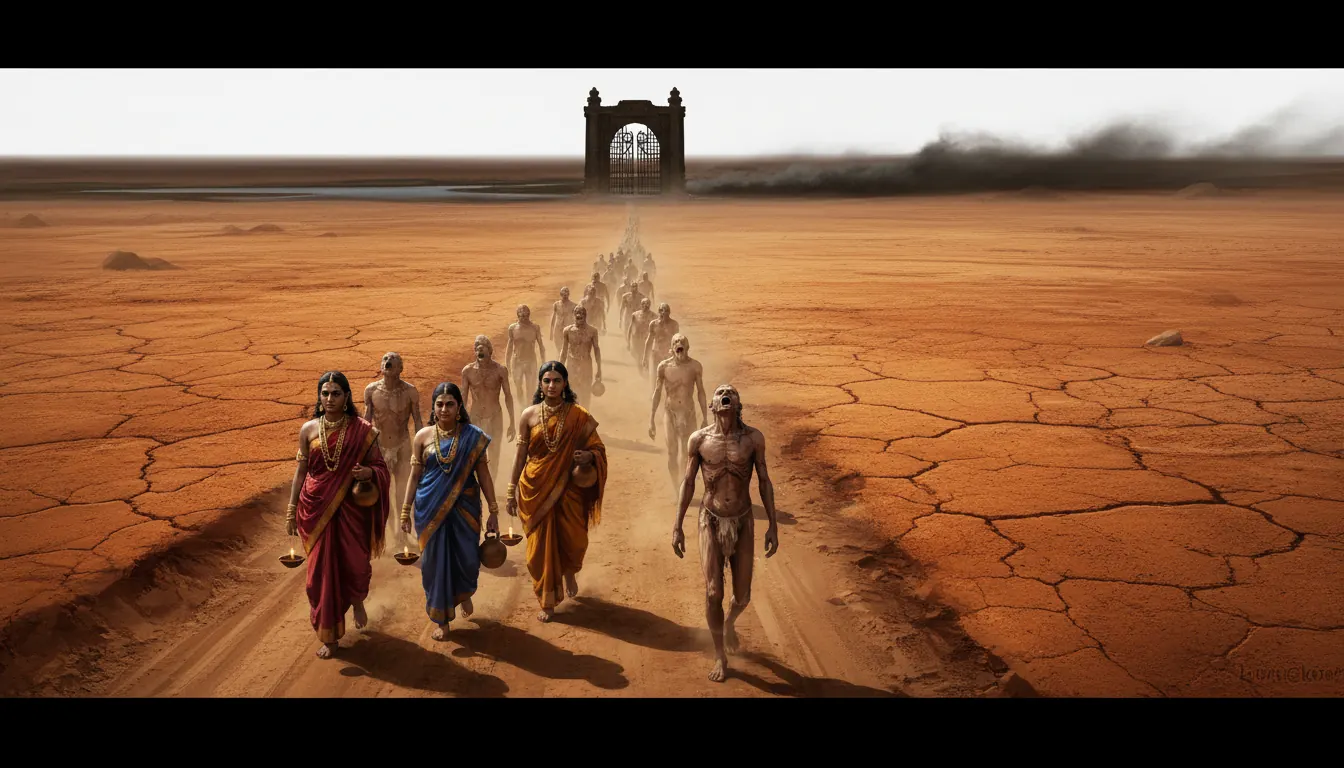
The messenger is described before he is sent, and the description is the reason the rest of the story happens. He was clad in black. His eyes were blood red and his hair stood erect, and his feet and his eyes and his nose all resembled those of a crow. This is not a clerk. This is the thing that comes for people, built to be seen at the last moment and not before.
"Go to the town of the brahmanas," Yama said, "and bring me the man named Sarmin, who was born into the line of Agastya. He is learned and devoted to peace of mind. He teaches the Vedas, and his way of life is well known."
Then, because he knew the town, Yama added the warning.
"Do not bring me another man of the same line who lives in the same neighbourhood. That man is the equal of the one I want in virtue, in learning and in birth. In his children and his conduct, too, he is just like the wise Sarmin. Bring me the one I mean."
Two men of one lineage, in one quarter of one town, matched in learning, matched in observance, matched even in the number and quality of their children. The judge of the dead, who is famous for keeping the accounts of every creature that breathes, had looked into Parnasala and found a place where his own records could be misread, and he said so out loud to the crow-faced thing standing in front of him.
And he gave one more instruction, which was about manners.
"He should be worshipped with respect," Yama said, not dragged here with irreverence.
The Very Opposite of What He Was Told
When the messenger got there, he did the very opposite of what he had been told to do.
There is no explanation offered for it and none is needed by anyone who has ever handed a careful instruction to an eager subordinate. He had been given a name, a lineage, a description, and an explicit warning about the one man in the town he must not touch, and he went straight to that man. He fell on him and carried off the very man Yama had forbidden him to bring. Not invited. Not escorted. Attacked, seized, and carried off, which was also the exact opposite of the courtesy he had been told to show.
So a learned brahmana of Agastya's line, who had done nothing that morning except be the neighbour of somebody else, was hauled out of the world before his time by a creature with a crow's face, and set down in the hall of the king of the dead.
And Yama, in all his power, rose when he saw the brahmana and honoured him with all due rites.
Hold on to that. The ruler of the dead, in his own house, before whom every creature that has ever lived is eventually brought to be measured, got to his feet for the man who had been dragged in wrongly, and paid him the honours due to a guest and a teacher of the Vedas. The error had not lowered the brahmana's standing by so much as a syllable. If anything it had exposed him, since a man who is taken by force and set down in front of Yama has no time to arrange his face, and what Yama saw when he looked up was worth standing for.
Then he turned to his servant and dealt with the mistake in one sentence.
"Let this one be taken back," the king of the dead said, "and let the other one be brought to me."
It is the only correction he makes in the whole account. He does not curse the messenger and he does not discuss the failure. The dead man is not dead, he is misfiled, and Yama says so and expects the filing to be put right.
And the brahmana, who had been standing there listening, spoke up and said that he would rather not go home.
I Cannot Know the Span That Time Has Set
"I have finished my study of the Vedas and I am no longer attached to the world," the brahmana said. "Whatever is left of my mortal life, I would like to spend living here, you whose glory never fades."
It is a strange and very calm request, and it comes from a man with nothing left to finish. His study was done. His household was raised. He had been carried out of his life by accident and had found, on arriving, that the place did not frighten him and the master of it had stood up to greet him, and he asked to be allowed to stay on as a resident for whatever remained of his term. Not to die early. To live out the rest of it here.
Yama refused, and the reason he gave is the most interesting thing he says in the story.
"I cannot know the exact span of anyone's life that Time has set," he said, "and so I cannot let anyone stay here unless Time has sent him. What I do is take note of the righteous deeds, or otherwise, that each person does in the world."
The king of the dead does not know when anyone dies. He is not the one who decides it. Time ordains the period, and Yama waits to be urged by Time, and what he himself does in the meanwhile is only what he had just been doing with two neighbours in Parnasala: keeping the account of what men do, and taking delivery when the summons comes. Even the mistake in this story was not his. He asked for the right man and was brought the wrong one, and the moment the wrong one is in front of him he cannot keep him, because nothing in his own house authorises it.
"Go back to your house at once, learned and splendid brahmana," he said, and then he did what a host does for a guest who has been badly handled at the door. "And tell me what is on your mind, and what I can do for you, you whose glory never fades."
An open offer, from Yama, to a man who was not supposed to be there.
The brahmana did not ask for years, and he did not ask about his own death.
"Tell me what deeds a man can do to earn great merit," he said. "Best of all beings, in all three worlds there is no greater authority on the subject than you."
Sesame, and Then Water
"Listen, brahmana rishi," Yama said, "to the excellent rules about giving."
He began with sesame, and he began by rating it high. The gift of sesame seeds is a very superior one, and what it produces is not a term of comfort somewhere but everlasting merit. One should give as much sesame as one can. A man who gives sesame every day is sure to have every wish fulfilled.
Then the particulars, which are the sort a householder can act on before the week is out.
Sesame given at Shraddhas, the rites for the fathers, is highly praised. Sesame should be given to brahmanas according to the rites the scriptures lay down. On the full-moon day of the month of Vaisakha one should give sesame to brahmanas above all. And they should also be fed sesame and given sesame to touch whenever a man can afford it, so that the seed passes through the hands and the mouths of learned men as often as the household's means allow. Those who want what is truly good for them should do this in their homes with their whole hearts.
Then Yama turned to water, and the instruction stops being about a rite at all and becomes about public works.
Beyond doubt, he said, men should give water in the same way, and set up shelters where drinking water is handed out. One should have tanks and lakes and wells dug. And then a line that reads like a man who has watched the whole world go past his court and knows exactly how rare the useful people are: such deeds are rare in the world, best of brahmanas.
"Always give water. It brings great merit. Best of brahmanas, set up shelters along the roads where water is given out."
And last, the smallest item in the whole discourse, which is also the only one that requires no digging, no season and no wealth. When a man has eaten, water to drink is the gift above all to give him.
Dig a tank if you can. If you cannot, hand the man who has just finished his meal a cup.
The Right Man Is Fetched
When Yama had said this, the messenger who had carried the brahmana from his house took him back to it. Once home, the brahmana did as he had been taught. He had gone out of the world by mistake and come back with a rule of life, and he kept it.
Then the messenger went again and fetched Sarmin, the man who had really been wanted, and reported to his master. Yama worshipped that righteous brahmana too, talked with him a while, and then sent him to be taken back to his house. To him too Yama gave the same teaching, and Sarmin, back in the world of men, did everything Yama had told him.
The two neighbours who could not be told apart were given, in the end, the same errand. The mistake cost nobody anything, because what the king of the dead had to say was not addressed to a particular man at all.
Bhishma went on from where Yama had stopped.
Like the gift of water, Yama praises the gift of lamps to light dark places, and he does so because he wishes to do good to the Pitris. A man who gives a lamp for a dark place is held to benefit the fathers, and one should always give lamps for dark spots, for the gift of lamps strengthens the sight of the gods, of the Pitris, and of the giver himself.
The gift of gems, he said, has been called a very superior gift, and its rules are generous. A brahmana who accepts gems and sells them to pay for a sacrifice commits no fault. A brahmana who accepts gems and gives them away again to brahmanas earns endless merit himself, and earns endless merit too for the man who first gave them to him. Manu himself said that a man who keeps the proper restraints and gives gems to a brahmana who keeps them too earns endless merit and passes it on to the one who receives them. The gem keeps paying as it travels.
And robes, last, with a condition attached that has nothing to do with cloth. A man who is content with his own wedded wife and gives robes wins a fine complexion and fine clothes for himself.
"I have told you, best of men," Bhishma said, "the merit of giving cows, gold and sesame, as the Vedas and the scriptures teach. A man should marry and raise children with his wedded wives. Of all things a man can gain, descendant of Kuru, a son is held to be the greatest."
Dharma Lesson
Yama stands up for the man his own servant dragged in by mistake, and the error costs the brahmana nothing, because the ruler of the dead does not decide when anyone dies. He only keeps the account of what a man did while he was alive. What he gives the wrong man and the right man is identical, and it is a list any household can act on: seed, drinking water, a lamp in a dark place, cloth. The story puts the whole apparatus of death behind the smallest ordinary kindnesses, and then says that such acts are rare in the world.