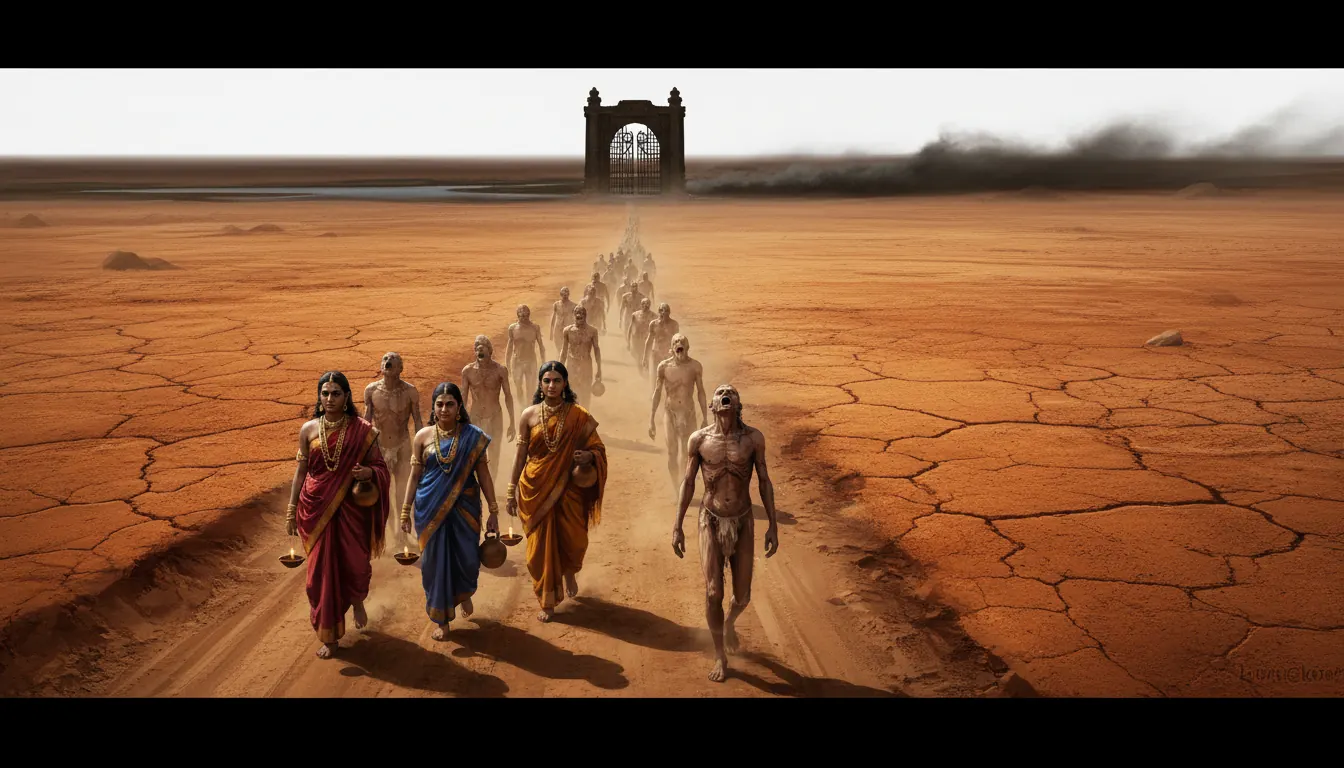
Gifts Under the Lunar Mansions
Narada tells Devaki what to give under each star, and the gods ask Brahman for ground to stand on
In short
Yudhishthira asks Bhishma what gifts actually gratify a brahmana, and Bhishma answers with Narada's teaching that food is the first of all gifts, tracing the circuit of wind, rain, sun, grain and seed by which food becomes every living body. He then recites the discourse Narada gave to Devaki at Dwaraka, naming what should be given under each of the twenty seven lunar mansions and what each gift returns. The teaching goes on to gold, water, ghee, firewood, umbrellas and sandals, to the sesame seed that sprang from the limbs of Kashyapa, and to the day the deities came to Brahman because they could not lawfully own the patch of earth their own altar needed.
Told in the Anushasana ParvaSet in Kurukshetra, Dwaraka and Himavat22 min read
What Pleases a Brahmana
Bhishma had finished with the gift of earth. He had said that it was the first of all gifts, that it cleansed the giver as a mother cleanses, and that Vasava himself, hearing the same doctrine from Brihaspati, had handed over the whole world with its jewels and its gems. Yudhishthira had listened to all of it lying at the foot of the arrow bed, and what he asked next was smaller and more practical.
"When a king wants to give gifts in this world," he said, "what gifts should he give, best of the Bharatas, to brahmanas of outstanding merit? What gift pleases brahmanas at once? What do they give back in return? Which gifts, king, bring rewards both here and hereafter? I want to hear all of this from you. Tell me about it in detail."
It was the question of a man who now owned everything and had not yet worked out what to do with any of it. He had the earth. He wanted the list.
Bhishma did not answer out of his own authority.
"Long ago I put these very questions to Narada, the godlike sage," he said. "Listen, and I will tell you what he answered."
Narada is the rishi who goes everywhere. He walks into the halls of gods and the courtyards of kings with his lute and his news, and he is the one figure in the epic who has seen every household in the three worlds from the inside. If anyone knew what a brahmana actually wants at the door, it was he.
And his answer did not begin with gold, or with land, or with any of the things a king thinks of first.
"The gods and all the rishis praise food," Narada said. "The life of the world and the powers of the mind all rest on food. There has never been, and never will be, any gift equal to the gift of food."
The Man at the Door
Narada built his case from the body upward. In this world food is the source of energy and strength. The breath of life rests on food. It is food that holds up the wide universe. Householders, mendicants and ascetics, three kinds of men who agree about almost nothing, all live on food and on nothing else.
Then he turned from the doctrine to the doorway, because that is where the doctrine is tested.
"The householder should never turn away the man who comes to his house," Narada said, "nor insult him by sending him off."
A deserving old man, worn out with toil, who has walked far from home, honours a house by coming into it. That is the direction the transaction runs in, and Narada is careful to put it that way round. The one who arrives hungry is doing the favour. And the giver must give with his temper packed away. The man who throws off the anger that knows no bounds, becomes righteous at heart and free of malice, and then gives food, is sure to find happiness both here and hereafter.
Then the line that cuts under every rule about who is fit to receive.
"Food given even to a Chandala or a dog is never wasted."
The Chandala is the man outside the four orders, whom the codes will not let sit down with anybody. The dog is not a person at all. Narada puts them in the same clause and says the merit survives in both cases, and he adds the traveller nobody knows: the man who gives clean food to a weary stranger on the road, someone he has never met, earns great merit for it.
When a brahmana asks for food, one should not ask about his family, or his conduct, or his learning in the Vedas. When someone asks for food, give food to him.
The brahmana, Narada said, is the guest of every creature in the universe and has a right to the first share of all food. He is a great being and he is also a fertile field, and whatever seed is sown in that field returns a rich harvest of merit. A house grows in prosperity when brahmanas come to it asking for alms and leave satisfied and honoured.
And unlike every other gift, this one can be watched working. A gift of food brings happiness to giver and receiver alike, plainly and at once. All other gifts bear fruit that cannot be seen.
Food is Earth, Food is Heaven
Then Narada widened the frame until the whole cosmos was inside it.
In an earlier Kalpa, he said, the Lord of all creatures declared that food is Amrita, the source of immortality. Food is Earth. Food is Heaven. Food is the Sky. Everything rests on food.
And he proved it by subtraction. Without food, the five elements that make up the body stop holding together, which is to say the body comes apart. Without food, even the strongest man's strength is seen to fail. Invitations stop. Marriages stop. Sacrifices stop. And then the last item on that list, which is the one nobody expects: when there is no food, even the Vedas disappear. The eternal word is kept alive in the throats of men who have eaten, and hunger can erase it from the world.
Then he described the circuit, which is the reason food can be called Heaven without exaggeration.
The god of the wind, who is lord of the breaths of life, carries above the clouds the water that the Sun has drawn up. Shakra pours that water back down on the earth. The Sun, with his rays, draws the earth's moisture up again, and the wind brings it down from the Sun. When the water falls from the clouds the goddess Earth grows moist, and then men sow all kinds of crops, and the whole world of creatures depends on what those crops yield.
It does not stop at the harvest. The flesh, the fat, the bones and the vital seed of every being have their origin in the food produced this way. From that seed spring all the many kinds of living creatures. Agni and Soma, the two powers that live within the body, create the seed and sustain it. The sun, the wind and the vital seed all arise from food and work through it, and Narada says they are to be counted as one element, one single quantity, and that it is from this one thing that all creatures spring.
Which is why the last sentence of the discourse is not about heaven at all. It is about a doorway again.
"The man who gives food to someone who comes to his house and asks for it," Narada said, "is said to give both life and energy to living creatures."
The Mansions Bright as Stars
"Because of what Narada told me," Bhishma said, "I have always given food. You too should give food, free of malice and with a cheerful heart."
Then the old man on the arrows did something he does rarely. He described the reward in full, the way a man describes a country he expects shortly to see.
The mansions of those great-souled givers shine with splendour in the heavenly worlds. They are bright as the stars in the sky and stand on many columns. They are white as the disc of the moon and hung with many tinkling bells, and they are rosy like the newly risen sun, and some of them stand where they are and some of them travel. Some have the glow of lapis lazuli. Some blaze like the sun. Some are made of silver and some of gold.
Inside them are trees that grant every wish of those who live there. Tanks, roads, halls, wells and lakes are all around. Thousands of carriages stand ready with horses and other animals harnessed to them, and the clatter of their wheels is always loud.
And then, because the gift was food, the country is made of food. Mountains of it. Heaps of cloths and ornaments beside them. Rivers that run milk. Hills of rice and other edibles. Palatial residences that look like white clouds, with beds of golden splendour inside them.
It is a heaven arranged as the opposite of a famine, and it is worth noticing what a man who is dying on a bed of arrows chooses to dwell on when he is free to imagine anything at all. Not thrones. Not victories. Milk, rice, cloth, shade and a hall with room enough for whoever arrives.
"All this is won by those who give food in this world," Bhishma said. "So become a giver of food yourself."
Narada Comes to Dwaraka
"I have heard your teaching on the rules for giving food," Yudhishthira said. "Now tell me how the planets and stars bear on the giving of gifts."
He was asking for the calendar. The moon passes each night into a different one of the twenty-seven mansions, and the old teaching is that a gift laid down under one star is not the same gift as the one laid down under the next.
"On this subject," Bhishma said, "people tell an ancient story of a conversation between Devaki and Narada, the greatest of rishis."
Devaki is Krishna's mother. She lived at Dwaraka on the sea, and one day the godlike Narada arrived there as he arrives everywhere, and she put the question to him, and he answered her in order, star by star, beginning where the list begins.
Under Krittika, please worthy brahmanas with payasa mixed with ghee, and you will reach worlds of great happiness.
Under Rohini, to free yourself of the debt you owe the brahmanas, give them many handfuls of venison along with rice and ghee and milk and other things to eat and drink.
Under Mrigasiras, which is also called Somadaivata, give away a cow with her calf, and you will go from this world of men to a very happy world in heaven.
Under the star that follows, keep a fast and give away krisara mixed with sesame, and in the next world you will cross even the mountains whose rocks are sharp as razors.
Under Punarvasu, give cakes and other food, and you will have beauty and great fame and be born next time into a family with plenty of food.
Under Pushya, give gold, worked or unworked, and you will shine like Soma himself in worlds wrapped in gloom.
Under Aslesha, give silver, or a bull, and you will be freed from every fear and grow very rich.
Under Magha, give earthen dishes filled with sesame, and you will have children and animals here and happiness hereafter.
Under Purva Phalguni, fast and give food mixed with phanita, the thickened juice of the cane, and the reward is great prosperity both here and hereafter.
Under Uttara Phalguni, give ghee and milk with the rice called shashthika, and you will win great honour in heaven. Whatever is given under that star, Narada said, brings merit that never runs out. Of this there is no doubt.
From Hasta to Bharani
Narada went on around the circle, and Devaki listened without once interrupting.
Under Hasta, fast and give a chariot drawn by four elephants, and you will reach worlds where every wish is granted.
Under Chitra, give a bull and fine perfumes, and you will take your pleasure among the Apsaras as the gods do in the groves of Nandana.
Under Swati, give wealth, and you will reach whatever worlds you wish and win great fame.
Under Visakha, give a bull, a cow that gives plenty of milk, a cart full of paddy with a prasanga to cover it, and clothes to wear. Such a man never meets with misfortune and is sure to reach heaven.
Under Anuradha, fast and give embroidered cloth and food, and you will be honoured in heaven for a hundred Yugas.
Under Jyeshtha, give the potherb called kalasaka with its roots still on, and you will prosper greatly.
Under Mula, with your mind restrained, give fruits and roots, and you will please the Pitris.
Under Purvashadha, fast and give cups of curds to a brahmana learned in the Vedas, and you will be born into a family rich in cows.
Under Uttarashadha, give jugs of barley water, with ghee and thickened sugarcane juice, and every wish of yours will be fulfilled.
Under the conjunction called Abhijit, give milk with honey and ghee to wise men, and you will reach heaven.
Under Sravana, give blankets or thick cloth, and you will travel through every happy world in a white chariot of pure splendour.
Under Dhanishtha, give a carriage drawn by bulls, or heaps of cloth and wealth, and you will go straight to heaven in your next life.
Under Satabhisha, give perfumes with aloe wood and sandalwood, and you will win the company of the Apsaras and fragrance that lasts forever.
Under Purva Bhadrapada, give rajamasha beans, and you will have plenty of every food and fruit.
Under Uttara, give mutton, and you will please the Pitris and earn merit that never runs out.
Under Revati, give a cow with a pail of white copper to milk her into, and in the next world that same cow will come to you, ready to grant every wish.
Under Aswini, give a chariot drawn by horses, and you will be born among many elephants and chariots.
Under Bharani, give cows and sesame to the brahmanas, and you will win great fame and many cows.
"That is what Narada told Devaki," said Bhishma. And Devaki, having listened, recited the whole of it in her turn to her daughters-in-law, the wives of Krishna. It went from a rishi to a mother, and from her to the women who ran the houses.
Gold, Water, Ghee and an Umbrella
Bhishma came back from the stars to the ordinary furniture of a life, and he cited his authorities by name as he went.
The illustrious Atri, son of the Grandsire Brahman, said that those who give gold are said to give everything in the world. King Harishchandra said that the gift of gold washes away sin, lengthens life, and brings the Pitris merit that never runs out.
Manu said that the gift of drink is the best of all gifts. So a man should have wells and tanks and lakes dug. A well full of water, from which all kinds of creatures drink, takes away half the sins of the man who dug it. When cows and brahmanas and good people keep quenching their thirst at a man's well or tank, his whole line is saved from hell.
Ghee pleases Brihaspati and Pushan and Bhaga and the twin Ashvins and the god of fire. It is a great medicine, it is needed for sacrifice, and it is the best of all liquids. The twin Ashvins give beauty to the man who gives ghee to brahmanas in the month of Aswin. Rakshasas never break into the house of a man who gives payasa mixed with ghee. A man who gives jars of water never dies of thirst.
Firewood is on the list too, which is a plain thing to be on a list of holy gifts. The man who gives brahmanas wood for their cooking and to keep off the cold succeeds in everything he sets out to do. The god of fire is pleased with him. He never loses his cattle. He is sure to win his battles.
The man who gives an umbrella has children and great prosperity, never suffers from any disease of the eyes, and earns besides the merit of a sacrifice.
And the rishi Sandilya, Bhishma said, held that of all gifts the gift of a chariot is the best.
Then Yudhishthira asked about the smallest thing yet. What are the merits of the man who gives a pair of sandals to a brahmana whose feet are being scorched by hot sand while he walks?
"A man who gives brahmanas sandals to protect their feet," said Bhishma, "tramples every thorn and gets through every kind of difficulty. He stands on the heads of all his enemies. Splendid carriages of gold and silver drawn by mules come to him. Whoever gives sandals earns the merit of giving a carriage drawn by well-trained horses."
Seeds From the Limbs of Kashyapa
"Grandsire, tell me once more, in detail, about the merit of giving sesame and land and cows and food," Yudhishthira said.
Bhishma began with the smallest of the four, and it turned out to have the longest pedigree.
Sesame seeds were created by the Self-born Brahman as the best food for the Pitris. That is their origin and their office. Everything else about them follows from it. Gifts of sesame always give the fathers great joy, and the man who gives sesame to brahmanas in the month of Magha never has to visit hell, which is full of every frightful creature. A man who worships the Pitris with offerings of sesame is counted as worshipping the gods at every sacrifice at once. One should never scatter sesame at a Shraddha idly, without some purpose in doing it.
And they came out of a body. Sesame seeds sprang from the limbs of the great rishi Kashyapa, who is one of the fathers of the world, and it is because of that birth that they are held to be so powerful as gifts. They bring prosperity. They bring beauty. They cleanse the giver of all his sins. That is why the gift of sesame stands above the gift of anything else, and its merit is said to be endless.
Bhishma named the men it had carried. Apastamva of great intelligence, and Kankha, and Likhita, and the great rishi Gautama, all rose to heaven by giving sesame seeds. Brahmanas who make homa offerings of sesame, abstain from sexual intercourse, and follow the religion of rites, are counted as pure as the offering of clarified butter itself.
Then the story that settles the matter. Long ago there was a time when havi, the clarified butter without which no offering can be poured, could not be had. The rishi Kushika stood before his three sacrificial fires with nothing to give them. So he offered sesame seeds instead, into all three, and by that offering he reached an excellent end.
The fire took it. That is the whole of the argument. What a man has, offered in the absence of what he ought to have had, is accepted.
The Gods Beg for a Piece of Earth
"Now listen to what I have to say next," Bhishma said.
Once the gods wanted to perform a sacrifice, found they could not, and went before the Self-born Brahman to explain why.
"Illustrious one, you are lord of the whole earth and of all the gods," they said. "With your permission we want to perform a sacrifice. But a man who has not come by the ground for his altar lawfully gets no merit from the sacrifice he performs. So please grant us a piece of earth for the sacrifice we wish to make."
See what the gods have admitted. They cannot lawfully own a patch of ground the width of an altar, without lawful title the whole rite is void, and they know it, and they have come to ask like anybody else.
"Greatest of the gods," said Brahman, "I will give you a piece of earth, sons of Kashyapa, where you may perform the sacrifice you intend."
"Our wishes are fulfilled," the gods said. "We will perform our sacrifice right here, with generous Dakshina. But let the Munis always worship this piece of earth."
And the Munis came, since a thing worshipped requires worshippers: Agastya, Kanva, Bhrigu, Atri, Vrishakapi, Asita and Devala. The gods performed their sacrifice on the slopes of Himavat, greatest of mountains, and completed it in due time. And they did not keep the whole of what they had earned. They attached a sixth part of the merit of their sacrifice to the gift of earth, and left it there for whoever should afterwards give ground away.
So the rules came down with the gods' sixth share behind them. A man who gives even a span of earth with reverence never sinks under any hardship. A man who gives a house that keeps out cold and wind and sun reaches the world of the gods and does not fall from it when his merit is spent. A man who gives a cowshed saves seven generations of his line. Farmland brings prosperity, and land with minerals in it makes a family great.
And the refusals. Never give away land that is barren, or scorched and dry, or close to a cremation ground, or that a sinful man has owned before you. When a man performs a Shraddha for his fathers on another man's land, the Pitris make both the gift and the Shraddha worthless. So a wise man buys even a small piece of land and gives that. Only forests, mountains, rivers and tirthas are exempt, since they are held to have no owners at all.
The River Made From Skins
"Now I will tell you about the gift of cows," Bhishma said.
Cows are held to be greater than all ascetics, and that is why the divine Mahadeva did his penance in their company. They serve human beings with milk, ghee, curds, dung, skin, bones, horns and hair. They feel neither cold nor heat. They are always working. Because they reach the highest end in the company of brahmanas, the wise say the two are equal.
Then Bhishma told the piece of history that explains why the rules are what they are now.
Long ago King Rantideva performed a great sacrifice in which a vast number of cows were slaughtered. From the fluid that ran out of the skins of the slaughtered animals a river was formed, and it is there still, and is called the Charmanvati.
He does not moralise over it. Cows are no longer animals fit for sacrifice. They are now animals fit to be given.
Once they are gifts, the weight falls on who receives them. The cow must never be given to one who will kill her. Not to a tiller of the soil. Not to an atheist. Not to a man whose trade is the keeping of cattle. Whoever gives a cow to any of these sinks into everlasting hell. Nor may a man palm off a bad animal on a brahmana: not one that is thin, nor one whose calves do not live, nor one that is barren, diseased, maimed, or worn out with work.
The reward climbs with the count. Give a thousand cows, and the giver does not go to hell and wins victory everywhere. Ten thousand, and he lives in bliss in the company of Indra. A hundred thousand, and he wins many worlds of endless happiness. The milk of cows is nectar, so the giver of a cow is a giver of nectar. Cows are the breath of life of living creatures, so he is a giver of the breath of life.
And then the old man closed the circle where he had opened it. Rantideva himself, the king who made that river, rose to heaven by giving food. What givers of food reach, men cannot reach by gifts of gold and robes. Parashara has said this too. Offer food to the gods first, for the food a man eats is the food the gods he worships eat as well. Give to a hungry guest at your door and you will reach the worlds kept for those who know Brahma.
"So I have told you," Bhishma said, "the merit of giving food, sesame, land and cows."
Dharma Lesson
The catalogue looks like superstition until you notice what it is doing. It takes a year of ordinary nights and leaves no night on which there is nothing to give, and it prices the gifts in things a household actually has: curds, blankets, firewood, a pair of sandals for a man walking on hot sand. Narada begins the whole teaching by refusing to let the giver ask who the asker is, and the gods end it by admitting that they cannot hold a sacrifice on ground they have not been lawfully given. Nobody in this discourse, not even the gods, is permitted to give from a position of ownership rather than of debt.