The Elephant Standard Comes Down
Dhrishtadyumna leaves Duryodhana without horses, driver, weapons or banner at noon on the seventeenth day
In short
On the second day of Karna's command, Duryodhana overwhelms Nakula and Sahadeva until Dhrishtadyumna rides past the twins and takes him on. The two kings cut each other's bows and each other's armour, and then the prince of the Panchalas empties sixteen broad-headed arrows into the Kuru king's chariot, killing his horses and driver and cutting away his bow, umbrella, dart, sword, mace and the jewelled elephant standard by which the whole field knew him. His brother Dandadhara carries the chariotless Duryodhana away, and Karna turns from Satyaki to avenge him on the Panchalas.
Told in the Karna ParvaSet in Kurukshetra18 min read
Three Fires at Noon
Sanjaya said: it was the seventeenth day, the second day of Karna's command, and by the middle of it the field had three fires burning in it in three different places.
Vikartana, the son of the Sun, stood in Bhimasena's way with the Panchalas and the Cedis and the Kaikayas drawn up behind Bhima, and covered him with arrows. Before Bhimasena's very eyes he killed many great chariot-warriors of the Cedis and the Karushas and the Srinjayas, one after another, so that Bhima had to watch it happen and could do nothing. Then Bhima did what a man does who has somewhere else to be. He left Karna, that best of chariot-warriors, and went at the Kaurava troops the way a blazing fire goes at a heap of dry grass.
So the Suta's son turned back to the Panchalas and the Kaikayas and the Srinjayas and began to kill their mighty bowmen in thousands.
Three men were doing this at once. Partha was wiping out the samsaptakas, who had sworn to defeat him or die. Vrikodara was wiping out the Kauravas. Karna was wiping out the Panchalas. Sanjaya named the three of them together and then turned the account on the man he was speaking to.
"Because of your evil policy, king, all these kshatriyas, scorched by the fine arrows of those three great warriors, were being wiped out in that battle."
Dhritarashtra said nothing. He had been hearing that sentence in one form or another for sixteen days.
And into that noon, with his own commander burning one wing of the Pandava host and his own troops burning under Bhima on the other, Duryodhana went looking for somebody to fight, and found the two youngest sons of Pandu.
The Twins and the Circle of the Bow
Nakula and Sahadeva were the sons of Madri, the youngest of the five, and their cousin had known them since they were boys in Hastinapura.
In a rage, Duryodhana pierced Nakula and his four horses with nine arrows. Then, with a razor-headed arrow, he cut off Sahadeva's golden standard, so that it came down in front of its owner.
Nakula struck him with seventy-three arrows. Sahadeva struck him with five. Duryodhana, in his anger, struck each of those foremost of bowmen with five, and then with a couple of broad-headed arrows cut off both their bows at once, and while their hands were empty pierced each of the twins with seven shafts.
They took up two other bows, beautiful, each like the bow of Indra himself, and standing there with the new weapons the two of them looked like a pair of young gods. Then they poured endless showers of terrible arrows on their cousin, like two masses of cloud pouring rain on the side of a mountain.
Duryodhana took them both on at once. The bow in his hands, said Sanjaya, seemed to be drawn to a full circle without pause, so that no one could see it come to rest, and arrows seemed to pour from it ceaselessly on every side. The twins lost their brightness. They looked like the Sun and the Moon in the sky when clouds have taken their splendour away, and the arrows that did it, gold-winged and whetted on stone, covered every point of the compass like the rays of the Sun, until the whole sky was one unbroken expanse and the expanse looked like the Destroyer at the end of the Yuga.
The great chariot-warriors watching from both sides came to the same conclusion at the same moment. Seeing the prowess of Dhritarashtra's son, they thought the two sons of Madri stood in the presence of Death.
The Son of Prishata Rides Across
The commander of the Pandava army saw it.
Dhrishtadyumna was Drupada's son and Prishata's grandson, born out of a sacrificial fire for one purpose, and he had already accomplished that purpose: on the fifteenth day he had killed Drona. He was the prince of the Panchalas, and Draupadi's brother, and since the fall of Bhishma and Drona he had carried the whole weight of the Pandava order of battle on his own chariot. He came now to the place where Duryodhana was.
He did not stop to consult the twins. Overtaking those two great chariot-warriors, riding straight past the brave sons of Madri as though they were not there, he put himself between his king's youngest brothers and the king of the Kurus, and began to hold Duryodhana off with his arrows.
Duryodhana was pleased to see him. He had a debt against this man that no one on his side had been able to collect, and he was smiling as he shot.
He pierced the prince of Panchala with twenty-five arrows. Then, eager to strike back, he pierced him again with sixty arrows, and again with five, and gave a loud roar over him so that the men nearby heard which of the two was winning.
Then the king took a sharp razor-headed arrow and, there in the battle, cut through his opponent's bow with the arrow already on the string, and cut away the leather guard that protected his hand.
Dhrishtadyumna threw the broken bow aside. He was a crusher of enemies, and he had been in this position before. He took up another bow, new, strong enough to bear a great strain, and stood up in his chariot blazing with fury, his eyes red as blood with rage, his body carrying so many wounds that Sanjaya, who had no love for him, said he looked resplendent standing there in them.
Fifteen Shafts Through Gold
Bent on killing Duryodhana, the Panchala hero sent off fifteen cloth-yard arrows that went hissing like snakes.
They were whetted on stone and feathered with the plumes of Kankas and peacocks, and they were shot with everything he had. They cut through the king's armour, which was decked with gold, and passed clean through his body, and went into the earth behind him because of the force with which they had been sent.
Duryodhana stood in his chariot with fifteen wounds in him. Sanjaya, describing his own master's son to that son's blind father, could find only one thing in the world that the sight resembled: a gigantic Kinsuka tree in the season of spring, standing under the weight of its own red flowers.
He did not fall. His armour was pierced and every limb of him had been weakened by the wounds, and out of that condition he was filled with rage and did the one thing still open to him. With a broad-headed arrow he cut off Dhrishtadyumna's bow.
Then, with great speed, before the other man could reach for another, he struck him with ten shafts on the forehead, in the space between the two eyebrows.
They stood there in a row in the bone. Polished by the hands of the smith, they adorned Dhrishtadyumna's face, said Sanjaya, like a number of bees settling on a full-blown lotus because they want the honey in it.
That was the whole of Duryodhana's advantage, and it lasted as long as it took a man to throw away a broken bow and pick up a whole one. Dhrishtadyumna threw the bow aside and took up another, and with it he took up sixteen broad-headed arrows, and he had already decided what each of them was for.
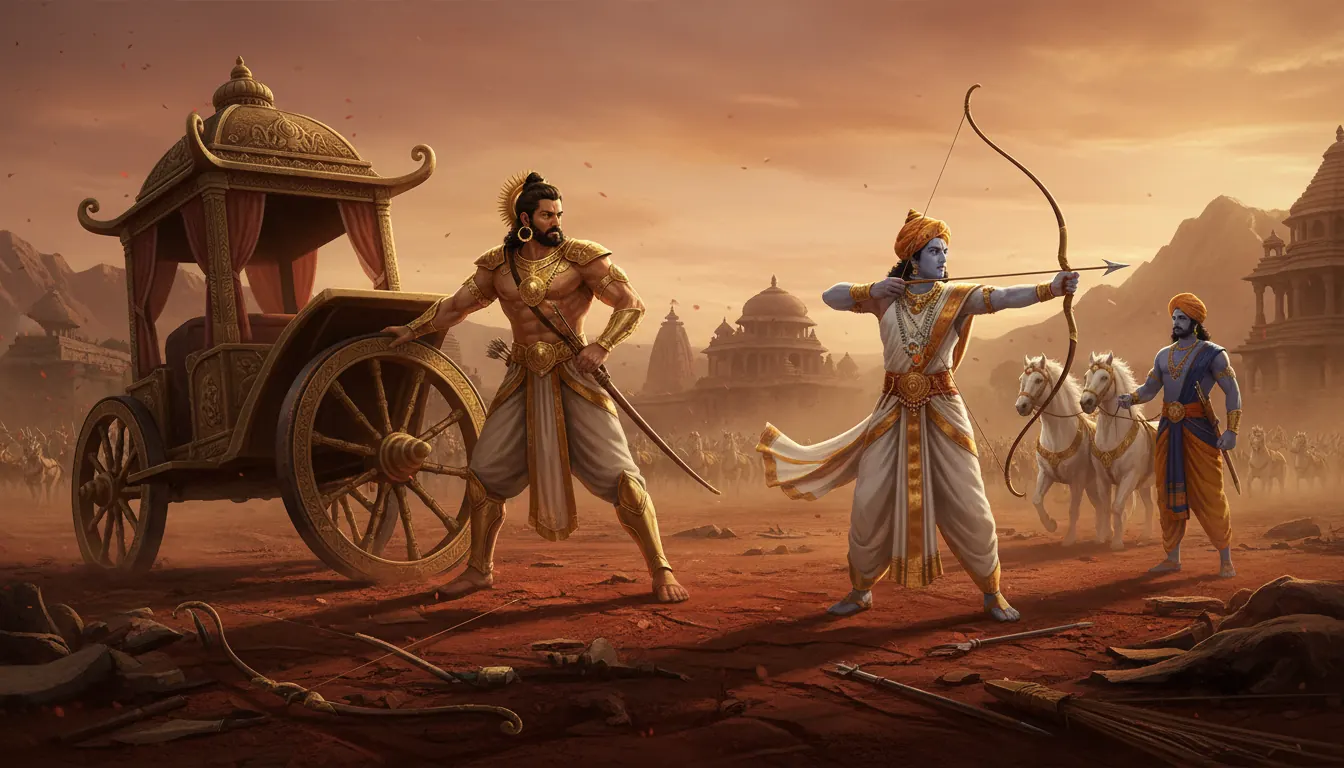
The Elephant Standard Comes Down
With five of the sixteen he killed Duryodhana's four horses and his driver.
With one he cut off the king's bow, the one decked with gold.
With nine more the son of Prishata took the chariot apart while its owner was standing in it. He cut off the upashkara, the frame of the vehicle itself. Then the umbrella that marked the man under it as a king. Then the dart, and the sword, and the mace, one after another, so that there was nothing left within reach of Duryodhana's hand that could be used against anybody.
The last of the nine took the standard.
All the kings on that part of the field saw it go. The beautiful standard of the Kuru king, decked with golden Angadas, bearing the device of an elephant worked in jewels, the mark by which every man in both armies located Duryodhana in a battle, was cut off by the prince of the Panchalas and came down.
The man who had ruled the earth for thirteen years stood in the wreck of his chariot with no horses, no driver, no bow, no sword, no mace, no umbrella and no banner, in front of the man who had killed his teacher.
Then Duryodhana's brothers born of the same mother rescued him. They closed around the king, who had lost his chariot and all his weapons besides, and before Dhrishtadyumna's eyes one of them, Dandadhara, took his elder brother up into his own chariot and quickly carried him away from the battle.
Dhrishtadyumna let him go. He had emptied his sixteenth arrow and there was no seventeenth prepared, and by the time another bow could be bent the elephant standard was lying on the ground and the man it belonged to was already behind the shields of his own people.
Karna Comes for the King
Meanwhile the mighty Karna had beaten Satyaki, and heard what had happened to the king he served.
Eager to rescue the ruler of the Kurus, he turned his chariot and drove straight at Drona's slayer, that warrior of fierce arrows. But Satyaki would not be left behind. The grandson of Shini chased Karna from behind, striking him with arrows as he went, the way one elephant chases a rival and gores him in the hindquarters with his tusks.
In the space between Karna and the son of Prishata the two armies met, and the battle that raged there between the great-souled warriors of both sides became fiercer than anything that day had seen. Not one fighter, Pandava or Kaurava, turned his face away from it.
Then Karna, unable to reach Dhrishtadyumna through that, went at the Panchalas instead with great speed.
The Sun had climbed to its height. At that hour there was a great slaughter of elephants and horses and men on both sides. The Panchalas, eager for victory, rushed at Karna the way birds rush to a tree, and the son of Adhiratha, filled with rage, began to strike them from the front with the sharp points of his arrows, singling out their leaders: Vyaghraketu, Susharma, Chitra, Ugrayudha, Jaya, Sukla, Rochamana, and the invincible Singhasena. Those eight surrounded him with their chariots and poured their arrows on him, and he killed all eight of them with sharp arrows.
Then he killed thousands of others skilled in battle. He killed Jishnu and Jishnukarman and Devapi, Chitra and Citrayudha, Hari and Singhaketu and Rochamana and the great chariot-warrior Salabha, and he called out his own name each time, in every instance, so that the men he was killing would know whose arrow it was.
The elephants he wounded fled in every direction in terror and threw the field into confusion. Others fell with cries, like mountains split by thunder. Along the track of Karna's chariot the earth was strewn with fallen elephants and horses and men and broken vehicles, and Sanjaya said that neither Bhishma nor Drona nor any other warrior of that army had ever achieved what Karna achieved in that hour.
The Whole Host Against One Man
As a lion ranges fearlessly through a herd of deer, so Karna ranged through the Panchalas. As a lion scatters a terrified herd to every point of the compass, so he scattered those throngs of Panchala chariots. As a herd that has come into a lion's jaws never escapes alive, so the great chariot-warriors who came near him did not escape. As people who touch a blazing fire are burned, so the Srinjayas were burned by the fire that was Karna when they came against it.
Sanjaya, watching, thought that not a single Panchala would get away from the son of Adhiratha alive.
Then the son of Adhiratha, having slaughtered the Panchalas, rushed in his fury at Yudhishthira himself, and Dhrishtadyumna and the sons of Draupadi and hundreds of warriors closed round the king to shield him. Shikhandi came, and Sahadeva, and Nakula, and Nakula's son, and Janamejaya of the Panchalas, and the grandson of Shini who had been chasing him all afternoon, and countless Prabhadrakas, all of them men of boundless energy, with Dhrishtadyumna riding at their head. They looked magnificent, said Sanjaya, as they struck Karna with arrows and with weapons of many kinds.
Like Garuda falling upon a large number of snakes, the son of Adhiratha, single-handed, fell upon all those Cedis and Panchalas and Pandavas together.
The battle between them became as fierce as the one fought long ago between the gods and the Danavas. He was one man in the middle of an army that had come specifically for him, and he stood in it like the Sun scattering the darkness around it, fearless, alone, facing all those great bowmen together while they poured shower after shower of arrows upon him.
Nobody on that field could say, at that hour, that the man who had been given the command two days ago was unequal to it.
What Bhima Was Doing Meanwhile
While the son of Radha was thus engaged with the Pandavas, Bhimasena was at the other end of the field with nobody to stop him.
In his rage he slaughtered the Kurus with arrows, every one of them like the rod of Yama. Fighting single-handed against the Bahlikas and the Kaikayas, the Matsyas, the Vasatas, the Madras and the Saindhavas all at once, he was a splendid sight. Elephants struck in their vital parts by his cloth-yard arrows fell with their riders dead and made the earth shake with the force of their fall. Horses fell with their riders dead on them. Foot-soldiers lay pierced, vomiting streams of blood. Chariot-warriors fell in thousands with the weapons slipping from their hands, and lay there lifeless, their bodies torn, with the fear of Bhima still on their faces.
The earth in that quarter was strewn with chariot-warriors and horsemen and elephant-riders and drivers and foot-soldiers and horses and elephants, all of them torn by the arrows of Bhimasena.
And the army of Duryodhana, cheerless and mangled and afflicted, stopped fighting and stood still.
Sanjaya could not get past what he had seen there. That gloomy army stood motionless in that dreadful battle, he said, like the Ocean during a calm in autumn. Stunned, it stood like the Ocean in a calm. However full of anger and energy and might it had been, the army of Dhritarashtra's son, stripped of its pride, lost all its splendour. Drenched in gore, it seemed to bathe in blood, and the fighters, drenched, went on coming at one another and killing one another because there was nothing else left to do.
The Suta's son, filled with rage, routed the Pandava division. Bhimasena, filled with rage, routed the Kurus. Both of them, busy at this work, were a splendid sight, and neither of them knew what the other was achieving.
The White Horses Go In
In the middle of that, Arjuna finished with the array he had been given and looked across the field.
He had slain a large number of samsaptakas in the midst of their own formation. Now he spoke to Vasudeva.
"This struggling force of samsaptakas is broken, Janardana. The great chariot-warriors among them are fleeing with their followers, unable to bear my arrows, like deer that cannot bear the lion's roar. The vast Srinjaya force also seems to be breaking in this great battle. There is the banner of the wise Karna, with its device of the elephant's rope, in the middle of Yudhishthira's division, where he is ranging about busily. The other great chariot-warriors of our army cannot defeat Karna. You know how great Karna's energy and prowess in battle are. Drive to where Karna is routing our forces. Avoid the others in this battle and go against the Suta's son, that mighty chariot-warrior. That is what I wish, Krishna. But do as you think fit."
Govinda smiled, and said, "Kill the Kauravas, son of Pandu, without delay."
Then the horses white as swans, driven on by Govinda, carried Krishna and the son of Pandu into that vast army, and the army broke on every side as they went in. The ape-bannered chariot, whose wheels thundered like the deep roar of clouds, passed into the army like a celestial chariot passing through the sky. The two of them, their eyes red with rage, piercing through that press, looked like the twin Ashvins invoked with proper rites at a sacrifice.
Seeing that, Duryodhana once more urged the samsaptakas against him: a thousand chariots, three hundred elephants, fourteen thousand horse, and two hundred thousand foot-soldiers armed with the bow, all of sure aim and versed in every kind of fighting. They covered Partha with showers of arrows from every side, and, covered in them, he took on a fierce form like the Destroyer with his noose.
Ten thousand kshatriyas later he reached their further wing, which the Kambojas were holding, and began to grind it as Vasava grinds the Danavas.
The Teacher's Son, and Two Miles of Quiet
When the wing and the further wing of the samsaptakas had been exterminated by Savyasachi, Ashwatthama came for him.
Drona's son rushed at him shaking his formidable bow and carrying many terrible arrows, like the Sun appearing with his own rays. His mouth was wide open with rage and his eyes were red, and he shot showers of fierce arrows and began to rout the Pandava army with them. The moment he saw Keshava on the chariot he raced at him, and with hundreds of sharp arrows he shrouded both Krishna and Dhananjaya and stunned them where they stood.
Seeing the two protectors of all moving and unmoving creatures covered with arrows, the universe cried out "Oh!" and "Alas!" Crowds of Siddhas and Charanas came to that spot from every side, all praying in their minds the same prayer: "May all the worlds be well."
Sanjaya said he had never seen prowess like that of Drona's son in that hour. Arjuna, for all his steadiness and lightness of hand, saw him and was stunned, and thought his own prowess was gone.
Krishna drew deep breaths and looked at both of them as though he would burn them with his eyes.
"Partha, what I see of you in this battle is very strange, since Drona's son is getting the better of you today. Do you no longer have the energy and the strength of arm you had before? Do you not still have Gandiva in your hands, and are you not still standing in your chariot? Are your two arms not sound? Has your fist been hurt? Why then do I see the son of Drona prevailing over you in battle? Partha, do not spare your attacker because he is your teacher's son. This is not the time for sparing him."
Partha took up fourteen broad-headed arrows at once, when speed mattered most, and with them cut off Ashwatthama's bow and standard and umbrella and banners and chariot and dart and mace. Then a few calf-toothed arrows went deep into his shoulder, and Ashwatthama, overcome by a deep faint, sank down on the wreckage, leaning against his flagstaff, and his driver carried him away unconscious.
Within a short time Bibhatsu had routed the samsaptakas, Vrikodara the Kurus, and Vasusena the Panchalas.
And Yudhishthira, in great pain from his wounds, retreated about two miles from the battle, and rested there for some time.
Dharma Lesson
Duryodhana fought well that noon. He beat two of the Pandavas, he stood upright with fifteen shafts through his gilded armour, and he still lost everything he was carrying inside a single exchange of bows. A kshatriya's standard is not a decoration; it is how his army finds him and how his enemies measure the day, and a man who has staked a war on being the visible centre of it has given his enemies exactly one thing to cut. What Dhrishtadyumna took from him at noon was not his life but his place on the field, and from here to the end of the war Duryodhana is a king other men keep having to carry off it.