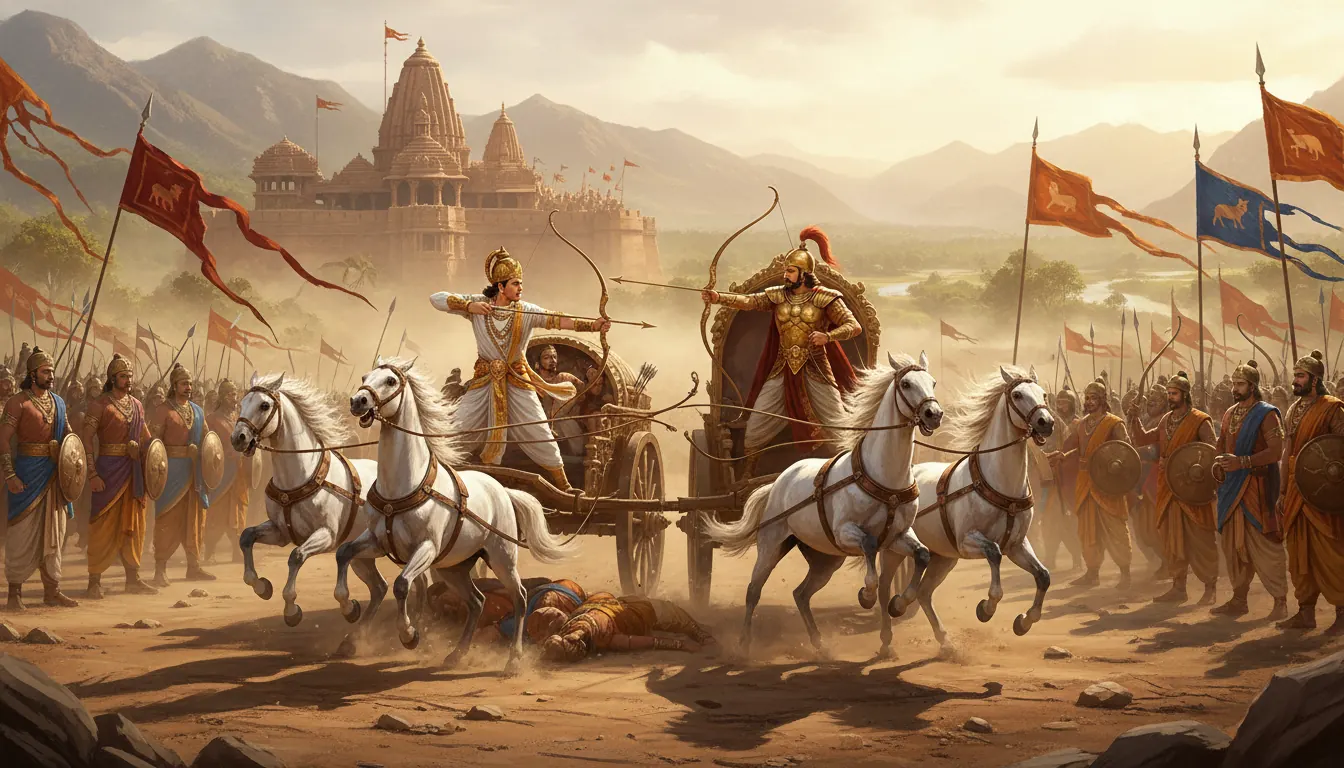
Ashwatthama Breaks the King's Guard
A roof of arrows over Yudhishthira, and the insult the king threw back
In short
On the seventeenth day, while Karna held Bhima and Kripa held Shikhandi, Drona's son advanced alone on Yudhishthira and covered the sky above him with an unbroken canopy of gold-decked arrows. Satyaki and the five sons of Draupadi charged him together and could not hold him; bows were cut, Satyaki's driver was killed with a dart, and every onlooker on the field counted the Pandavas as dead men. Yudhishthira answered with words instead, telling Ashwatthama that a bow in a brahmana's hands made him a brahmana in name only. Ashwatthama thought about it, said nothing, and buried him in arrows until the king rode away.
Told in the Karna ParvaSet in Kurukshetra and Hastinapura18 min read
The King Behind His Guards
It was the seventeenth day of the war, and Sanjaya was telling it to a blind man in a hall in Hastinapura, one quarrel at a time, because by then the field had come apart into quarrels.
Kripa had Shikhandi on foot with a sword and no shield. Kritavarma had Dhrishtadyumna. Duryodhana had the twins between them. Karna, who had been made commander of the Kuru army the morning before, had Bhimasena and the Karushas and the Kaikayas and the Srinjayas all at once. And in the middle of the noise stood the eldest son of Pandu, and around him stood the men whose whole business that day was that he should not be reached.
Satyaki was one of them, the grandson of Shini, a Vrishni of Krishna's own people who had learned the bow from Arjuna and had spent much of this war standing between Yudhishthira and whoever came. The others were the five sons of Draupadi, one born to each of the five brothers: Prativindhya, Sutasoma, Shrutakarma, Shrutakirti, Satanika. They were young men. Their fathers were scattered across four miles of dust, and their eldest uncle was theirs to keep.
Ashwatthama looked at that arrangement and came on cheerfully.
He was the son of Drona, and Drona had been killed on this field two days before, and the man who took his head was out there at this moment commanding the troops those five young men belonged to. He was also, by birth, a brahmana, son of a brahmana, of a line whose proper work was the fire and the text and the teaching of other men's sons.
He came scattering fierce arrows equipped with wings of gold and whetted on stone, showing off the manoeuvres of his chariot, and the great skill he had won, and his extraordinary lightness of hand.
Sanjaya, who had watched every great bowman in that war take his turn at the front, was careful with the word he chose next. Conversant with all weapons, Drona's son encompassed Yudhishthira in that battle.
Not charged him. Encompassed him. What follows is a description of what happened to the sky.
A Canopy Embroidered With Gold
He filled the entire sky with arrows charged with the force of celestial weapons.
That is the sentence, and it is meant literally. The sky over that part of the field was covered with the shafts of Drona's son, and nothing could be seen. The vast space in front of Ashwatthama became one expanse of arrows, without a seam in it anywhere, arriving faster than a man could count and going on arriving.
The sky, covered like this with that dense shower of arrows decked with gold, looked beautiful, Sanjaya said to the king, as if a canopy embroidered with gold had been spread there. That is the image he kept. Not a hail, not a storm. A ceiling. Somebody had put a roof of worked gold over an acre of Kurukshetra, and the men underneath it were inside a room that had not existed a moment before.
And where there is a canopy there is shade. With the sky covered by that bright shower, a shadow like the shadow of clouds fell there. The light on the faces of the guards went grey in the middle of a clear afternoon, and they knew what had caused it, and knowing did not help them.
It was a wonderful sight we saw then, said Sanjaya, when the sky had become one expanse of arrows, for not one creature that ranges the sky could move through it.
The birds could not get through. That is the measure of it, and it is a soldier's measure rather than a poet's: the air above that ground had been made solid enough that a thing built to live in the air could not pass.
Under the roof, the men it had been built for stood and tried to fight. Then Satyaki, though struggling resolutely, and Pandu's son king Yudhishthira the just, as also all the other warriors, could not display their prowess.
There was nothing wrong with any of them. There was simply nothing to shoot at, and no moment in which to shoot it.
The Kings Who Could Not Look
The strangest part of it, and Sanjaya reported this without embarrassment, was that the Pandava chariot-warriors were filled with wonder.
Seeing the great lightness of hand shown by the son of Drona, those mighty men who were being killed by it stood and admired the hands. They had all been trained. Most of them had been trained by Drona or by men Drona had trained, and they knew exactly what they were watching and exactly how much of a life it takes to be able to do it, and the knowledge arrived in them as awe before it arrived as fear.
Then it arrived as fear. All the kings became incapable of even looking at Ashwatthama, who then resembled the scorching Sun himself in the sky.
There is no exaggeration to strip out of that. A man cannot look at the sun. He turns his head. Kings on that field, each of whom had a standard and a lineage and a reason to be brave in public, found that when they turned their eyes toward the place where Drona's son was working, their eyes went elsewhere of their own accord, and they let them.
And while all this admiring and flinching went on, the Pandava troops were being slaughtered. That clause sits in the middle of the passage like a stone. The wonder was not free. Every moment the great chariot-warriors spent marvelling at the lightness of those hands was a moment in which ordinary men in front of them were being taken off the earth in numbers.
It was Draupadi's sons who moved first, and then Satyaki, and then Yudhishthira, and then the Panchala warriors, all uniting together.
They cast off their fears of death.
Sanjaya put it that way to Dhritarashtra deliberately, because it was not courage in the ordinary sense and he would not pretend it was. Nobody in that group thought he would live through what he was about to do. They had looked at the thing, and been unable to look at it, and understood that standing still under the golden roof was simply a slower way to die than running at the man holding it up.
So they ran at him.
They Cast Off Their Fear of Death
Satyaki got there first and pierced the son of Drona with twenty-five arrows, and then, before the answer could come, with seven long shafts decked with gold.
Yudhishthira pierced him with three and seventy.
Then the five young men, in the order Sanjaya gave them, each with what he had. Prativindhya with seven. Shrutakarma with three. Shrutakirti with seven. Sutasoma with nine. Satanika with nine. And many other heroes pierced him with many arrows from every side.
Set those numbers beside one another and you can see the shape of the charge. Satyaki and Yudhishthira threw everything they had in their hands, twenty-five and seven, three and seventy, the volleys of men who intend to end a thing in the first exchange. The boys shot in single figures. Three arrows. Five. Seven. Nine. That is not weakness. That is what it looks like when a young chariot-warrior comes into range of a master, gets his bow up, and gets off what he can before the sky closes over him again.
They were the sons of the five greatest bowmen alive and they were shooting at the son of their fathers' teacher, and the count of their shafts fits on one hand each.
For a moment the roof of arrows was down, because a man cannot cover a sky and defend his own chest at the same instant. Ashwatthama had to stop building and start answering. That was the whole of what the charge achieved, and it was not nothing: it was the only breath the Pandava division got that hour, and every man in it had bought it with the same coin, having agreed in advance not to expect to spend the change.
Then the arrows went home in him, twenty-five and seven and three and seventy and all the rest of them together, and Drona's son stood in his chariot with the arrows standing out of his arms and his chest, and filled with rage, and began to breathe.
Sanjaya said he breathed like a snake of virulent poison.
Two Arrows Each, Counted Out
What came back was arithmetic, and it was addressed by name.
He pierced Satyaki in return with five and twenty arrows whetted on stone. He pierced Shrutakirti with nine, and Sutasoma with five, and Shrutakarma with eight, and Prativindhya with three. He pierced Satanika with nine. And Dharma's son, the king, he pierced with seven.
And each of the other warriors he pierced with a couple of shafts.
Read that last line slowly, because it is the frightening one. In the middle of a general engagement, with seven named men shooting at him from seven directions and hundreds of others behind them, Ashwatthama went round the whole crowd and gave every single anonymous warrior in it two arrows apiece. Not a shower into the mass. Two, and two, and two, counted out, while the seven who mattered were being dealt with individually.
That is what the phrase lightness of hands means when you take the wonder out of it. It means a man is shooting fast enough to treat a battle as a list.
Then he began on the bows. With some sharp arrows he cut through the bow of Shrutakirti, which is the cheapest way to remove a young man from a fight without the trouble of killing him. Shrutakirti, who was a great chariot-warrior and had been raised by people who did not accept that kind of dismissal, took up another bow and pierced Drona's son with three arrows, and then with many others with sharp points, which was his answer to being told he was not there.
And Drona's son covered the Pandava troops, sire, with thick showers of arrows.
The roof went back up. That was the pattern of the whole encounter, and the guards were learning it: they could take the canopy down for as long as they could keep shooting, and no longer, and it went back up faster every time.
The Bows Come Apart
Then, smiling as he did it, he cut off the bow of king Yudhishthira the just with three sharp arrows.
The smile is in the text, and with the cheerfulness he came on with it is one of the few things Ashwatthama does in this whole passage that looks like enjoyment. It was not a small thing to disarm that particular man in front of his own troops. Yudhishthira had been the object of the entire Kuru war effort for days; Drona had gone into every morning since the eleventh day meaning to take him alive; and here was Drona's son doing the first half of it, with his father two days dead, smiling.
The son of Dharma took up another formidable bow and pierced Drona's son with seventy arrows in the arms and the chest.
He was not a great bowman by the standard of that field, but he was not a weak one either, and seventy arrows into the arms and chest of the man who has just humiliated you is a reply with something in it.
Then Satyaki, filled with rage, cut through the bow of Drona's son with a sharp crescent-shaped arrow, and gave a loud roar.
That roar was the high-water mark of the Pandava guard that afternoon. One arrow, well placed, and the golden canopy had no one to hold it up, and the man who had done it let the whole field know.
With his bow cut through, that mightiest of men quickly brought Satyaki's driver down from his chariot with a dart.
He did not reach for another bow first. Bowless, in the half-second when he had nothing to shoot with, he picked up a dart and threw it and killed the one man in Satyaki's chariot whose death would take Satyaki out of the battle without touching him. Then he took up another bow and covered the grandson of Shini with a shower of arrows.
With his driver slain, Satyaki's horses were seen running this way and that across the battlefield.
The best warrior in Yudhishthira's guard went past his own king sideways, dragged by four frightened horses with no hand on the reins, still holding his bow, unable to use it.
Fire in Dry Grass
Then the Pandava warriors headed by Yudhishthira, shooting sharp shafts, all rushed with impetuosity towards Drona's son.
It was the second charge and it was made for the same reason as the first, by fewer men, with their best protector loose on the field behind runaway horses. That scorcher of foes, seeing those warriors advancing angrily against him, met them all in that dreadful battle.
Received them. He did not give ground and he did not need to manoeuvre. He stood where he was and took the charge on his bow.
Then, said Sanjaya, like a fire in the forest consuming heaps of dry grass and straw, that mighty chariot-warrior, with showers of arrows for his flames, consumed the Pandava troops in that battle as if they were a heap of dry grass and straw.
He had used the fire image before in that hall, about other men. He used it here without softening it and without granting the dry grass any dignity. What was in front of Ashwatthama was fuel, arranged in heaps.
That army of Pandu's son, scorched in this way by the son of Drona, was thrown into utter turmoil, like the mouth of a river churned by a whale.
It is a strange and exact figure and it is worth pausing on. A river mouth is wide, and it is where a river is calmest, and a whale that comes up into it has nowhere to go and neither does the water. The great mass of the thing thrashing in the shallows sends the whole estuary up in confusion from bank to bank. One creature, badly out of proportion to the place it is in, and the water cannot settle anywhere.
People then, seeing the prowess of Drona's son, regarded all the Pandavas as already slain by him.
Not the division. Not the guard. All the Pandavas, the five of them and their cause and their thirteen years and the whole account, closed and settled by a brahmana in a chariot in one afternoon, in the opinion of everybody watching from both armies.
A Brahmana in Name Only
And Yudhishthira, that great chariot-warrior, who had been Drona's pupil in the same yard as the man in front of him, was filled with rage and the desire to retaliate, and he spoke.
"Tiger among men, you have no affection, you have no gratitude, since you want to kill me today."
He began with the two words a family uses. Affection and gratitude. They had grown up in the same house of instruction. Drona had eaten the Kuru bread and taught these two men to draw a bow standing side by side, and the elder of them was now pointing out to the younger that there is a debt in that, and that it was being ignored.
Then he went to the thing underneath.
"The duties of a brahmana are asceticism and giving and study. Only the kshatriya should bend the bow. So it seems that you are a brahmana in name only."
That is the sharpest sentence anyone speaks in this part of the war, and every word of it is a rule that both men had been taught by the same teacher. Austerity, giving, and study: the three works of a brahmana, none of which involves a chariot. The bending of a bow is the kshatriya's work, and the kshatriya's alone. Yudhishthira was not calling him a bad warrior. He was saying, in the middle of the demonstration of the finest archery anyone on that field had ever seen, that the whole of that skill was a trespass, and that a man who can do this is not a brahmana who happens to fight but a brahmana who has stopped being one.
And having said it, the king who could not lift his eyes to the man a few minutes earlier made him a promise.
"But before your very eyes, mighty-armed one, I will defeat the Kauravas in battle. Do what you can in battle. I tell you that you are a wretch among brahmanas."
Wretch among brahmanas. He put it last, so that it would be the part that was remembered.
The Answer He Did Not Give
Thus addressed, the son of Drona, smiling, and reflecting upon what was proper and true, gave no reply.
There is a great deal inside that line. He did not deny it. He did not answer with his father's name or his own vows or the sixteen days he had spent in a war he did not begin. He reflected upon what was proper and true, and Sanjaya, who did not have to include the detail, includes it: the man thought about whether the charge was fair.
And then said nothing, and smiled, which is what men do when they have thought about it and have not liked the answer.
Without saying anything, he covered the son of Pandu in that battle with a shower of arrows, like the destroyer himself in wrath while engaged in annihilating creatures.
That was the reply. The canopy came down over Yudhishthira alone this time, and it was no longer a demonstration of lightness of hands and nobody in either army was admiring it. Everything Yudhishthira had said about him was answered by doing more of the thing he had been accused of doing, harder, and at the man who had said it.
Thus covered by Drona's son, the son of Pritha quickly went away from that spot, leaving that large division of his.
The king of the Pandavas turned his chariot and left, and the guard that had been assembled around him, the sons of Draupadi and the Panchalas and Satyaki with his loose horses, he left where they stood, because there was nothing else to be done and no way to take them with him.
After Yudhishthira had gone, the great-souled son of Drona also left that spot.
That is the ending, and it has no victor in it. Ashwatthama had beaten the king's whole guard single-handed and had not killed one of the seven men he named. Yudhishthira had been disarmed, scorched, pronounced dead by every onlooker on the field, and had ridden off it under his own reins.
Then Yudhishthira, avoiding the son of Drona in that great battle, went against your army, resolved to carry out the cruel work of slaughter.
He went and found somebody else to fight. Later that day, wounded and in great pain, he would draw off about two miles from the battle and rest.
Dharma Lesson
Yudhishthira's taunt is true and it is also the argument of a man who has just been beaten and has nothing left but a rule to quote. Ashwatthama does not answer it, and the text says why: he reflected upon what was proper and true, and then covered his accuser with arrows. A man who is doing the wrong work superbly is not usually reachable by being told which caste he was born into. What is worth noticing is that neither of them killed the other when he could have, and that the guard around a king is finally made of young men who shoot three arrows and five and seven at someone they cannot beat, because standing still is the slower death.