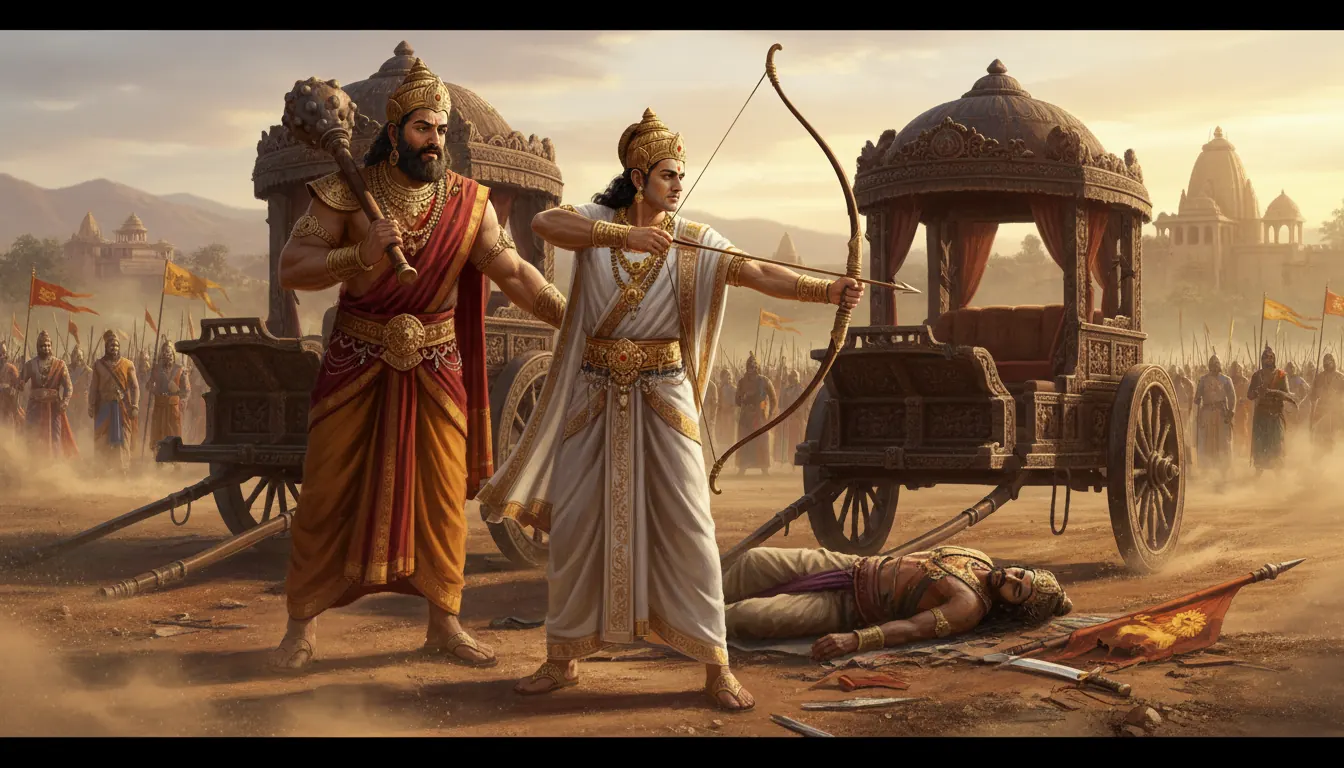
Karna and Satyaki Clash
One Vrishni holds the Kaurava army, and the sixteenth day ends in dust
In short
On the afternoon of the sixteenth day the whole Kaurava host, with Duryodhana's brothers at its head, goes against Satyaki alone, and Karna strikes him with arrows bright as the rays of the Sun. Satyaki buries Karna's chariot in arrows and holds him until Arjuna arrives, and Arjuna cuts the bows of five great warriors in a row and comes on. The Pandava leaders ring Karna and are scattered like trees before a wind, and then Arjuna, smiling, answers weapon with weapon until the Kaurava army closes its eyes and wanders. The Sun enters the Setting Mountain, and both armies leave the field to the beasts.
Told in the Karna ParvaSet in Kurukshetra and Pandava Camp14 min read
The Van Where Karna Stood
Dhritarashtra had asked for the afternoon, and Sanjaya gave him the afternoon.
It was the sixteenth day, and the man at the head of the Kaurava army was Karna. The troops that had been driven back and scattered in the first half of the day formed again with him in front of them, and they were, Sanjaya said, difficult of defeat in fight. They returned to the field and fought a battle that resembled the battle between the gods and the Asuras.
The noise brought them on. Elephants and men, chariots and horses and conchs, all making one uproar, and out of that uproar the elephant riders and the chariot warriors and the foot soldiers and the horsemen came forward in great numbers, full of rage, and killed one another with blows of every kind of weapon there was. Battle-axes. Swords. Arrows of many kinds. When the weapons were gone, the animals themselves were used, elephants driven into men and horses driven over them.
Sanjaya described what the ground looked like to a man who could not see it. It was strewn with human heads, and he did not spare his blind king the detail of the heads. They were adorned with white teeth and fair faces and beautiful eyes and goodly noses. They were graced with diadems and earrings still. Every one of them resembled the lotus, or the Sun, or the Moon. With those heads lying on it, the Earth looked exceedingly resplendent.
Elephants and men and horses were killed by the thousand with hundreds of spiked clubs and short bludgeons, with darts and lances and hooks, with Bhusundis and maces. The blood that fell ran together and made currents across the field, like a river with its own banks.
And the chariot warriors and the men and the horses and the elephants that had been killed lay where they were, with ghostly features and gaping wounds, so that the field of battle looked like the domains of the king of the dead at the hour when the universe dissolves.
That was the ground. Sanjaya then told his master what his sons did on it.
The Whole Host Against One Man
They went for Satyaki.
He was the bull of Shini's race, a Vrishni of Krishna's own people, the man who had already crossed the whole Kaurava army once in a single chariot to reach Arjuna, and by this day of the war there was nobody on the Kaurava side who did not know his standard. The troops of Dhritarashtra, and his sons, those bulls among the Kurus, who looked like the children of the gods, with a host of warriors of boundless might going in front of them, all advanced on that one man.
Sanjaya let his king hear how large it was. Teeming with the finest men and horses and chariots and elephants, raising an uproar as loud as the vast deep, like the army of the Asuras or the army of the gods, that host shone with a fierce beauty as it moved.
Then the son of Surya took him. Karna, who in prowess was like the chief of the gods himself and like the younger brother of Indra, struck that greatest man of Shini's race with arrows as splendid as the rays of the Sun.
Satyaki did not give ground. He answered at once, and quickly buried that great man, with his chariot and his horses and his driver, under many kinds of arrows that Sanjaya called as terrible as a snake's poison. For a while nothing of Karna could be seen from the Pandava side except the arrows standing in him.
The Atirathas of the Kaurava army, the great chariot warriors, saw it. They saw Vasusena, that bull among chariot warriors, badly hurt by the arrows of the hero of Shini's race, and they came for him with elephants and chariots and foot soldiers to take the pressure off.
That force was vast as the ocean, and it did not hold. The Pandava warriors, led by the sons of Drupada, were very quick, and they fell on that relief force and broke it, and it fled from the field. In the rout there was great slaughter of men and chariots and horses and elephants.
One chariot had held the Kaurava host, and while it held, the day was already going wrong for them.
The Prayer Before the Charge
While that was happening, two men in one chariot were finishing their prayers.
Arjuna and Keshava had said their daily prayer, and they had duly worshipped the lord Bhava, and only then did they turn toward the fighting. Sanjaya reports the worship in the middle of a battle narrative without any comment, as though it were the most ordinary thing in the world that the two greatest of men should stop, in the afternoon of the sixteenth day, and do what was owed to Shiva before doing what they intended to do next. Then, resolved to kill those enemies of theirs, they rushed at the Kaurava troops.
The Kurus heard it before they saw it. The rattle of that chariot was like the roar of the clouds. Its banners waved beautifully in the air. It had white horses yoked to it, and it was coming straight at them, and Sanjaya says that the men who watched it come cast their eyes on it cheerlessly.
Then Arjuna bent Gandiva.
He was, as Sanjaya tells it, as if dancing in his chariot, and he filled the sky and all the points of the compass, the main ones and those between, with showers of arrows, not leaving the smallest space empty. There was no gap in it anywhere, no angle by which a man could come at him.
Like a storm destroying the clouds, the son of Pandu destroyed with his arrows many chariots that looked like celestial vehicles. They were finely adorned, equipped with weapons and standards, and they came apart with their drivers still in them. Many elephants also, with the men who guided them, adorned with triumphal banners and weapons. Many horsemen with their horses. Many foot soldiers. All of them Arjuna sent with his arrows to the realm of Yama, and the ranks in front of him simply ceased to be ranks.
Into that, one man went alone.
Five Bows in a Row
Duryodhana went alone against that mighty chariot warrior, angry and irresistible, a very Yama, and struck him with his straight arrows.
It lasted the time it takes to count seven arrows.
With those seven, Arjuna cut down his opponent's bow, and his driver, and his horses, and his standard. With one more he cut down the umbrella above the king's head, which was the sign that the man standing there was a king. Then, seeing his chance, he loosed at Duryodhana a superb arrow, an arrow able to take the life of the man it struck, and the war would have ended in the middle of that afternoon.
Drona's son cut it into seven fragments in the air.
So Arjuna turned on Ashwatthama. He cut through his bow and killed the four horses of his chariot with his arrows. Kripa came in next, the old master, brother of Drona's wife and teacher to every prince on that field, and Arjuna cut off the formidable bow of Kripa too. Then Hridika's son Kritavarma, the Bhoja who had saved Duryodhana out of the wreck of the morning, and Arjuna cut through his bow, and felled his standard, and killed his horses. Then Dushasana, and his bow went the same way as the others.
Four of the greatest names in the Kaurava army, all of them ranked among the finest chariot warriors, stood in a row with cut bows in their hands, and Duryodhana behind them with nothing left in his chariot but the floor of it.
Having disarmed them, Arjuna did not stop to finish any one of them. He went on through the gap they had made by failing, and proceeded against the son of Radha.
Which was, in the end, the only place on that field either man had ever been going.
The Ring Around the Suta's Son
Karna left Satyaki.
He had been holding him all this while, and now he turned from him without finishing him, because the white horses were coming, and he pierced Arjuna with three arrows and Krishna with twenty, and then Partha again, and again, and again. Sanjaya says that although the arrows Karna shot while slaying his foes in that battle were many, and although he fought like Indra himself inspired with wrath, Karna felt no fatigue at all.
But Satyaki was not a man who was finished with by being left. He came up behind, and pierced Karna with nine and ninety fierce arrows, and then once more with a hundred.
After that they all came.
Every leading hero among the Parthas began to attack Karna at once. Yudhamanyu and Uttamauja, the two Panchala princes whose whole duty in this war was to guard the wheels of Arjuna's chariot. Shikhandi, who had brought down Bhishma. The five sons of Draupadi, and the Prabhadrakas who fought beside them. Yuyutsu, Dhritarashtra's own son fighting on his cousins' side. The twins Nakula and Sahadeva. Dhrishtadyumna of Panchala, who had killed Drona the day before. The divisions of the Cedis and the Karushas and the Matsyas and the Kaikeyas. The mighty Chekitana. And king Yudhishthira of excellent vows.
All of these, with chariots and horses and elephants and foot soldiers of fierce prowess, surrounded Karna on all sides in that battle. They showered him with many kinds of weapons. And Sanjaya, who was watching from close enough to hear it, records the one detail that makes the ring more than a manoeuvre: they spoke harsh words to him while they did it, resolved to destroy him.
The whole leadership of the Pandava army had come to one place to kill one man, and they were telling him so as they closed.
The Wind Among the Trees
Karna cut the shower out of the air.
He took that mass of weapons coming at him from every side with his sharp shafts, and then he dispersed the men who had thrown them by the power of his own weapons, and Sanjaya reached for the image that his blind master would be able to see. Like the wind breaking down the trees that stand in its way.
Full of rage, he was seen to destroy chariot warriors. He was seen to destroy elephants with their riders still on them, and horses with their horsemen, and large bands of foot soldiers at once. Sanjaya does not name the men who fell there, and the omission is itself a kind of report: the ring closed on Karna and then simply came apart, and there was nothing in it worth naming afterward.
Slaughtered by the energy of Karna's weapons, almost the whole of that force of the Pandavas turned and left the field. They went deprived of weapons. They went with their limbs mangled and torn.
This is the hour that the Kaurava army had been waiting for since the day the old grandsire went down, and it had come at last, and it had come from the man Duryodhana had always said it would come from. The army that had broken Bhishma and killed Drona was walking backwards away from one chariot, and the fighting on that whole part of the field had reduced itself to a single question, which was whether anybody at all could stand in front of the son of Radha.
One man could, and he was already on his way.
Arjuna Smiling
Then Arjuna, smiling all the while, checked Karna's weapons with his own.
Sanjaya puts the smile in deliberately, because it is the difference between the two halves of that hour. Karna had fought the encircling army in wrath and broken it. Arjuna came up against the same man who had just broken it and treated the whole thing as a piece of work he knew how to do, and every weapon Karna sent was met by the weapon that answered it, and nothing got through.
Then he covered the sky, and the Earth, and all the points of the compass, with a dense shower of arrows.
The shafts of Arjuna fell like heavy clubs and spiked bludgeons. Some among them fell like Sataghnis, the hundred-slaying engines that are set on the walls of forts. Some fell like fierce thunderbolts. They did not come as arrows come. They came as a weight out of the sky onto men who had nowhere to put themselves.
Slaughtered by them, the Kaurava force, its infantry and its horse and its chariots and its elephants together, shut its eyes. That is Sanjaya's phrase to his king, and it is not a figure of speech about courage. The men on that side of the field closed their eyes in the middle of a battle, and uttered loud wails of woe, and wandered senselessly about with the arrows still coming down.
Many horses and men and elephants perished there. Many more, struck by arrows and badly hurt, fled in fear, and the fear was general now, and it did not belong to any particular part of the line.
The army that had gone forward behind Karna at the beginning of the afternoon was no longer an army going anywhere.
The Dust and the Setting Mountain
While the warriors were still engaged in that battle from desire of victory, the Sun approached the Setting Mountain and entered it.
After that nobody could see. There was the darkness, and there was, Sanjaya says, especially the dust, and between the two of them the men on the field could not notice anything favourable or unfavourable. A chariot warrior could not tell whether the shape in front of him was his enemy or the man who guarded his wheel.
The mighty bowmen among the Kauravas feared a night-battle. They had fought one already in this war and knew what it cost. So they retired from the field, accompanied by all their combatants, and the retirement was theirs to make because it was their day that had gone wrong.
When the Kauravas withdrew, at the close of the day, the Parthas withdrew too, and they went cheerfully, glad of their victory. They did not go quietly. They jeered at their enemies as they went, making all kinds of sounds with their musical instruments, drums and cymbals and conchs, and over the noise of the instruments they were applauding two names, Achyuta and Arjuna, the driver and the bowman of the chariot with the white horses.
When the army had been drawn off, all the troops and all the kings uttered benedictions upon the Pandavas. Then those sinless men went to their tents, and were very glad, and rested there for the night.
Behind them the field was left to itself. Rakshasas came to it, and pishachas, and carnivorous beasts in large numbers, and they came in numbers because there was a great deal there for them. Sanjaya, describing that ground to the father of the men who had lost it, said it resembled the sporting ground of Rudra himself.
In the Kaurava tents that night Karna would tell Duryodhana that Arjuna had deceived them with a sudden shower of weapons, and that tomorrow he would frustrate all his purposes. But that was the night. The day ended with the Pandava drums going and the beasts coming in.
Dharma Lesson
The Kauravas sent an army against one man and could not move him, and the Pandavas sent an army against Karna and were scattered like trees before a wind. The field is not decided by numbers on either side of it. It is decided by whether the man who stands in the way is willing to be the only one standing there, and by the time Arjuna came up, the day had already been spent by two such men on each other while everything else broke around them.